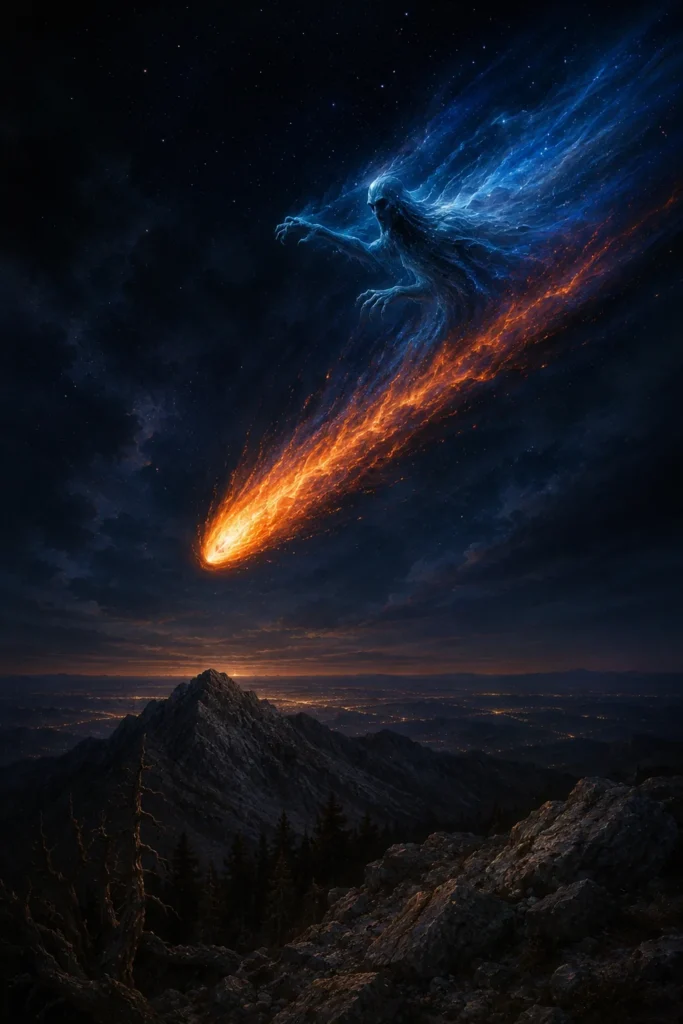
Masaw, guardian of the fourth world
By Ralf Ittermann · last reviewed on
Masaw is a god of Hopi tradition.
Lord of fire and death, guardian of the fourth world. Masaw appears among the Hopi as a god of fire and earth, and the following section explains this dual role.
Masaw, also spelled Maasaw or Masauwu, is the Hopi god of fire, death and earth, and the guardian of the present, fourth world. According to tradition, he received the Hopi people as they emerged into this world and showed them the path of righteous living.
The tradition is oral and living; some content is deliberately withheld from outsiders. This page follows the reticent manner of presentation found in the specialist literature.
Type: God of fire, death and earth, guardian of the fourth world
Origin: the Hopi in Arizona, a living oral tradition
Texts: mostly ethnographic records
Period: living tradition, ethnographically documented
Appearance: a fearsome figure who roams at night carrying a torch

Historical Classification
Period of the Texts
A living Hopi tradition, documented mostly through ethnography; some content is deliberately passed down with reticence.
Area of Diffusion
The land of the Hopi in Arizona, in the south-west of North America.
Sources
Modest and deliberately reticent: ethnographic studies, above all by Malotki and Lomatuway’ma, along with Waters; the specialist literature treats Masaw with corresponding caution.
Name and variants
Hopi: Masaw, also written Maasaw or Masauwu. The tradition concerning him is oral; it describes him as lord of both the surface of the earth and the underworld at once, as god of fire and death.
Appearance
Appearance
Masaw is described as a fearsome, blood-stained figure who roams at night carrying a torch; his fire lights up the darkness of night and of the underworld.
Effect
Masaw moves through the night with fire and watches over the boundary between life and death. He is at once lord of death and keeper of the earth and its fertility; as lord of the earth he shows the Hopi the modest, righteous way of life.
Profile: Masaw
The key aspects of the fire and earth god at a glance.
A central figure in Hopi origin narratives: he received the people as they emerged from the lower worlds into the present, fourth world.
Fire, death and earth: he watches over the boundary between life and death and preserves the earth and its fertility.
A fearsome, blood-stained figure who roams at night carrying a torch; his fire lights up the night and the underworld.
Guardian of the fourth world and guide: to the Hopi people, to whom he entrusted the earth, he shows the modest, righteous way of life.
Made present in ceremonies and through Katsina figures; torch and fire are part of the nocturnal rites. Details are omitted out of respect.
Chthonic fire and death deities of other cultures; among fire gods, for instance, the Black God of the Diné or the Aztec Xiuhtecuhtli.
The welcome at the threshold of the fourth world
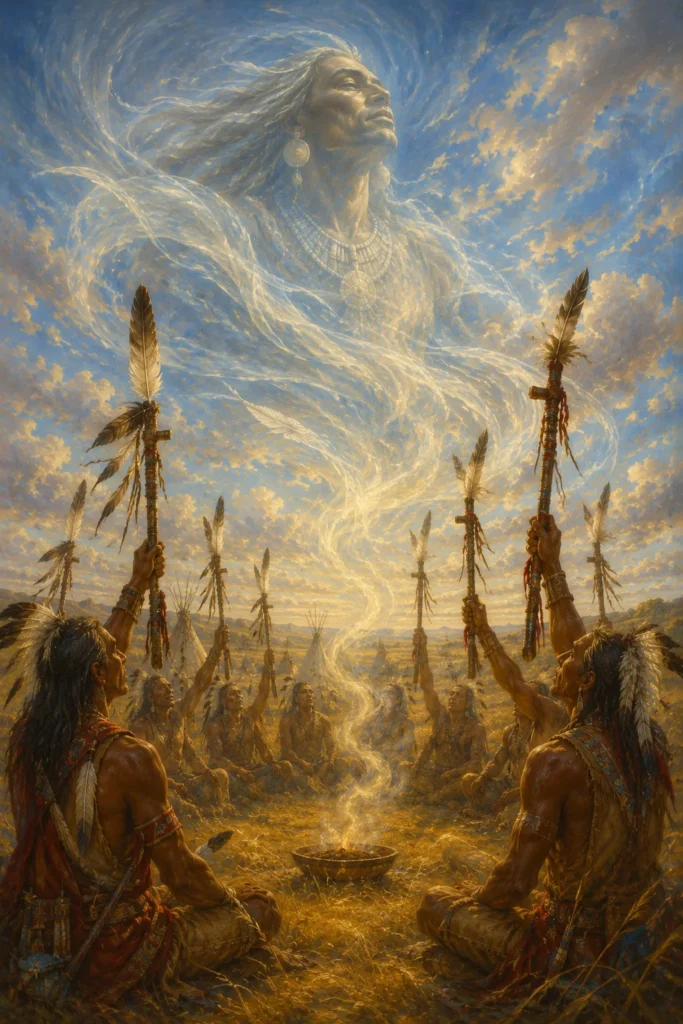
In Hopi belief, Masaw is lord of both the surface of the earth and the underworld at once, god of fire and death. In the origin narratives he appears as the one who receives the people at the Emergence, the ascent from the lower worlds: at the threshold of the present, fourth world, the guardian of this world met them and showed them the path of righteous, modest living.
The tradition concerning this is oral and part of a living religion; some content is deliberately withheld from outsiders. What the ethnographic literature records is therefore a fragment, not a complete picture.
Reticent tradition and classification
Masaw is known through ethnographic research on the south-west, but out of respect for Hopi religion he is often presented only with reticence. In popular culture he is barely present.
From a religious-studies perspective, Masaw is an example of the close connection between fire, death and earth in a North American cosmology: the nocturnal fire marks the boundary between the worlds, and the fire god is at the same time the creator of the present world order. One clarification: Masaw is not an evil god. He is fearsome, but at the same time guardian of the earth and guide to righteous living.
Ceremonies and reverence
Masaw is made present in ceremonies and through Katsina figures; his fire and torch are part of the nocturnal rites. Since he is also lord of death, dealings with him are marked by reverence and strict rules. Out of respect for Hopi tradition, the precise forms of worship are not set out here.
Fire and death gods compared
Masaw links fire and death much like chthonic fire and death deities of other cultures; as lord of the earth and guide of the people he is at the same time a figure of creation and order. His connection of nocturnal fire and the realm of the dead has loose counterparts among chthonic deities in the Mesoamerican and Greek spheres, for instance in the vicinity of the Aztec fire god Xiuhtecuhtli. In the south-west he is matched by the Black God of the Diné as a fire figure of a neighbouring culture, and in western Mexico by the fire grandfather Tatewari.
Frequently asked questions about Masaw
Who is Masaw?
The Hopi god of fire, death and earth, and guardian of the present world.
Why does he carry a torch?
His fire lights up the night and the underworld; he is described as a nocturnal fire figure.
Is he an evil god?
No. He is fearsome, but at the same time guardian of the earth and guide to righteous living.
Further links
Further reading:
- Black God – the fire god of the Diné
- Tatewari – the fire grandfather of the Huichol
- Xiuhtecuhtli – the Aztec fire god
- Protective candle, sage, amulet – traditional protective means
- Protection Compass – an overview of protective means
Literature (selection)
Further standard works in the bibliography.
For the Hopi, Masaw remains god of fire and death and, at the same time, guardian of the earth: a fearsome yet guiding figure whose nocturnal fire marks the boundary between the worlds.