Xiuhtecuhtli, the old god at the centre of the world
By Ralf Ittermann · last reviewed on
Xiuhtecuhtli is a god of Aztec tradition.
Lord of the hearth fire, of time and of the New Fire.
Xiuhtecuhtli, also known as Huehueteotl, the old god, is the fire deity of the Aztecs. He is lord of the hearth fire, of time and of the centre of the world, the navel around which the four cardinal directions revolve.
At the centre of his cult stood the New Fire, rekindled every 52 years to secure the continuity of the world. As Huehueteotl, he is regarded as one of the oldest deities of Mesoamerica: corresponding fire deities are already attested in Cuicuilco and Teotihuacan.
Type: fire god, lord of the hearth, of time and of the world centre
Origin: Aztec Central Mexico, precursors in Cuicuilco and Teotihuacan
Texts: pictorial codices and the work of Bernardino de Sahagún, especially the Codex Florentinus
Period: Aztec classical era to early colonial sources
Appearance: old god with a fire brazier and turquoise diadem on his head

Textual history
Period of the Texts
The evidence ranges from the Aztec classical era to the early colonial sources; the 16th-century Codex Florentinus is particularly notable.
Area of Diffusion
Central Mexico and the Aztec empire; as a hearth god, Xiuhtecuhtli was present in every household, and as an imperial god at rulers’ courts and festivals.
Sources
Good: rich pictorial codices and the work of Bernardino de Sahagún provide a broad basis for the cult and its iconography.
Name and variants
Nahuatl: xiuhtli means turquoise, year and fire, tecuhtli means lord; Xiuhtecuhtli is the lord of turquoise and fire. Even the name thus interweaves the precious stone, the calendar and the flame into a single concept.
Appearance and behaviour
Appearance
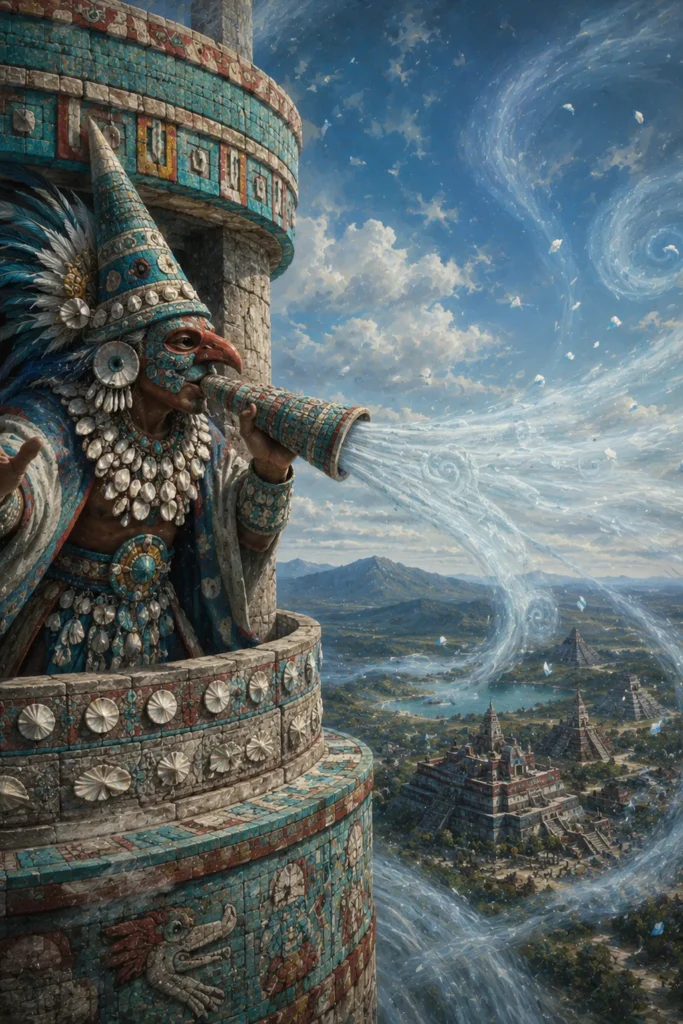
Xiuhtecuhtli is often depicted as a bent old man with a fire brazier or incense burner on his head. His headdress bears the turquoise diadem xiuhuitzolli; his attributes include the fire serpent Xiuhcoatl and the colours turquoise and red.
Effect
As lord of the hearth and fire, he is present at the centre of every household; as lord of time, he presides over the calendar order. He sits at the centre of the world, the navel around which the four cardinal directions revolve.
Profile: Xiuhtecuhtli
The most important aspects of the old fire god at a glance.
As Huehueteotl, the old god, one of the oldest deities of Mesoamerica; fire deities of this type are already attested in Cuicuilco and Teotihuacan.
Household and hearth, the rulers and the whole of society: from the daily hearth fire to the renewal of the world every 52 years.
A bent old man with a fire or incense brazier on his head, the turquoise diadem xiuhuitzolli and the fire serpent Xiuhcoatl.
Hearth fire, calendar order and the centre of the world: fire is the focal point of house and world, and its renewal secures creation.
The ceremony of the New Fire, Toxiuhmolpilia, at the end of each 52-year cycle, along with the Izcalli festival with hearth offerings for the god.
From old god to lord of turquoise and fire
Nahuatl xiuhtli means turquoise, year and fire, tecuhtli means lord; Xiuhtecuhtli is the lord of turquoise and fire. As Huehueteotl, the old god, he is regarded as one of the oldest deities of Mesoamerica: corresponding fire deities are already attested in Cuicuilco and Teotihuacan, long before the rise of the Aztecs.
The main sources are the pictorial codices and the work of Bernardino de Sahagún. They show a god who connects two levels: the daily hearth fire in the house and the cosmic order of time. From his seat at the centre of the world, the navel between the four cardinal directions, the old god holds both together. At the domestic hearth he had a female counterpart in Chantico, whose sphere of responsibility, however, lay with the house, the volcanoes and the goldsmiths, not with the calendar and the centre of the world.
Research and classification
Xiuhtecuhtli and the New Fire have been intensively studied in Mesoamerican studies and are a standard example of cyclical concepts of time and fire. In popular culture he is less well known than Quetzalcoatl or Huitzilopochtli.
In religious studies, Xiuhtecuhtli links the hearth cult with the cosmic order of time: fire is the focal point of house and world, and its periodic renewal secures the continuity of creation. The ceremony of the New Fire is a prime example of ritual world renewal.
The New Fire and the hearth offerings
Well documented is the ceremony of the New Fire, Toxiuhmolpilia, the Binding of the Years. At the end of a 52-year cycle, all fires were extinguished; on Mount Huixachtlan a new fire was kindled in the chest of a sacrificial victim and carried from there to every temple and household, so that the world would continue. Among the regular festivals was Izcalli, with hearth offerings to Xiuhtecuhtli; in this way the god remained present in the daily life of every household even between the great cycles.
Hearth deities and sacred fires compared
As a hearth deity, Xiuhtecuhtli corresponds to the Greek Hestia and the Roman Vesta, and as lord of the sacred fire to the Persian Atar; the fire serpent Xiuhcoatl is a distinct Mesoamerican motif. Within Aztec religion he is accompanied by Chantico as the female mistress of the hearth fire, while he himself additionally governs time and the centre of the world.
Frequently asked questions about Xiuhtecuhtli
Who is Huehueteotl?
The old god, a very ancient fire-god concept that merged with Xiuhtecuhtli or is regarded as his aged form.
What was the New Fire?
At the end of each 52-year cycle, all fires were extinguished and a new fire kindled to secure the continuation of the world.
What does the name Xiuhtecuhtli mean?
Roughly Turquoise and Fire Lord; xiuhtli stands simultaneously for turquoise, year and fire.
Further links
Literature (selection)
Further standard works in the bibliography.
As the Aztec fire god and lord of the year and the hearth fire, Xiuhtecuhtli holds household and cosmos together: the same flame that warms daily life renews the world every 52 years.