Cihuateteo are spirits of the Aztec tradition.
Honoured warrior women of birth, feared at the crossroads. The entry honours the Cihuateteo as warrior women feared above all at the crossroads by night.
Cihuateteo are the deified spirits of Aztec women who died in childbirth, regarded throughout the Aztec empire as both revered and feared. Because their death in childbirth was understood as death in battle, their souls travelled to an honoured solar region in the west, where they escorted the sun from its zenith to its setting.
On fixed calendar days, however, they returned to earth as dangerous crossroads spirits. They descended at crossroads, struck children with paralysis, convulsions and illness, and lured men into adultery or drove them mad. Bernardino de Sahagún described them in the 16th century in the Florentine Codex, in connection with the goddess Cihuacoatl.
Type: Deified spirits of women who died in childbirth
Origin: Aztec beliefs about death in childbirth
Texts: Florentine Codex of Bernardino de Sahagún, 16th century
Period: Pre-colonial Aztec era
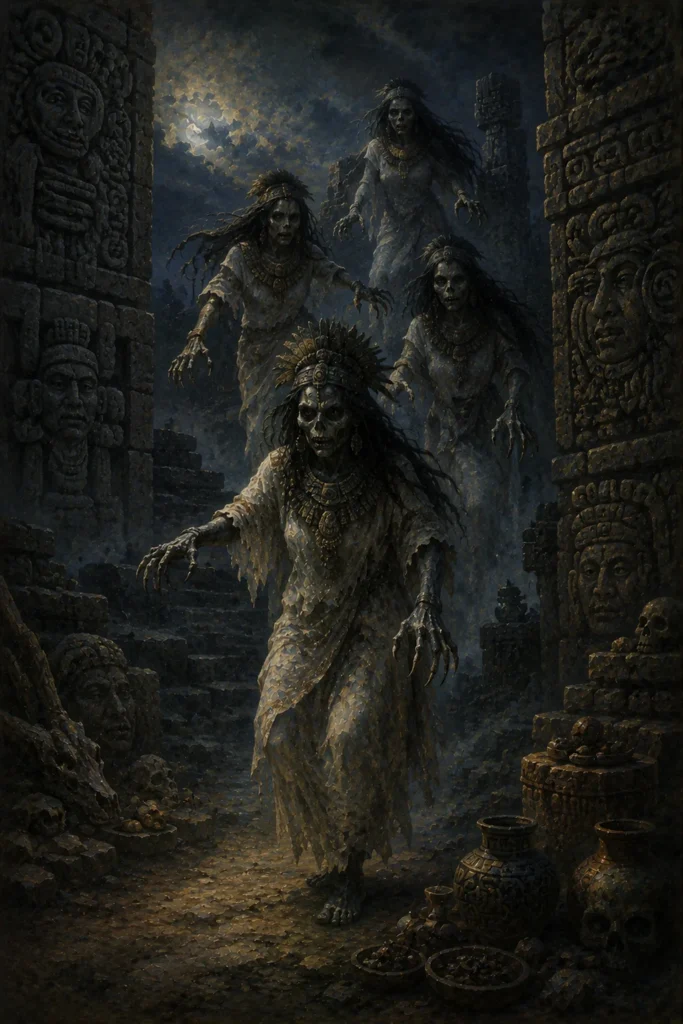
Appearance: Skeletal form with clawed hands
Aztec, pre-colonial: the Cihuateteo are attested in the Florentine Codex of Sahagún from the 16th century, which records pre-colonial tradition.
Central Mexico, the heartland of Mexica culture. There, belief in the return of the Cihuateteo at crossroads was widespread.
Good: the primary source of the Florentine Codex and surviving stone sculptures of the Cihuateteo in museums.
Nahuatl: Cihuatl means woman, teotl god or goddess: Cihuateteo literally means divine women. The name thus names precisely the liminal status of these spirits between human woman and goddess.
Appearance
The Cihuateteo carry within them a deep ambivalence of honour and terror: as escorts of the sun they are revered, as nocturnal crossroads demons they are feared. Their iconography shows a skeletal face and clawed hands. The crossroads is a classic liminal and dangerous place, at which the core of childbirth death is determined: the mother who could not raise a child of her own now threatens the children of others.
Effect
On their days of descent, people stay away from crossroads and keep children indoors, for the Cihuateteo bring paralysis, convulsions and illness. They lure men into adultery or drive them mad.
The key aspects of the Cihuateteo at a glance.
Deified female spirits of the Aztec Mexica culture, documented in the Sahagún Codex and in connection with the goddess Cihuacoatl.
Children and men who cross crossroads on the dangerous calendar days.
Skeletal face and clawed hands, also recorded in surviving stone sculptures.
Paralysis, convulsions and illness in children; adultery and madness in men.
Offerings at crossroads shrines and avoiding crossroads on the days of descent.
La Llorona, her later Mexican descendant, and the South Asian Churel as the next childbirth parallel.
Women who died in childbirth were regarded throughout the Aztec empire as warriors who had fallen in the battle of birth. Their souls therefore travelled to an honoured solar region in the west, where they escorted the sun from its zenith to its setting.
On certain calendar days, however, these honoured dead returned to earth as dangerous Cihuateteo. Bernardino de Sahagún attests to them in the 16th century in the Florentine Codex, where they appear in connection with the goddess Cihuacoatl. As a pre-colonial component of Mexican spirit tradition, they are also considered the breeding ground for the later legend of La Llorona.
With their surviving stone sculptures, the Cihuateteo are a central topic of Aztec religion in museums and in research. They are sometimes received popularly as Aztec vampires and as the original form of La Llorona, and form a reference point in discourses on motherhood and death.
From a religious-studies perspective, the Cihuateteo are a classic case of the childbirth-death complex: women who died in childbirth are both revered, as warriors and escorts of the sun, and feared, as dangerous crossroads spirits. They combine the seductive death-woman with the threat to children and an institutionalised cult, forming an important pre-colonial building block of the La Llorona syncretism. As such, they remain a borderline case between goddess and demoness.
Well documented are roadside shrines and shrines at crossroads, where offerings were made to the Cihuateteo to appease them, along with the rule of keeping children indoors on the days of their descent. This is the best-attested protective system of the Cihuateteo, an institutionalised cult with offerings and avoidance rules that can be traced directly back to Sahagún. Incense burning and offerings at the crossroads shrines were part of the cult, an amulet served children as a worn protective sign on the dangerous days, and consecrated holy water was later added as a Christian sign in dealing with the spirits.
The Cihuateteo are related to other female spirits who died in childbirth: the Malay Langsuir and the also Malay Pontianak, as well as the South Asian Churel, all of whom arise from death in childbirth. Close to them in the lineage of lament stands the Japanese Ubume. As a pre-colonial source for the legend of La Llorona, the Cihuateteo also reach into Mexico’s present day.
Are the Cihuateteo goddesses or demonesses?
Both at once: as escorts of the sun they were venerated, as nocturnal spirits of the crossroads they were feared. They thus form a genuine borderline case between goddess and demoness.
When are the Cihuateteo dangerous?
On fixed calendar days, when they descend to the crossroads. Outside these days they were not considered threatening.
How were children protected from the Cihuateteo?
By keeping them indoors on these days and making offerings at the crossroads shrines to appease the spirits.
Recommended internal links:
Further standard works in the bibliography.
As deified women who died in childbirth, the Cihuateteo remain Aztec spirit-women between two worlds: honoured as solar warriors, feared as spirits of the crossroads who threaten children and men on their designated days.
Against its influence, cross-cultural tradition names these protective means:
Compare in the Protection Compass →Recommended protective means
The simplest protective means in this collection: 41 layers of fine gold 999, platinum, silver and silicon, manufactured in Ruhla, Thuringia. It requires no activation, is bound to no person, and is effective within a radius of around 50 meters, even without being worn.
Related Beings

The Golem, a creature of clay brought to life by sacred names. Origins in Jewish folk belief and ...

Boitatá, the Brazilian fire serpent and guardian spirit of the forests. Origin, the punishment fo...

Nephthys, Egyptian patroness of the dead and goddess of mourning. Mummification, afterlife, Book ...

Hamadryads: Greek tree nymphs whose lives are bound to their tree. With the myth of Erysichthon a...

La Sirène, the mermaid Lwa of Haitian Vodou. Origin, the mirror, and the connection to Agwe and M...

Vajrakilaya, three-headed yidam of the Nyingma school with a ritual phurba blade. Meditative prac...