iWell Guard

La Llorona, the endless lament by the water

La Llorona is a spirit of Mexican tradition.

She weeps at rivers and lakes for her drowned children.

SpiritMexico

Table of Contents

La Llorona, spirit of Mexican tradition
La Llorona

La Llorona, the Weeping Woman, is the spirit of a woman who once drowned her own children and has since wandered weeping along rivers and lakes in search of them. Her wailing and calling lures children and nocturnal wanderers dangerously close to the water.

In the basic narrative, a woman drowns her children out of revenge against an unfaithful or abandoning man and afterwards roams as a restless spirit at bodies of water. The first documented mentions date from the 19th century; the legend today counts among the best-known in Latin America.

At a glance: La Llorona

Type: Wailing female spirit, death omen at the water
Origin: Mexican legend rooted in Aztec goddess motifs and colonial reshaping
Texts: first documented mentions in the 19th century, extensively studied by Kirtley and Pérez
Period: 19th century to the present
Appearance: weeping woman in a white or black robe with long hair, her face often hidden

Historical Classification

Period of the Texts

19th century to the present: the first documented mentions date from the 19th century, while the oral tradition presumably reaches further back and remains alive to this day.

Area of Diffusion

Mexico, Central America and the US Southwest. She appears at rivers, lakes and canals, always at night.

Sources

Good: fundamental are the studies by Bacil Kirtley and Domino Renée Pérez, alongside a broad popular and literary tradition.

Name and variants

Spanish: The name derives from llorar, to weep: La Llorona is literally the Weeping Woman. The name thus directly names her central act, the endless, wailing weeping at the waters.

Appearance

Appearance

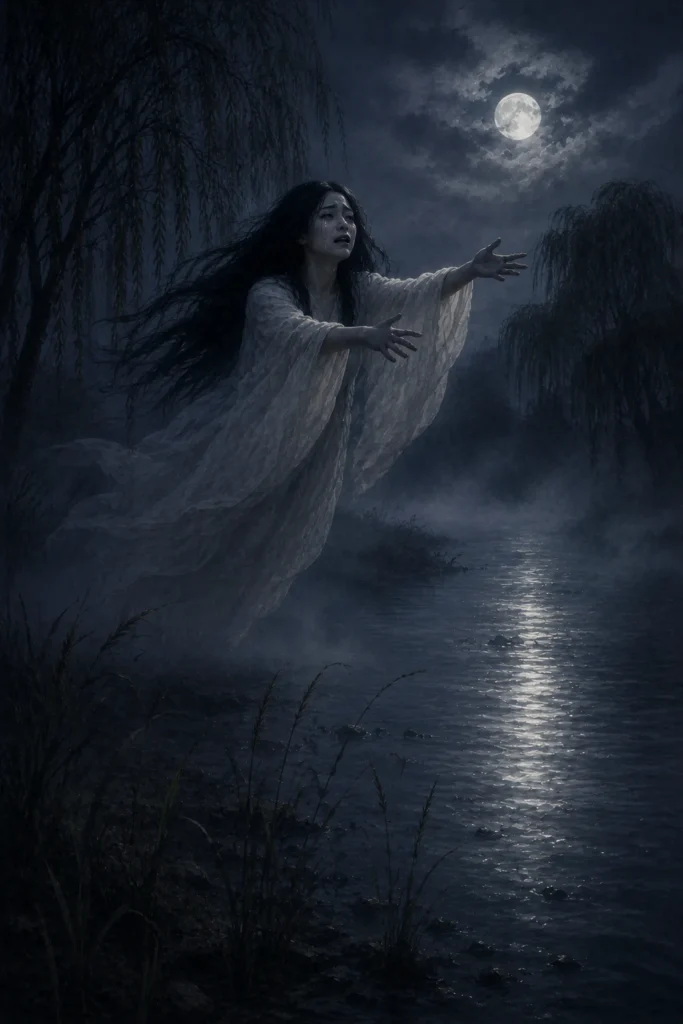
La Llorona appears as a weeping woman in a white or black robe with long, loose hair; her face often remains hidden or cannot be made out at all. She stays near rivers, lakes and canals and is always accompanied by her wailing.

Effect

Her weeping and her calling for the lost children exert a dangerous pull: children who are alone at the water at night are considered especially at risk. The legend functions above all as a cautionary tale meant to deter people from leaving children outside after dark or approaching bodies of water at night.

Profile: La Llorona

The key aspects of the weeping woman at a glance.

Cultural Context

One of the best-known legends of Latin America, rooted in Mexican colonial history and older Aztec goddess motifs.

Relates To

Children and nocturnal wanderers near bodies of water who are drawn in by her wailing.

Depiction

Weeping woman in a white or black robe, long hair, face often hidden or unrecognisable.

Function

Death omen and warning figure: her appearance warns against leaving children alone by the water at night.

Approach

Keep children in the house at night, avoid bodies of water after dark, protection through prayer and making the sign of the cross.

Related

The European White Lady, the Central American Siguanaba and the Venezuelan La Sayona as related weeping and avenging female figures.

Cihuacoatl, La Malinche and the White Lady of Europe

The name La Llorona derives from the Spanish llorar, to weep, and literally means the Weeping Woman. In the basic narrative, a woman drowns her own children out of revenge against an unfaithful or abandoning man and afterwards roams as a restless spirit along rivers and lakes, eternally in search of them.

The image of the weeping woman in white is often traced back to the Aztec goddess Cihuacoatl, who according to tradition appeared in white and roamed wailing at night, as well as to the Cihuateteo, the spirits of women who died in childbirth. After the Spanish conquest, these pre-colonial motifs merged with the experience of a subjugated people; a widespread interpretation further overlays the myth with the story of La Malinche. The folklorist Bacil Kirtley also points to the German White Lady as a European parallel.

From ghost story to symbol of resistance

La Llorona is widely present in literature, music, theatre and as a symbol of Chicano resistance, and counts among the most widely received legends of Latin America. The 2019 film The Curse of La Llorona further brought the figure international recognition.

From a religious studies perspective, La Llorona is a prototype of colonial syncretism, in which an indigenous goddess and a Christian moral tale merge. She combines betrayed motherhood, child death and female revenge, and is a liminal spirit at the water, situated between life and death.

Protecting children, avoiding water

A formalised cult is barely attested for La Llorona; it is above all a cautionary and educational legend. The usual folk defence consists of keeping children indoors after dark, avoiding bodies of water at night, and protecting oneself through prayer and the sign of the cross. Blessed holy water and the cross belong to the traditional defence, as do a worn amulet and the light of a protective candle as a watch during the feared night by the water. No independent cult of veneration is recorded.

Weeping and avenging women compared

La Llorona is related to the European White Lady, whom the folklorist Bacil Kirtley cites as a direct historical parallel, and to the Japanese Ubume, the spirit of a woman who died in childbirth and appears by riverbanks. As a seductive and luring death-woman, she is also close to the Central American Siguanaba and the Venezuelan La Sayona. In the wider circle of Latin American cautionary and avenging figures stand the Colombian La Patasola and the Yucatec Xtabay, both deadly female figures at the edge of the wilderness.

Frequently asked questions about La Llorona

Why did she drown her children?

Usually out of revenge or despair over an unfaithful or abandoning man; in Malinche variants, after being betrayed by the Spanish conqueror.

Is the legend pre-colonial or European?

Both: indigenous goddess motifs such as Cihuacoatl meet European narrative structures of the White Lady.

Where does she appear?

At rivers, lakes and canals, always at night, where her wailing is said to be heard.

Further links

Recommended internal links:

Literature (selection)

A selection of key sources and studies:
  • Kirtley, Bacil F.: La Llorona and Related Themes. In: Western Folklore 19 (1960).
  • Pérez, Domino Renée: There Was a Woman. La Llorona from Folklore to Popular Culture. Austin 2008.

Further standard works in the bibliography.

La Llorona remains above all one thing: the Weeping Woman, that weeping woman by the water, whose wailing still echoes today along the rivers and lakes of Mexico and warns against the nocturnal proximity of water.

Classification & Protection

IVLEVEL
The Protection Compass assigns this being to influence level IV, Severe influence.

Against its influence, cross-cultural tradition names these protective means:

Compare in the Protection Compass →

Recommended protective means

iWell Guard

The simplest protective means in this collection: 41 layers of fine gold 999, platinum, silver and silicon, manufactured in Ruhla, Thuringia. It requires no activation, is bound to no person, and is effective within a radius of around 50 meters, even without being worn.

All protective means at a glance →