Tezcatlipoca, Lord of the Night Wind
By Ralf Ittermann · last reviewed on
Tezcatlipoca is a god of the Aztec tradition.
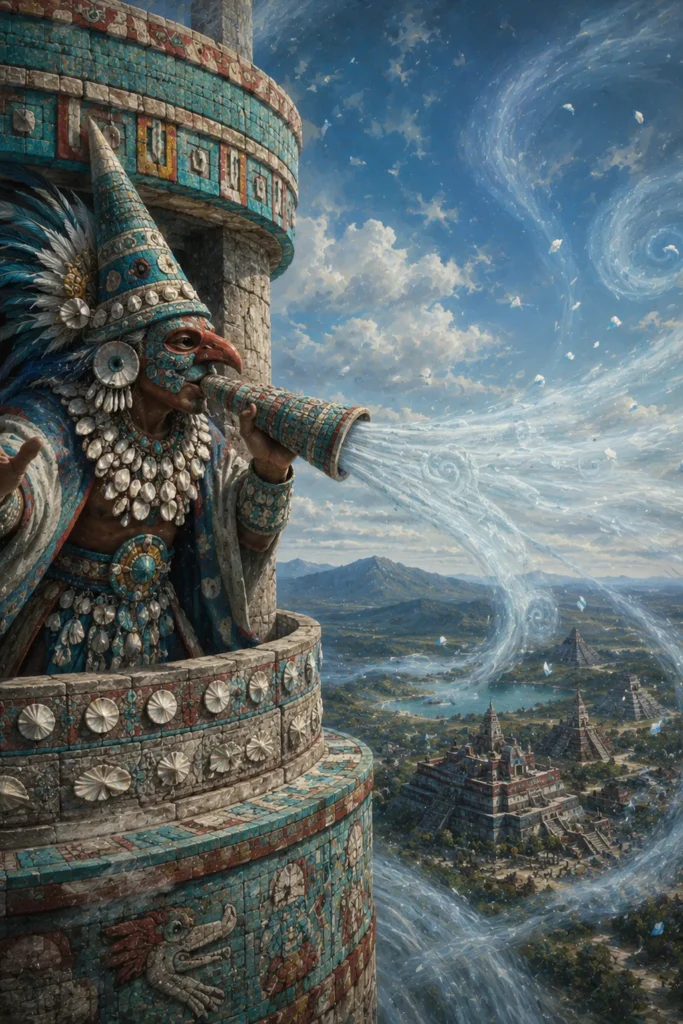
Yoalli Ehécatl, the night wind: invisible and intangible.
Tezcatlipoca, the Smoking Mirror, is one of the most powerful Aztec deities, lord of the night sky, sorcery and fate. This page focuses primarily on his wind aspect: the epithet Yoalli Ehécatl, night wind, and his rule over the north, the region of the dead, Mictlampa.
The night wind is thereby a metaphor for the invisible and intangible: just as the wind of night blows through the world, so does Tezcatlipoca, without anyone being able to grasp him. As night wind, he is associated with night winds and hurricanes; in the variant Itztlacoliuhqui, he embodies the cold, cutting obsidian wind of frost and ice.
Type: Lord of the night sky, sorcery and fate, also night wind and the north
Origin: Central deity of the Aztecs, Tlaxcaltecs and Toltecs
Texts: Codex Florentinus (Sahagún), Diego Durán, codices
Period: Postclassical Nahua culture
Appearance: God with a smoking obsidian mirror

Textual history
Period of the Texts
The evidence belongs to postclassical Nahua culture; the main sources are Sahagún’s Codex Florentinus and the work of Diego Durán.
Area of Diffusion
The central Mexican highlands; Tezcatlipoca was a central deity of the Aztecs, the Tlaxcaltecs and the Toltecs.
Sources
The source material is very good: the Codex Florentinus, further codices and Durán’s accounts document the cult and mythology in detail.
Name and variants
Nahuatl: Tēzcatlīpohca means Smoking Mirror, from tezcatl, mirror, and poca, to smoke, an allusion to the obsidian divination mirrors. The central wind-related attestation is the epithet Yoalli Ehécatl, night wind, a metaphor for the invisible and intangible.
Form and effect
Appearance
His hallmark is the smoking obsidian mirror on his chest, hand or in place of his right foot, which he lost in battle with the earth monster Cipactli. He wears black and yellow facial bands, his primary colour is black; his animal form is the jaguar.
Effect
Tezcatlipoca is a bringer of both good and evil, the embodiment of change through conflict. His connection to wind is real but only a partial aspect: as night wind, he is associated with night winds and hurricanes, he rules over the north, Mictlampa, the region of the dead, and as Itztlacoliuhqui he embodies the cold obsidian wind. His true role is that of the all-powerful, quasi-invisible creator, fate and ruler god.
Profile: Tezcatlipoca
The key aspects of the night wind god at a glance.
Central deity of the Aztecs, Tlaxcaltecs and Toltecs; the night wind Yoalli Ehécatl is one of his epithets and aspects.
Night sky, sorcery and fate; as night wind, the invisible, along with the north, Mictlampa, the region of the dead.
God with a smoking obsidian mirror on his chest, hand or in place of his right foot, black and yellow facial bands and the jaguar as his animal form.
Bringer of good and evil, change through conflict; in his wind aspect, night winds and hurricanes as well as the cold obsidian wind Itztlacoliuhqui.
Main festival Toxcatl, with a young man serving as a living image of the god; the priests blackened themselves with soot and burned copal incense four times a day.
Ehecatl is the rain-bringing wind god; Tezcatlipoca’s night wind, by contrast, is merely one aspect of a much broader god.
Yoalli Ehécatl: the wind of the night and the north
The name Tezcatlipoca means Smoking Mirror and alludes to the obsidian divination mirrors. The central evidence for the wind aspect is the epithet Yoalli Ehécatl, Night Wind: a metaphor for the invisible and intangible quality that characterises the god. The main sources are Sahagún’s Codex Florentinus and Diego Durán.
The wind aspect unfolds in three directions: as Night Wind, Tezcatlipoca is associated with night winds and hurricanes. He rules over the north, Mictlampa, the region of the dead. And in the variant Itztlacoliuhqui, he embodies the cold, cutting obsidian wind of frost and ice. All of this remains embedded in his actual role as an almighty, quasi-invisible creator, fate and ruler god.
Reception and classification
The turquoise- and skull-adorned Tezcatlipoca mask in the British Museum is world-famous. Guilhem Olivier’s monograph and a collected volume edited by Elizabeth Baquedano are standard works; the trickster archetype lives on in literature, film and games.
From a religious-studies perspective, Tezcatlipoca is not a simple devil, which would be a colonial distortion, but a creator and life god. The four Tezcatlipocas are colour variants; only the black one is the actual Tezcatlipoca. And the wind aspect, night wind and north wind, is a real but limited part of his very broad role.
Toxcatl: the festival of the living image
His main festival was Toxcatl: a flawless young man lived for a year as the god’s living image, teixiptla, was married to four goddesses during the last twenty days, broke clay flutes as he ascended the temple, and was sacrificed at the end of the dry season. The priests blackened themselves with soot and burned copal incense four times a day. The smoking obsidian mirror itself is regarded as his very own sign.
Night wind and day wind: parallels and distinctions
Within the Maya world, Tohil and K’awiil are related to the smoking obsidian knife; in terms of role typology, without any historical connection, Tezcatlipoca resembles the trickster and fate deities of other cultures, such as Loki. Within his own pantheon, he stands opposite Ehecatl: Ehecatl is entirely a wind god, bringer of the rain winds as an aspect of Quetzalcoatl, whereas the night wind of Tezcatlipoca remains just one epithet among many, the metaphor of an ungraspable god.
Frequently asked questions about Tezcatlipoca
What does Tezcatlipoca mean?
Smoking Mirror, an allusion to the obsidian divination mirrors.
What is his wind aspect?
The epithet Yoalli Ehécatl, Night Wind, and rulership over the north, the region of the dead, Mictlampa.
Is he a devil?
No. That is a colonial distortion; he is a powerful creator and fate god.
Further links
Further reading:
- Ehecatl – the Aztec wind god of the day and the rain winds
- Censing and Purification – copal smoke was part of his cult four times a day
- Amulet – a protective symbol in the spirit of reverence before the lord of fate; the obsidian of the smoking mirror is regarded as his very own sign
- Protection Compass – an overview of protective means
Literature (selection)
Further standard works in the bibliography.
As the Aztec night wind Yoalli Ehécatl, Tezcatlipoca, named the Smoking Mirror, reveals his most unsettling side: the god who, like the wind of night, is everywhere and can be grasped nowhere.