Ehecatl, the wind of the Feathered Serpent
By Ralf Ittermann · last reviewed on
Ehecatl is a god of the Aztec tradition.
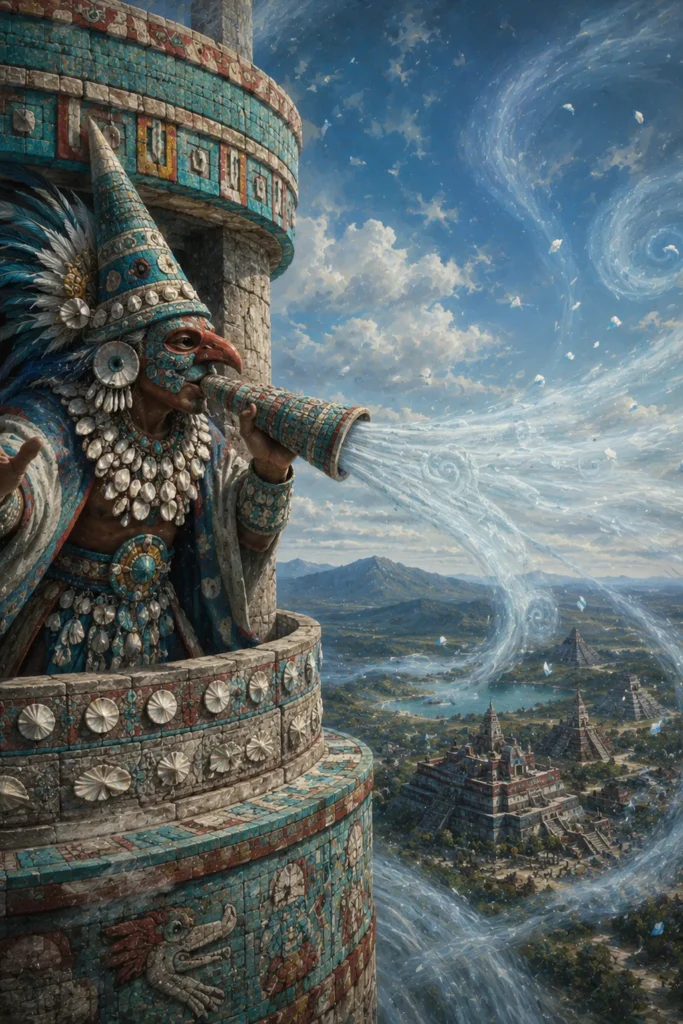
The wind god with the beak mask, who brings the rain winds.
Ehecatl is the Aztec wind god and the wind aspect of the Feathered Serpent Quetzalcoatl, which is why he is also called Ehecatl-Quetzalcoatl. As god of the air, he brings the rain-bearing winds that precede the rain.
He was worshipped in characteristic round wind temples, cylindrical structures with a conical roof, on which the wind finds no edge. His marks are the conical hat and the red beak mask through which he blows the wind; his calendar name is 9 Wind.
Type: Wind god, wind aspect of Quetzalcoatl
Origin: Postclassic Nahua culture, probably of Huastec origin
Texts: Codices, Sahagún, Five Suns myths
Period: Postclassic period until the conquest
Appearance: God with conical hat and red beak mask
Origin and sources
Period of the Texts
The evidence belongs to the postclassic Nahua culture; the main sources are the codices, sculpture and the work of Sahagún.
Area of Diffusion
The central Mexican highlands; Ehecatl probably has Huastec origins on the Gulf coast and was adopted by the Aztecs.
Sources
The source material is good: postclassic codices, sculptures and the surviving round temples, together with the Five Suns myths.
Name and variants
Nahuatl: ehēcatl simply means wind; the god’s name is identical with the everyday word. His calendar name is 9 Wind. The full name Ehecatl-Quetzalcoatl designates him as the wind aspect of Quetzalcoatl, the Feathered Serpent.
Nature and effect
Appearance
Ehecatl wears a conical hat and a characteristic beak mask through which he blows the wind; his body is black, the mask red. He also wears shell ornaments, especially the wind jewel ehecacozcatl, a cut conch shell. His temples are round and cylindrical with a conical roof, some with a doorway shaped like a serpent’s mouth.
Effect
As god of the air and the rain-bringing winds, Ehecatl is linked to all the cardinal directions, especially the west. He descended into the underworld Mictlan to fetch the bones for present-day humanity, set the sun and moon in motion, and, through the Mayahuel myth, brought the agave and pulque. He is patron of merchants.
Profile: Ehecatl
The key aspects of the wind god at a glance.
Wind god of the postclassic Nahua culture, as Ehecatl-Quetzalcoatl the wind aspect of the Feathered Serpent; probably of Huastec origin.
The air and the rain-bearing winds; also patron of merchants, as well as farmers and society as a whole.
God with conical hat and red beak mask, black body and shell ornaments, including the wind jewel ehecacozcatl.
Bringer of the rain winds, mover of the sun and moon, fetcher of the bones from Mictlan, and giver of the agave through the Mayahuel myth.
Its own round, cylindrical wind temples with conical roofs; specific sacrificial rites solely for Ehecatl are not established in detail.
From the Gulf coast to the highlands
The name Ehecatl is identical to the Nahuatl everyday word for wind; his calendar name is 9 Wind, and his full name Ehecatl-Quetzalcoatl identifies him as the wind aspect of the Feathered Serpent. The god probably has Huastec origins on the Gulf coast and was adopted by the Aztecs.
The sources are postclassical codices, sculptures and the myths of the Five Suns. In these, Ehecatl plays pivotal roles in the history of the world: he descended into the underworld Mictlan to retrieve the bones for present-day humanity, and set the sun and moon in motion when the new world stood still. Through the Mayahuel myth he brought humanity the agave and thus pulque.
Afterlife and Classification
Notable evidence includes a round temple beneath the Pino Suárez metro station in Mexico City and the large Calixtlahuaca statue in the National Museum of Anthropology. Ehecatl appears in Neo-Mexica and dance movements as well as in fantasy fiction.
From a religious-studies perspective, Ehecatl is not a god separate from Quetzalcoatl but rather his wind aspect. Important clarifications: the beak mask is technically a buccal mask, not a duck’s bill. The round temples are deliberately cylindrical, not unfinished pyramids. And Ehecatl is Aztec, not to be equated with the Maya Kukulcán.
Round temples for the wind
Ehecatl’s own round wind temples are attested as cult buildings: cylindrical structures with conical roofs, some with an entrance shaped like a serpent’s mouth. No secure detailed information exists on specific sacrificial or protective rituals dedicated solely to Ehecatl; as an aspect of Quetzalcoatl, he shares the generally less bloody cult involving incense as well as bird and serpent offerings, though this is a general tendency rather than evidence specific to Ehecatl.
Feathered serpents and distant wind gods
Within Mesoamerica, Ehecatl corresponds to the Feathered Serpents Kukulcán in Yucatán and Ququmatz among the K’iche’, both associated with round structures. Typologically, without historical kinship, he is close to wind gods such as Aiolos, the Japanese Fujin and the Vedic Vayu. Within his own pantheon, he must be clearly distinguished from Tezcatlipoca: Ehecatl is the rain-bringing wind of Quetzalcoatl, whereas Tezcatlipoca carries the night wind merely as an epithet within his much broader role.
Frequently asked questions about Ehecatl
What does the name Ehecatl mean?
Simply wind; the god’s name is identical to the Nahuatl everyday word for wind.
Is Ehecatl a separate god?
No. He is the wind aspect of Quetzalcoatl and is therefore called Ehecatl-Quetzalcoatl.
Why are his temples round?
The round, cylindrical shape is deliberate and linked to wind symbolism, not an unfinished pyramid.
Further links
Further reading:
- Tezcatlipoca – the Aztec night wind, for comparison
- Ququmatz – the Feathered Serpent of the K’iche’
- Vayu – the Vedic wind god as a typological parallel
- Protective candle, Smoke cleansing, Amulet – traditional protective means
- Protection Compass – an overview of protective means
Literature (selection)
Further standard works in the bibliography.
As the Aztec wind god and wind aspect of Quetzalcoatl, Ehecatl connects the most everyday of phenomena, the wind before the rain, with the great creation myths of the highlands, and his round temples still stand today as witnesses to this connection.