iWell Guard

Ququmatz, the Quetzal Serpent of Q'umarkaj

Ququmatz is a god of Maya tradition.

The Quetzal Serpent who, with Tepeu, called forth the earth.

GodMaya

Table of Contents

Ququmatz, the Feathered Serpent of the K'iche'
Ququmatz

Ququmatz, also Gucumatz, is the Feathered Serpent of the K’iche’ Maya, a creator god in the Popol Vuh, associated with wind, water and sky. At the beginning of creation, he drifts with Tepeu in the primordial sea; together they speak the word earth, whereupon the world comes into being.

Unlike with Hurakan, a cult is attested for Ququmatz: in the capital Q’umarkaj stood a round temple dedicated to him, tended by his own high-ranking priesthood.

Overview: Ququmatz

Type: Creator and ancestor deity, associated with wind, water and sky
Origin: Postclassic K’iche’ Maya, possible area of origin the Valley of Mexico
Texts: Popol Vuh, Annals of the Kaqchikels
Period: Postclassic, cult attested in Q’umarkaj
Appearance: serpent cloaked in quetzal feathers

Historical Classification

Period of the Texts

The figure belongs to the postclassic K’iche’ culture; the main source is the Popol Vuh, supplemented by the Annals of the Kaqchikels.

Area of Diffusion

The highlands of Guatemala, with the K’iche’ capital Q’umarkaj; a possible area of origin of the figure is the Valley of Mexico.

Sources

The source material is good: the Popol Vuh, the Annals of the Kaqchikels, and the archaeological evidence of the round temple at Q’umarkaj.

Name and variants

K’iche’: q’uq’, the quetzal bird, and kumatz, serpent, literally give Quetzal Serpent, more precise than the common Feathered Serpent. The figure may have been borrowed from the Valley of Mexico, merged with local deities such as Tohil, and took on traits of the Classic Maya creator Itzamna.

Appearance

Appearance

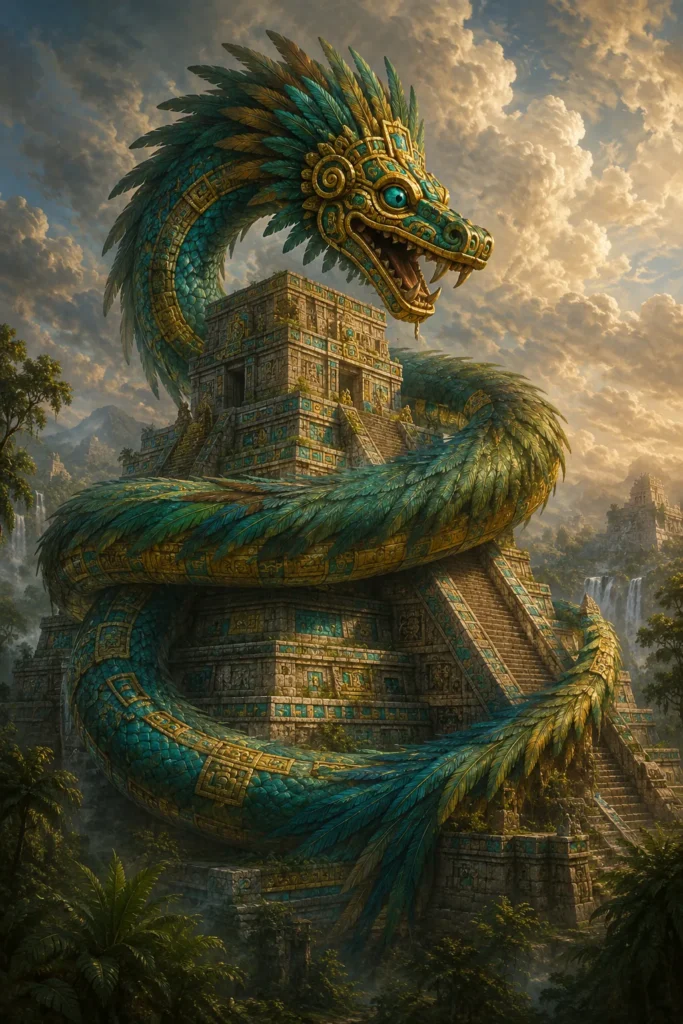
Ququmatz is a serpent cloaked in quetzal feathers; blue-green stands for vegetation and sky, red for fire, the shedding of skin for rebirth. He unites celestial and serpentine spheres and has a dual gender as mediator between the sun god Tohil and the moon goddess Awilix. His connection to water is strong, for instance to the Xocomil storm on Lake Atitlán.

Effect

Ququmatz initially drifts with Tepeu in the primordial sea; together they speak earth, whereupon land, mountains, forests and animals come into being. The creation of humanity only succeeds with maize, after mud and wood have failed. He carries the sun across the sky and is the mythical ancestor of the K’iche’ nobility.

Profile: Ququmatz

The most important aspects of the Quetzal Serpent at a glance.

Tradition

K’iche’ version of the pan-Mesoamerican Feathered Serpent, merged with local deities and traits of the creator Itzamna.

Responsible for

Creation in the Popol Vuh, as well as wind, water and sky; also mythical ancestor of the K’iche’ nobility.

Depiction

Serpent cloaked in quetzal feathers: blue-green for vegetation and sky, red for fire, the shedding of skin as an image of rebirth.

Sphere of Influence

Speaks the earth into being with Tepeu, carries the sun across the sky, and mediates between the sun god Tohil and the moon goddess Awilix.

Cult

Attested: round temple in Q’umarkaj between the temples of Tohil and Awilix, along with the high-ranking priesthood Aj Q’uq’umatz.

Comparables

The Feathered Serpents Kukulkan and Quetzalcoatl as relatives of the same family, along with Ehecatl as the Aztec wind aspect.

Quetzal bird and serpent: origin of a creator figure

The name combines q’uq’, the quetzal bird, with kumatz, the serpent: literally Quetzal Serpent, more precise than the common translation Feathered Serpent. The main source is the Popol Vuh, supplemented by the Annals of the Kaqchikel. A possible area of origin is the Valley of Mexico; the figure was borrowed, merged with local deities such as Tohil, and took on traits of the Classic Maya creator Itzamna.

In the Popol Vuh, Ququmatz initially drifts with Tepeu upon the primordial sea. Together they speak the earth into being, whereupon land, mountains, forests and animals arise; humans are only successfully made from maize, after attempts with mud and wood have failed. As the mythical ancestor of the K’iche’ nobility, his significance extends into the political order.

Afterlife and Classification

After the conquest, Ququmatz became rare as a specifically K’iche’ figure; today he is known chiefly through the Popol Vuh and the often imprecise equation with Kukulkan and Quetzalcoatl.

From a religious-studies perspective, Ququmatz is a benevolent creator and ancestor deity. Important clarifications: he is not Quetzalcoatl, but a distinct deity of the same family, and likewise to be distinguished from Kukulkan. Feathered Serpent is imprecise; the name literally means Quetzal Serpent. And he never creates alone, but always as a pair with Tepeu and in cooperation with Hurakan.

The round temple of Q'umarkaj

Unlike with Hurakan, a cult is documented: in the capital Q’umarkaj stood a round temple for Ququmatz, between the temples of Tohil and Awilix, reflecting his mediating role; the circular imprint is preserved. The priesthood Aj Q’uq’umatz from the Kaweq dynasty held high rank, and King Kotujá bore the god’s name as a title. A separately attested sacrificial ritual, however, is less clearly documented than the temple and priesthood evidence.

One serpent, many names: the kinship

Ququmatz is the K’iche’ version of the pan-Mesoamerican Feathered Serpent. He is not identical with the Yucatec Kukulkan or the Aztec Quetzalcoatl, but belongs to the same tradition strand with a shared older ancestral line; its wind aspect Ehecatl shows how closely serpent and wind are linked in Mesoamerica. In the Popol Vuh itself, Hurakan is his counterpart: Ququmatz the Quetzal Serpent of water with an attested cult, Hurakan the barely documented lightning triad of the sky.

Frequently asked questions about Ququmatz

What does Ququmatz literally mean?

Quetzal Serpent, from q’uq’, quetzal bird, and kumatz, serpent; the translation Feathered Serpent is imprecise.

Is Ququmatz the same as Quetzalcoatl?

No. It is the same family of the Feathered Serpent, but a distinct K’iche’ deity.

Is a cult attested?

Yes. In Q’umarkaj stood a round temple with its own priesthood.

Further links

Recommended internal links:

Literature (selection)

A selection of key sources and studies:
  • Christenson, Allen J.: Popol Vuh. Sacred Book of the Quiché Maya People. Norman 2007.
  • Recinos, Adrián / Goetz, Delia / Morley, Sylvanus G.: Popol Vuh. The Book of the People. Norman 1954.
  • Preuss, Mary H.: Gods of the Popol Vuh. Culver City 1988.

Further standard works in the bibliography.

As the Feathered Serpent of Maya-Guatemala and creator in the Popol Vuh, Ququmatz represents the benevolent side of creation: the word spoken with Tepeu that calls forth the earth, and a temple whose round imprint survives to this day.

Classification & Protection

ILEVEL
The Protection Compass assigns this being to influence level I, Minor influence.

Against its influence, cross-cultural tradition names these protective means:

Compare in the Protection Compass →

Recommended protective means

iWell Guard

The simplest protective means in this collection: 41 layers of fine gold 999, platinum, silver and silicon, manufactured in Ruhla, Thuringia. It requires no activation, is bound to no person, and is effective within a radius of around 50 meters, even without being worn.

All protective means at a glance →