Hurakan, the lightning triad of the Popol Vuh
By Ralf Ittermann · last reviewed on
Hurakan is a god of Maya tradition.
The Heart of the Sky: storm, lightning and creation in one.
Hurakan, the Heart of the Sky, is the storm, wind and lightning god of the K’iche’ Maya and a creator deity in the Popol Vuh. He takes part in every attempt at creation and brings about the great flood over the ungrateful wooden people.
Hurakan is not an anthropomorphic individual figure, but a triad of lightning and storm aspects. His name stands indirectly behind the word hurricane, with one important caveat: the direct European forerunner is the Caribbean Taíno word.
Type: Storm, wind and lightning god, creator figure
Origin: Postclassic K’iche’ Maya
Texts: Popol Vuh
Period: Postclassic, transmitted in the colonial-era Popol Vuh
Appearance: not a single figure, but a lightning triad

Source context
Period of the Texts
The figure belongs to postclassic K’iche’ Maya culture; the main source is the Popol Vuh, the sacred book of the K’iche’.
Area of Diffusion
The highlands of Guatemala, the heartland of the K’iche’ Maya and the setting of the Popol Vuh.
Sources
The source situation is good, but rests essentially on a single text: the Popol Vuh with its creation narratives.
Name and variants
K’iche’: The name is understood as Jun Raqan, one leg or one-legged, iconographically linked to the one-legged lightning god K’awiil; Tedlock’s informants also interpret raqan as a counting word for animate beings, so that one leg could also mean unique. The direct European forerunner of the word hurricane is the Caribbean Taíno word hurakán; whether the Maya name and the Taíno word share the same origin is disputed among scholars.
Appearance and behaviour
Appearance
Hurakan is not an anthropomorphic individual figure, but a triad of lightning and storm aspects under the title Heart of the Sky: Caculhá Huracán, the great thunderbolt, Chipi-Caculhá, the smallest lightning or spark, and Raxa-Caculhá, the green or sudden lightning. The iconography is that of lightning, a leg from the sky to the earth.
Effect
As Heart of the Sky, Hurakan takes part in all four attempts at creation and repeatedly calls forth earth together with Ququmatz and Tepeu. He brings about the great flood to destroy the ungrateful wooden people, whose survivors become monkeys; only the maize people succeed.
Profile: Hurakan
The key aspects of the Heart of the Sky at a glance.
Creator and storm figure of the K’iche’ Maya in the Popol Vuh, iconographically linked to the one-legged lightning god K’awiil.
The creation myth: Hurakan takes part in every attempt at creation, from animals to mud and wood to the maize people.
Not a single figure, but the lightning triad Caculhá Huracán, Chipi-Caculhá and Raxa-Caculhá; the image is lightning as a leg from the sky to the earth.
Storm, wind and lightning as well as creation; in the punishment, Hurakan brings about the great flood upon the wooden people.
Hard to grasp: for Hurakan as an independent cult figure, there is scarcely any archaeologically documented cult site or recorded sacrificial rite.
Guabancex in the Caribbean, along with K’awiil, Cocijo and Tohil; as a power of the sky, he resembles Tezcatlipoca.
Jun Raqan: one leg, one name, one word for the world
The name Hurakan is understood as K’iche’ Jun Raqan, one leg or one-legged, which fits iconographically with the one-legged lightning god K’awiil: the lightning is the one leg that reaches from the sky to the earth. Tedlock’s informants also interpret raqan as a counting word for animate beings, so the name could equally mean unique. The main source is the Popol Vuh.
There, Hurakan is the Heart of the Sky and is involved in all four attempts at creation: together with Ququmatz and Tepeu, he repeatedly calls forth earth. He destroys the ungrateful people of wood through the great flood, their survivors becoming monkeys; only the people made of maize succeed.
From the Heart of the Sky to the Hurricane
Hurakan is an indirect namesake of the word hurricane, with an important caveat: the direct European precursor is the Caribbean Taíno word hurakán, and whether the Maya name and the Taíno word share the same origin is scientifically disputed. He is widely present in popular culture; the Popol Vuh is the basis of his fame.
From the perspective of religious studies, Hurakan is a purely mythological creator figure, not a demon; the punishment and flood motif is narrative. Important clarifications: he is not the direct namesake of the word hurricane, the direct precursor is the Caribbean word. He is not a single god, but a triad. And Jun Raqan literally means one leg, though it can also mean unique.
Cult evidence: a literary figure
For Hurakan as an independent cult figure, there is hardly any archaeologically identifiable cult site or documented sacrificial rite; he is primarily a literary and mythological creator figure. The related lightning-god iconography K’awiil is widely attested in the Classic period, but is not identical to a documented Hurakan cult. Concrete rites therefore cannot be claimed; engagement with Hurakan is engagement with a text, the Popol Vuh.
Lightning gods, celestial powers and the Caribbean
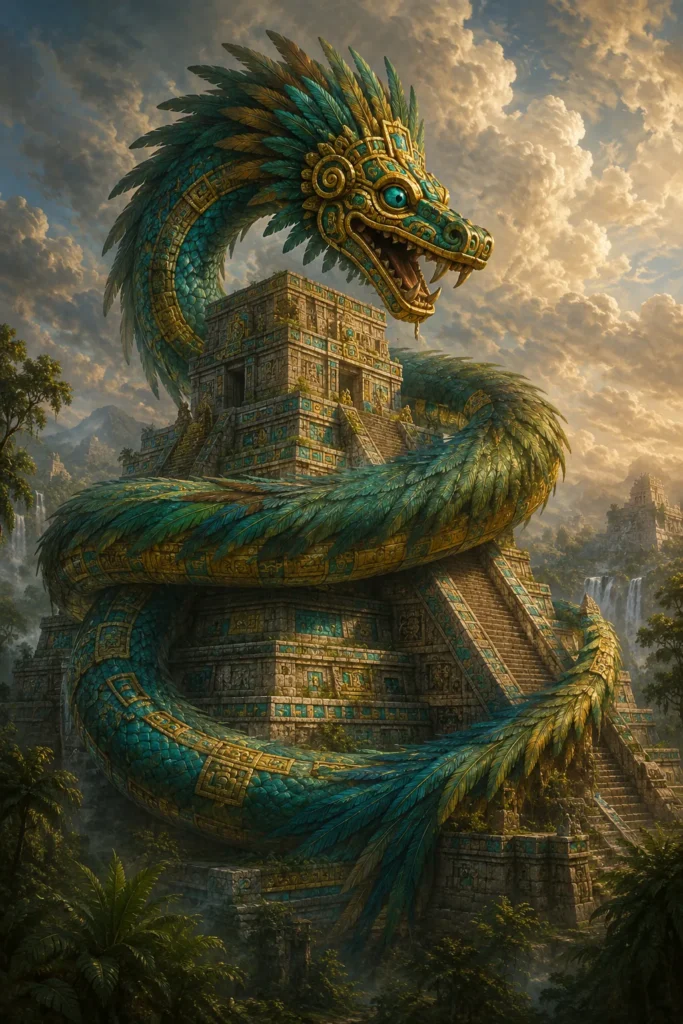
Hurakan is related to the Yucatec K’awiil or Bolon Tzacab, the Zapotec Cocijo, and the K’iche’ god Tohil; as a celestial power, he resembles the Aztec Tezcatlipoca. In the Popol Vuh itself, he is joined by Ququmatz, yet the two remain clearly distinct: Hurakan is the lightning triad of the sky, Ququmatz the Quetzal Serpent with an attested temple cult. In the Caribbean, he corresponds to the Taíno storm figure Guabancex, though the connection between the names is disputed.
Frequently asked questions about Hurakan
What does Heart of the Sky mean?
It is Hurakan’s title as a creator and lightning power, under which he acts as a triad of lightning aspects.
Does the word hurricane come from him?
Only indirectly. The direct precursor is the Caribbean Taíno word; a shared origin is disputed.
Is Hurakan a single figure?
No. He is a triad of three lightning aspects.
Further links
Further reading:
- Ququmatz – the creation partner in the Popol Vuh
- Guabancex – the Caribbean storm zemí relevant to the hurricane question
- Tezcatlipoca – the Aztec celestial power as a parallel
- Amulet, protective candle, salt – traditional protective means
Literature (selection)
Further standard works in the bibliography.
As Heart of the Sky, Hurakan is the Maya storm god of the Popol Vuh: not a single figure, but a triad of lightning that created the world, sent the flood, and passed its name down into our word for weather.