The Black God, bringer of fire and orderer of the stars
By Ralf Ittermann · last reviewed on
The Black God is a god of the Navajo tradition.
Fire bringer of the Diné and orderer of the stars in the sky.
Black God is the English rendering of Haashchʼééshzhiní, the fire god of the Navajo, the Diné. He is regarded as the inventor of fire and as the one who ordered the stars in the sky; in tradition he is an old, deliberate fire bringer and culture hero.
The tradition is oral and embedded in the great ceremonial complexes of the Diné; protected ceremonial content is omitted here out of respect.
Type: Fire god, fire bringer and orderer of the stars
Origin: Navajo (Diné) in the southwestern United States, living tradition
Texts: predominantly ethnographic records
Period: living tradition, ethnographically documented
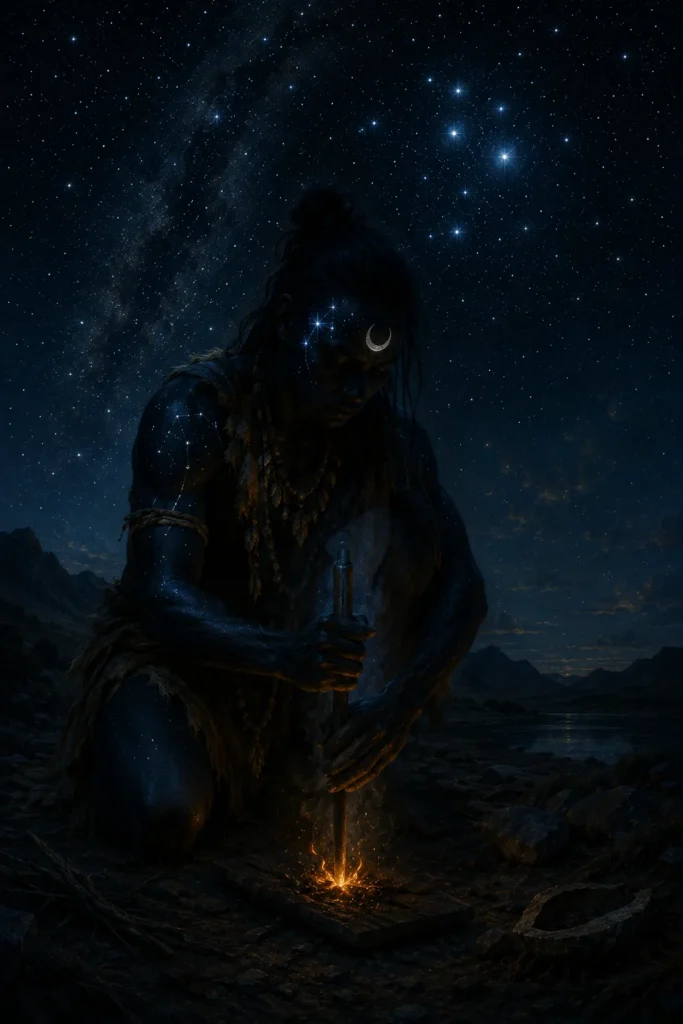
Appearance: figure painted black with a fire drill, crescent moon and Pleiades on the forehead
Traditional context
Period of the Texts
Predominantly ethnographically documented, living Diné tradition; the tradition is oral and embedded in the great ceremonial complexes.
Area of Diffusion
The territory of the Navajo (Diné) in the southwestern United States.
Sources
Moderate: ethnographic studies, above all Reichard and Matthews; the scholarly literature treats the Black God with restraint out of respect for the living religion.
Name and variants
Navajo: Haashchʼééshzhiní means roughly Black Yeʼii, black deity. He belongs to the Yeʼii, the sacred beings of the Navajo, and is the lord of fire.
Being and effect
Appearance
The Black God is depicted painted black; on his forehead he wears a crescent moon, and on his temple the Pleiades, the constellation that, according to tradition, he placed there. His attribute is the fire drill, with which fire is generated.
Effect
He brought people fire and the skill of kindling it with the drill; at the same time he ordered the stars in the night sky. He is regarded as calm, deliberate and benevolent.
Profile: Black God
The key aspects of the fire bringer at a glance.
One of the Yeʼii, the sacred beings of the Diné; his tradition belongs to the great ceremonial complexes.
Fire and its generation with the fire drill; along with the ordering of the stars in the night sky.
A figure painted black with a crescent moon on the forehead and the Pleiades on the temple; his attribute is the fire drill.
Fire bringer and culture hero: he gave people fire and fire technology while also ordering the cosmos of the stars.
Presence in Diné ceremonies and in the sandpaintings of the healing rites; protected ceremonial content is omitted out of respect.
Fire drill and Pleiades: the tradition
Haashchʼééshzhiní means roughly Black Yeʼii, black deity. The Black God belongs to the Yeʼii, the sacred beings of the Navajo, and is the lord of fire: he brought people fire and the skill of kindling it with the fire drill.
At the same time he is a celestial figure: according to tradition he ordered the stars in the night sky and placed the Pleiades, which he has since worn on his temple, alongside the crescent moon on his forehead. The tradition is oral and embedded in the great ceremonial complexes of the Diné; it portrays him as an old, calm, deliberate and benevolent culture hero.
Ethnography and classification
The Black God is known through the ethnographic literature on the Navajo and through interest in sandpaintings, but is depicted with restraint out of respect for the living religion.
In the study of religion he is an example of the fire bringer as orderer of the cosmos: he combines the invention of earthly fire with the ordering of the stars. For the Diné, fire thus stands for culture, knowledge and the structure of the sky at once; the benevolent fire bringer is not a threatening being.
Sandpaintings and ceremonies
The Black God appears in Diné ceremonies and in the sandpaintings, the dry paintings, that belong to the healing rites. His fire drill and the ritual making of fire are part of the tradition. Out of respect for the Diné tradition, the protected ceremonial content is not elaborated on here.
Fire bringers of other cultures
As a fire bringer and culture hero, the Black God corresponds to the Greek fire-bringer motif as well as the fire-drill inventor of other cultures; as orderer of the stars he links fire and sky, similarly to how several fire deities bring together fire, light and cosmos. Comparable figures on the continent are Masaw, the fire and earth god of the Hopi, and Tatewari, the fire grandfather of the Huichol; from the Vedic world, the fire god Agni stands for the same type of divine fire.
Frequently asked questions about the Black God
What does the name mean?
Roughly Black deity; he belongs to the Yeʼii, the sacred beings of the Navajo.
What does he have to do with the stars?
According to tradition he ordered the stars and placed the Pleiades, which he wears on his temple.
How did he make fire?
With the fire drill, which he brought to people as fire bringer.
Further links
Literature (selection)
Further standard works in the bibliography.
As the fire god of the Diné, whose name Haashchʼééshzhiní is equally familiar to Navajo people and to ethnography, the Black God stands for a fire that orders culture and cosmos at once.