Niltsi is god of Navajo tradition in a broad sense: a wind principle, not a person.
The Holy Wind: air, breath and soul in one.
Niltsi, also Nilchʼi, is among the Navajo, the Diné, the Holy Wind, a central cosmological principle. He is air, breath and soul in one, and gives all beings life, movement and the inner orientation towards harmonious behaviour.
Niltsi is not a personal deity, but an ever-present reality. The principal source is James Kale McNeley’s study Holy Wind in Navajo Philosophy, based on fieldwork carried out from 1970 to 1972; out of respect for the living Diné religion, protected ceremonial knowledge is treated here with restraint.
Type: Life-giving, all-pervading wind principle
Origin: Navajo (Diné), south-western USA
Texts: McNeley 1981, earlier Matthews 1897 and Reichard 1950
Period: predominantly ethnographically documented, living Diné tradition
Appearance: not pictorially personal, an ever-present wind
Predominantly ethnographically documented and part of a living Diné tradition; the principal study is based on fieldwork from 1970 to 1972.
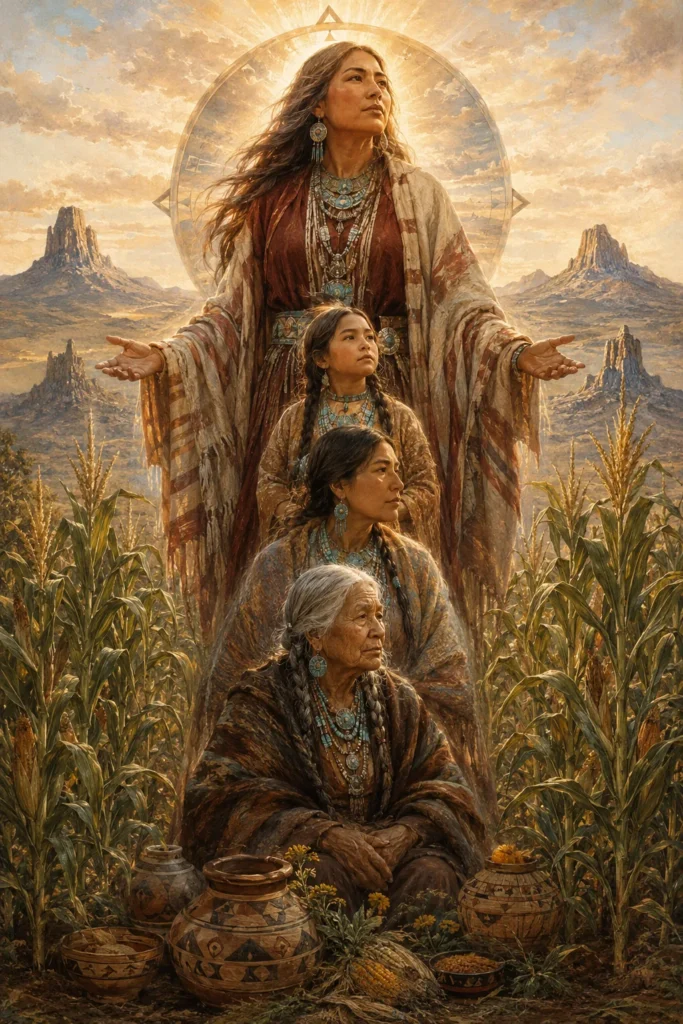
The Diné people of the south-western USA; Niltsi belongs to the core of Navajo cosmology.
Good: McNeley’s Holy Wind in Navajo Philosophy of 1981 as the principal source, earlier Matthews 1897 and Reichard 1950.
Navajo: Nilchʼi means wind and refers to the air and atmosphere in their entirety; McNeley speaks of the Holy Wind, nilchʼi diyinii. Wind, breath and soul coincide conceptually.
Appearance
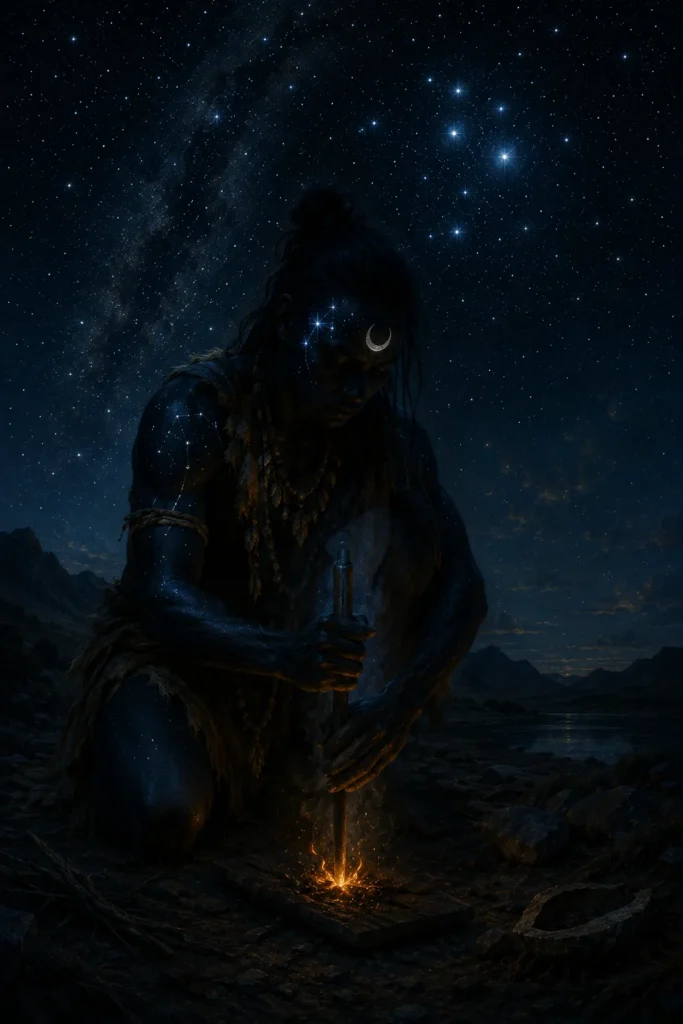
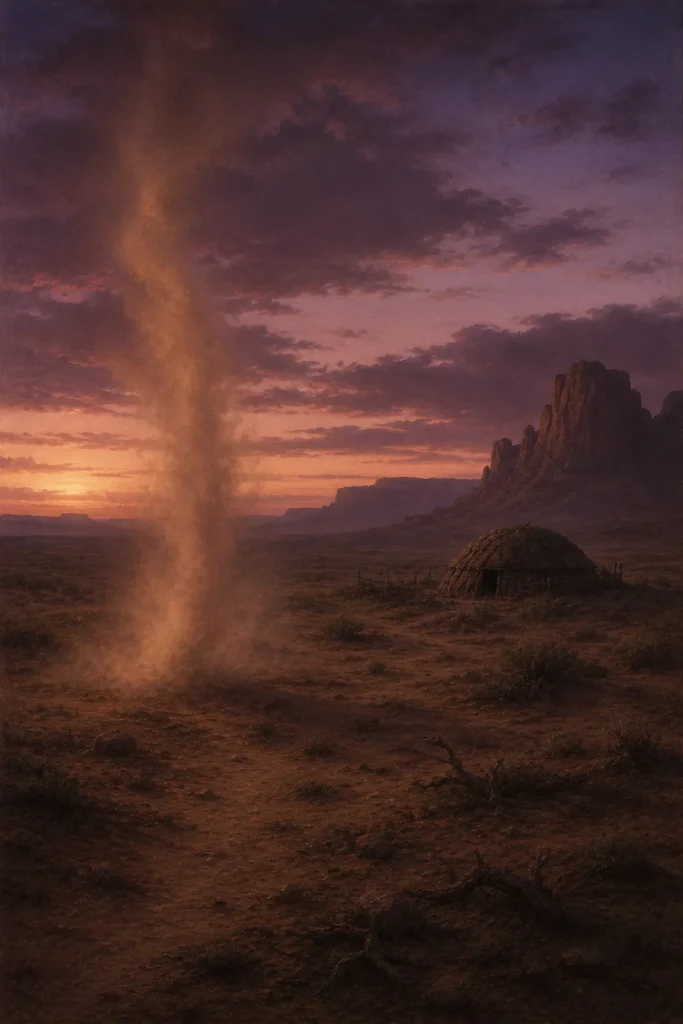
Niltsi is not pictorially personal, but a single, ever-present reality in which all beings share. His action is shown in the whorls on fingers, toes and crown, and in the breath.
Effect
Niltsi gives life, movement, thought, speech and behaviour. After birth, children are introduced to the winds of the four directions; these bestow the wind standing within a person, nilchʼi biiʼ sizinii, which wordlessly guides towards harmonious behaviour and is the primary source of moral orientation.
The key aspects of the Holy Wind at a glance.
Central cosmological principle of the Diné: air, breath and soul in one, not a personal deity, but a present reality.
Life, movement, thought, speech and behaviour of all beings; the inner wind is the primary source of moral orientation.
Not pictorially personal. His action becomes visible in the whorls on fingers, toes and crown, and in the breath.
Life-giving wind principle: after birth, the winds of the four directions bestow the wind standing within a person, which wordlessly leads to harmony.
Not worship of a god in the narrower sense; attested are prayers and offerings to the little winds, embedded in healing ceremonies such as the Blessingway.
Breath-soul concepts such as ruach, pneuma, anima or prana serve merely as translation aids; in North America the Pawnee wind spirit Hotoru.
Nilchʼi means wind and refers to air and atmosphere in their entirety; McNeley speaks of the Holy Wind, nilchʼi diyinii. Wind, breath and soul converge in this concept. The principal source is James Kale McNeley’s study Holy Wind in Navajo Philosophy, based on fieldwork conducted from 1970 to 1972; earlier accounts are found in Matthews 1897 and Reichard 1950.
Out of respect for the living Diné religion, protected ceremonial knowledge is treated with restraint here. What can be said is this: Niltsi is not one figure among others, but the single reality in which all beings participate, from the breath of the individual to the atmosphere as a whole.
McNeley’s Holy Wind is considered a standard work of Navajo philosophy. In esoteric-popular contexts, Niltsi is sometimes equated with the Holy Spirit, an appropriation.
From a religious-studies perspective, Niltsi is not a personal wind deity but an all-pervading life principle. Important clarifications: it is not to be equated with the Western notion of a soul within a body, and the equation with the Christian Holy Spirit is merely a translational analogy.
Worship of a god in the strict sense does not exist here. Attested are prayers and offerings to the little winds, intended to strengthen the inner wind and ward off harmful winds, embedded in healing ceremonies such as the Blessingway. Detailed ceremonial knowledge is deliberately treated with restraint; the living Diné religion sets the limit of what an overview page may set out.
Niltsi resembles the breath-soul concepts of other cultures, such as ruach, pneuma, anima or prana, but this serves only as a translational aid, not an equation. Within North America, it is close to the Pawnee wind spirit Hotoru as a life-giving breath. Typologically comparable, though belonging to a different tradition, is the Lakota force Taku Skanskan, which connects sky and movement.
What is Niltsi?
The Holy Wind of the Navajo, an all-pervading life principle of air, breath and soul.
Is Niltsi a personal deity?
No. It is not a personal wind deity but an ever-present reality in which all beings participate.
What does it have to do with morality?
The wind standing within a person wordlessly leads to harmonious behaviour and is the primary source of moral orientation.
Recommended internal links:
Further standard works in the bibliography.
What the keyword Navajo Holy Wind summarises is, for Niltsi, breath and life of the Diné as one: not a figure that could be depicted, but the air itself, which thinks, animates and wordlessly guides towards harmony.
Against its influence, cross-cultural tradition names these protective means:
Compare in the Protection Compass →Recommended protective means
The simplest protective means in this collection: 41 layers of fine gold 999, platinum, silver and silicon, manufactured in Ruhla, Thuringia. It requires no activation, is bound to no person, and is effective within a radius of around 50 meters, even without being worn.
Related Beings

Baal-Hammon is the supreme male deity of Carthage, consort of Tanit and recipient of the Tophet d...

Nergal, war god and underworld ruler of Mesopotamia. Temple in Kutha, marriage to Ereshkigal, co-...

Charming in German folk tradition: the origin of the healing formula, its working principle accor...

Baba Yaga, the witch of the chicken-legged hut, is an ambivalent primordial figure of Slavic folk...

The Rainbow Serpent is a central creator figure in Australian Aboriginal religion. Myth, regional...

Zhurong, the Chinese fire god and god of the south. Origin, his battle against the water god Gong...