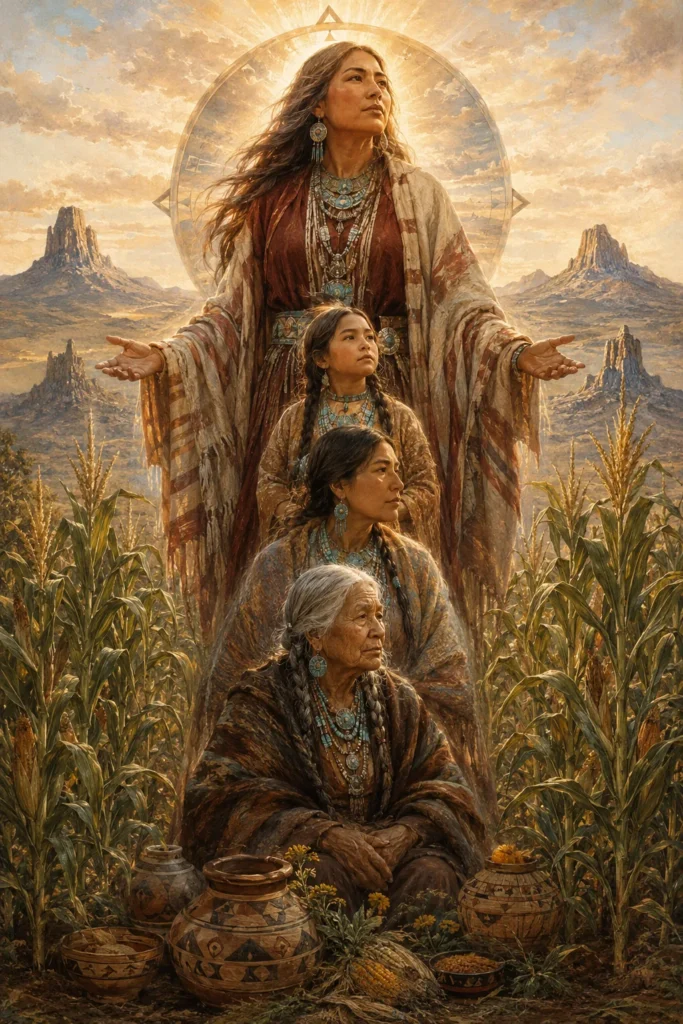
Changing Woman (Navajo Asdzaa Nadleehe, also Estsanatlehi) is the central female goddess of the Navajo tradition. She embodies the eternal alternation between the seasons and the stages of life, and is regarded as the creator of the first Navajo people and as the mother of the Hero Twins.
Changing Woman embodies in the Navajo tradition the Navajo life cycle from girl to woman to mother and grandmother.
Changing Woman is the highest positive female figure in the Navajo pantheon and at the same time the personified goddess of life and time.
She differs from the zoomorphic creator Spider Grandmother of the Pueblo peoples through her purely anthropomorphic form and through her connection to the cyclical structure of time. Within Navajo theology, she is the most important reference figure for all life transitions: birth, puberty, marriage, and death.
From a religious-studies perspective, Changing Woman belongs to the class of female life-and-time goddesses represented in many religions. Structurally comparable are the ancient Greek Demeter-Persephone constellation, the Indian Aditi, the ancient Persian Anahita, and the Andean-Amazonian Yacumama in her life cycle dimension.
Changing Woman differs from these parallels through her specific four-phase structure of the life cycle: girl, young woman, mature woman, old woman, repeated in an eternal cycle.
The Navajo religion is particularly well documented compared to many other indigenous American traditions. It was comprehensively explored in the early 20th century by the anthropologist Gladys Reichard (Navajo Religion, 1950), by Father Berard Haile (1880-1961), by Washington Matthews (Navaho Legends, 1897), and in ongoing discourse by numerous Navajo theologians.
An important component of the Navajo theology system is the strict differentiation between the Yei (sacred beings, comparable to the Pueblo Kachina) and the Diyin Dineh (holy peoples, a higher class of actual creator beings).
Changing Woman belongs to the Diyin Dineh and therefore stands at a higher level in the theological hierarchy than the Yei beings.
This dual structure of the Navajo pantheon, with different classes of sacred beings of varying power and function, has been described in depth by Gladys Reichard in Navajo Religion (1950) and differs structurally from the simpler Pueblo Kachina tradition.
The Navajo name Asdzaa Nadleehe literally means woman who changes. The root etymology is unambiguous: asdzaa = woman, nadleeh = to change, to transform, to alter. Changing Woman is thus the woman who changes, the personification of changeability itself.
An alternative designation, prevalent in some sources, is Estsanatlehi, an older spelling of Asdzaa Naadleeh that goes back to Washington Matthews. Some sources additionally distinguish a sister figure, Yolkai Estsan or Asdzaa Yolgai (White Shell Woman), who is, however, more an aspect of Changing Woman herself than a separate goddess.
The standard English translation Changing Woman has been common in American Anglo-Saxon literature on Native peoples since the early 20th century. It emphasizes the central transformation-related component. The less frequently used translation Self-Renewing Woman is semantically more precise but has not become established.
Changing Woman is depicted in Navajo sand paintings and in traditional iconography as a dignified woman in four different stages of life.
In her girl phase she appears as a young, white-clad girl with long black hair; in her young-woman phase as a blue, youthful being; in her maturity phase as a yellow-clad, fertile mother; in her old-age phase as a black-clad wise woman.
This four-color, four-phase structure corresponds to the four-directional colors of Navajo cosmology and makes Changing Woman the cosmic personification of cyclical time.
In surviving Navajo sand paintings, Changing Woman often appears at the center of the mandala image, surrounded by the four sacred mountains of the Navajo: Sisnaajini (Blanca Peak in the east), Tsoodzil (Mount Taylor in the south), Dook’o’ooslid (San Francisco Peak in the west), and Dibe Nitsaa (Hesperus Peak in the north).
This arrangement connects Changing Woman’s four-phase structure with the geographical four-mountain structure of the Navajo homeland.
In modern Navajo art, particularly in the works of Navajo sculptor Helen Hardin (1943-1984) and Navajo painter R.C. Gorman (1931-2005), Changing Woman is a recurring motif. She is usually depicted as a dignified, middle-aged Navajo woman in traditional dress (full-length skirt, velvet blouse, silver and turquoise jewelry).
The central mythological narrative surrounding Changing Woman is the Hero Twins myth of the Navajo, which explains the entire universe and simultaneously forms the ritual-practical foundation of the most important Navajo healing ceremonies (chantway).
The narrative begins with the birth of Changing Woman from the union of Spider Grandmother and a heavenly power. Changing Woman is born on Gobernador Knob in New Mexico and is ceremonially brought to womanhood in a twelve-day rite.
She is then impregnated by the sun Tsohanoai and gives birth to the Hero Twins Monster Slayer and Born for Water.
The Twins grow up in accelerated time, seek out their father the sun, are initiated by him in the sun-pursuit quest, and return with the sacred life tools, with which they defeat the monsters of the world, including the Big Monster Yeitsoh.
A second narrative strand describes the creation of the first Navajo people by Changing Woman. She rubs skin from her chest and shoulders and forms from this skin material four woman-and-man pairs who constitute the four main clans of the Navajo: Towering House People, Bitter Water People, Honey Combed Rock People, and Western Water Clan.
This creation by skin abrasion is a genuinely indigenous American creation variant and differs from the hand-from-clay creations of the Near Eastern and Mediterranean religions.
A third mythological narrative strand describes Changing Woman’s journey to the western Pacific, where she settles with the moon Tlehonaa’ei in an alternative homeland area.
In this narrative variant, Changing Woman regularly travels back and forth between the four sacred mountains and the Pacific west, thereby explaining the cyclical alternation between summer and winter, between sowing time and harvest time.
This movement mythology connects Changing Woman with the American Pacific coast and explains the geographical reach of the Navajo imaginative world.
The central ritual-practical reference to Changing Woman is formed by the Kinaalda ritual, the puberty initiation of young Navajo girls. At the first menstruation, the young woman is symbolically transformed into Changing Woman herself in a four-day ceremony and thus made a fully adult woman.
The course of the Kinaalda is highly ritualized. On the first day, the young woman is washed, dressed in a special women’s garment, and isolated in a particular hogan dwelling form.
Over the following three days she must run four long distances each day (each time after sunrise, heading east and back), thereby symbolically re-enacting the rapid aging of Changing Woman.
On the fourth day, a large corn cake (alkaan) is baked in an underground oven; the young woman must distribute this cake to the entire community in the evening.
On the final night, the blessing-way singing-healing takes place, during which the sacred Navajo songs are sung over twelve hours and the young woman is symbolically guided through all the stages of Changing Woman’s life.
The Kinaalda is the most important ritual-practical event in the Navajo tradition and belongs to the most vital indigenous American religious rites.
It is still regularly performed in Navajo reservation communities today; it has also undergone a remarkable renaissance in the urban Navajo diaspora. The Navajo anthropologist Charlotte Frisbie systematically described the ritual in Kinaalda: A Study of the Navaho Girl’s Puberty Ceremony (1967).
An important component of the Kinaalda is the symbolic shaping of the young woman. On the fourth day, the initiated young woman asks an older woman, usually the mother, grandmother, or a particularly respected family member, to massage and shape her limbs.
This massage signifies that the young woman is symbolically molded into the form of Changing Woman: a beautiful, healthy, dignified woman who can endure a full life.
The limbs, dusted with corn flour, are gently rubbed and aligned; after the massage the young woman stands up and steps forward as a newly transformed woman. This act of shaping and transformation has been described in detail by Schwarz and Frisbie.

Changing Woman is in the Navajo tradition the most important protective figure for women, children, and all life cycle transitions. Her apotropaic veneration concentrates on four areas: protection of girls at puberty, protection of pregnant women, protection of newborns, and protection of older women in their final years of life.
Concrete protective practices include wearing turquoise and white-shell jewelry (Changing Woman’s characteristic materials), keeping small corn-flour pouches as a symbol of Changing Woman at the house entrance, burning buffalo sage in the four directions at every ritual-practical occasion, and invoking Changing Woman in every difficult life situation.
A particularly important protective practice is the Blessing Way ceremony (Hoozhooji), which is regarded as the fundamental healing and protective rite of the Navajo tradition.
The Blessing Way can be invoked for a wide range of occasions: birth, wedding, house construction, travel preparation, illness, warrior preparation; and in each of its variants it is closely tied to Changing Woman’s life cycle theology.
It is performed by a hataalii (singing healer) over two to five nights and encompasses singing-healing, sand painting, herbal treatment, and silent reflection.
Changing Woman is an unusual religio-philosophical figure because she is not only a life goddess but a personified time-changeability. Religiously comparable are the ancient Greek Hekate (Maiden-Mother-Crone triad, actually three phases instead of the Navajo’s four phases), the Hindu Tripura goddess (three aspect-manifestations), the Celtic-Irish Morrigan (triad goddess), and the ancient Polynesian Hina (maid-woman-crone).
Noteworthy, however, is the specific four-phase structure of Changing Woman, which distinguishes her from the usual three-phase goddesses. The four-phase structure fits the Navajo cosmology with its four-directions system and reflects a genuine theological distinctiveness. Karl Luckert highlighted this structural distinctiveness in Coyoteway (1979) and further Navajo studies.
Within the North American indigenous traditions, Changing Woman shows close parallels to the Pueblo Spider Grandmother and the Lakota White Buffalo Calf Woman.
All three are female founding-and-holy-woman figures who occupy a comparable ritual-practical position in their respective traditions. The structural convergence among these three figures suggests a pan-American holy-woman tradition whose precise cultural-historical relationships have not yet been fully clarified in research.
An additional important parallel is shown by the ancient Scandinavian Freyja tradition, in which a female goddess likewise combines fertility, beauty, and magical life connections in one figure. However, Freyja lacks the explicit four-phase structure that makes Changing Woman so specific.
In his comparative studies on Navajo religion, Karl Luckert repeatedly warned against a hasty identification of Changing Woman with classical Mediterranean or Germanic goddess figures and insisted on the genuinely indigenous American theological distinctiveness of the figure.
Changing Woman remains undiminished in the modern Navajo religion. The Navajo Nation (with approximately 400,000 tribal members the largest indigenous nation in North America) practices its traditional religion in a form only partially broken by centuries of Spanish and American colonization.
The Kinaalda ritual is performed hundreds of times annually in Navajo reservation communities; the Blessing Way ceremonies are a central component of religious practice.
In academic research, Washington Matthews, Gladys Reichard, Father Berard Haile, Navajo theologian Frank Mitchell, religious studies scholar Charlotte Frisbie, and Navajo researchers Maureen Trudelle Schwarz and Karl Luckert have systematically described the Changing Woman tradition.
The contemporary Navajo writer and physician Lori Arviso Alvord (The Scalpel and the Silver Bear, 1999) reflected on the medical aspect of the Changing Woman theology in a dialogue with Western medicine.
From a religious-studies perspective, Changing Woman is an important example of a genuinely indigenous American theology whose richness has only been appropriately recognized in global religious history since the 20th century.
Her four-phase structure, her cosmological embedding in the four sacred mountains, and her ritual-practical presence in the Kinaalda make her one of the theologically richest figures in American religious history. The iWell Guard reference to the Navajo tradition describes these findings from a religious-historical perspective, without making claims of effect or spiritual recommendations.
An important recent line of research addresses the question of indigenous feminism. Navajo writers such as Lori Arviso Alvord, Luci Tapahonso (Saanii Dahataal: The Women Are Singing, 1993), and Esther Belin have brought Changing Woman forward as the theological foundation of a genuinely indigenous women’s position in modern American society.
The Navajo tradition, with its matrilineal inheritance, its matri-centered residential structure, and its theological female lead figure Changing Woman, offers an important counter-model to the patriarchally structured dominant American society.
The following selection lists central works on Navajo religion and North American indigenous research.
The closest ritual connection to Changing Woman, known in the language of the Dine as Asdzą́ą́ Nádleehé, exists in the Kinaaldá, the four-day ceremony marking a girl’s first menstruation.
The myth tells that the Holy People held the first Kinaaldá for Changing Woman herself when, after a brief childhood, she became a woman. Every Dine woman for whom the ritual is performed today thereby symbolically re-enacts this primordial event and is equated with Changing Woman for the duration of the ceremony.
The course of events is precisely regulated. The girl runs several times daily toward the east in the direction of sunrise, with the running distance extended on successive days; this is intended to ensure endurance and a long life.
An older woman who serves as a role model shapes the girl’s body through massage, an act that repeats the modeling of the ideal human being.
The culmination is the baking of a large corn cake, the alkaan, in a lined pit; the cake is an offering to the sun and is distributed among the participants.
On the final night, songs are sung belonging to the cycle of Blessingway rites, that central ritual complex of the Dine oriented toward well-being and order.
Anthropological works, such as those of Charlotte Frisbie, who extensively documented the Kinaaldá in the 1960s, emphasize that the ceremony is less an initiation drama than an act of blessing and alignment. The Kinaaldá is still practiced today and is regarded by many Dine families as an expression of cultural continuity.
Knowledge about Changing Woman became known outside Dine communities initially through records made by outsiders. The army physician and ethnographer Washington Matthews documented versions of the Dine Bahane’, the creation narrative, in the 1880s and 1890s, publishing among other things the Navajo Creation Myth.
Father Berard Haile, a Franciscan friar, collected texts on the Blessingway rites over several decades. These early editions are valuable but carry the filters of their time: Christian-inflected terminology, the selection of particular singers as informants, and a transcription of what was an oral tradition bound to ritual contexts.
Later research has critically situated these sources. Gladys Reichard worked closely with Dine singers, and Leland Wyman edited extensive ritual texts in the second half of the century.
A notable shift came with the publication of versions authored by Dine themselves, such as the literary edition of the Dine Bahane’ brought out by Paul Zolbrod in 1984, which draws on Dine sources.
It is important to recognize that there is no single Changing Woman narrative. The Dine tradition includes regional variants bound to particular ceremonial contexts, and some material is considered not intended for the public.
Today’s Dine institutions, including Dine College, emphasize community ownership of their knowledge. Anyone representing Changing Woman should make the difference visible between the accessible, often colonially filtered editions and the living, internally transmitted tradition.
Related key terms: Changing Woman Asdzaa Nadleehe Estsanatlehi Kinaalda Blessing Way Hero Twins Navajo.
iWell Guard draws on the cultural-historical tradition of wearable protective objects, in the tradition of Native American and many other cultures worldwide. 41 layers, real gold, platinum, silver, crafted in Germany. 30-day return policy.
Individual experiences may vary. Not a medical device. No healing promise.