Chindi, the remnant left behind at death
By Ralf Ittermann · last reviewed on
Chindi is a spirit of Navajo tradition.
Not the spirit of the deceased, but their unresolved remnant.
Chindi is the spirit of the dead of the Diné, also called Navajo: the remnant of a person left behind at death, everything negative that the person was unable to bring into balance during their lifetime. It leaves the body with the last breath.
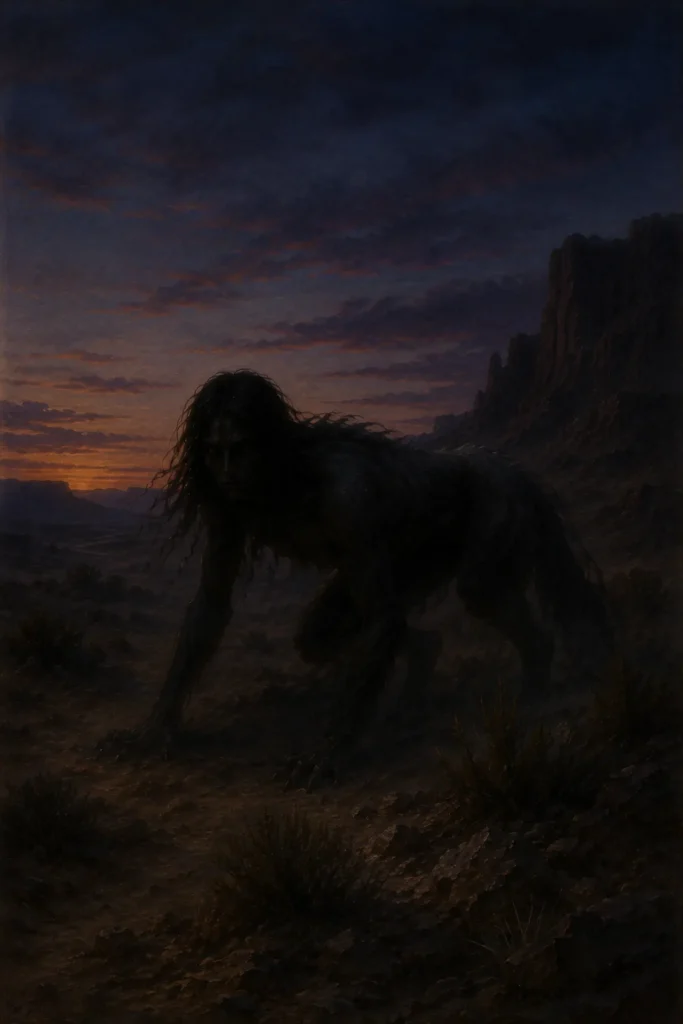
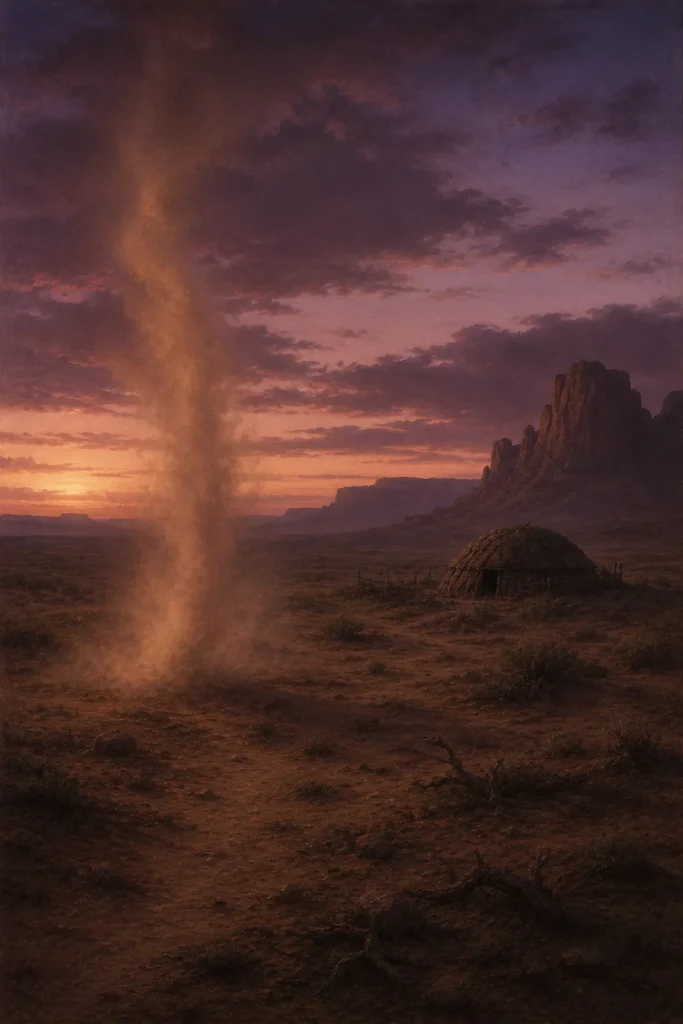
Contact with it can trigger the feared ghost sickness. The Chindi has no fixed form; in some accounts dust devils and whirlwinds are associated with it.
Type: spirit of the dead, the disharmonious remnant of a person after death
Origin: Diné cosmology (Navajo) in the south-western United States, centred on the ideal of harmony and balance
Texts: published Navajo ethnography and reference works, the topic is in part culturally protected
Period: traditional, still alive today
Appearance: usually no fixed form, sometimes associated with dust devils and whirlwinds
Context of tradition
Period of the Texts
The belief belongs to the still-living Diné cosmology and draws on published Navajo ethnography and reference works.
Area of Diffusion
The belief is widespread among the Diné or Navajo in the south-western United States.
Sources
Partly a closed topic: the source material draws on published ethnography, while ceremonial detailed knowledge is deliberately left unmentioned here.
Name and variants
Diné: in the language of the Diné, also called Navajo, Chindi refers to the remnant of a person left behind at death: everything negative that could not be brought into balance during their lifetime. It leaves the body with the last breath.
Appearance and symbolism
Appearance
The Chindi has no fixed form. In some accounts dust devils and whirlwinds are associated with it. Symbolically it embodies the unresolved, disharmonious remnant of a life.
Effect
Contact with a Chindi can trigger what is known as ghost sickness, with symptoms such as nausea, fever, exhaustion and a feeling of suffocation. The Chindi is thus regarded as a cause of unease and misfortune around a death.
Profile: Chindi
The key aspects of the spirit of the dead at a glance.
Part of the Diné cosmology with its central ideal of harmony and balance, to which the Chindi stands opposed as an outcast counterpart.
The bereaved and anyone who comes into contact with the dead or places of death.
No fixed form; in some accounts associated with dust devils and whirlwinds.
Brings on ghost sickness with nausea, fever and exhaustion, and is regarded as a cause of misfortune around a death.
Strict avoidance taboos, not speaking the name of the deceased, and cleansing ceremonies to restore balance.
The Wabanaki Skadegamutc and the Hawaiian Night Marchers as further figures of ancestral dread, along with the Indian Bhoot.
The outcast counterpart to harmony
According to the generally published Navajo conception, the Chindi is the remnant of a person left behind at death, leaving the body with the last breath. The religious background is the Diné cosmology with its central ideal of harmony and balance; the Chindi is, as it were, the outcast counterpart to it.
Death and spirits of the dead are a culturally sensitive, in part protected topic among the Diné. This account therefore remains deliberately general: it follows the published ethnography without embellishing or going into detail on ceremonial knowledge.
Hillerman novels and the limits of popularisation
The Diao-si-gui became known to a wide audience through Tony Hillerman’s Navajo crime novels and their film adaptations, calling it Chindi. This popular reception is understandable but simplifies the complex Diné concept.
From a religious-studies perspective, the Chindi stands at the intersection of death taboo and harmony cosmology: it is not the deceased person but the disharmonious residue that threatens the balance. The avoidance customs are functionally to be understood as protecting the living from ghost sickness.
Avoidance taboos and unnamed ceremonial knowledge
Well-documented and generally known are strict avoidance taboos surrounding death and the dead. Traditionally, houses in which someone died were abandoned or destroyed to avoid illness; the name of a deceased person was long left unspoken, out of concern that the Chindi might hear it.
For protection and to restore balance, there are purification ceremonies in which, among other things, smoke cleansing and mugwort as a healing herb play a role; a worn amulet is regarded as a protective sign in dealing with the spirit of the dead. The exact course of the ceremonies is deliberately not described here, as it constitutes culturally protected ceremonial knowledge.
A worldwide pattern, not a namesake
The Chindi corresponds to the widespread image of a dangerous residue of the dead clinging to the place of death. The idea that contact with the dead causes illness appears in many cultures in death taboos and avoidance customs; a typological comparison is more useful here than a comparison of names. Within the North American spirit-of-the-dead traditions in this collection, it stands opposite the Wabanaki Skadegamutc, whose danger arises not from a taboo residue but from an evil shaman itself.
Frequently asked questions about the Chindi
Is the Chindi the spirit of the deceased?
No, according to the belief it is only the negative, unresolved residue of a life, not the whole person.
What is ghost sickness?
An illness attributed to contact with a Chindi, involving symptoms such as nausea, fever and exhaustion.
Why is the name of a dead person avoided?
Out of concern that the Chindi might hear the name and come near.
Further links
Further reading:
- Skadegamutc – the ghost witch of the Wabanaki, a death danger in another North American tradition
- Night Marchers, Bhoot – related figures of ancestor avoidance and the restless dead
- smoke cleansing, mugwort, amulet – traditional protective means
- Protection Compass – protective means at a glance
Literature (selection)
Further standard works in the bibliography.
As a Navajo spirit of the dead, the Chindi remains above all the disharmonious residue of a life: not a revenant in the European sense, but the unresolved element that, according to Diné belief, remains behind with the last breath and can, upon contact, trigger the feared ghost sickness.