Skadegamutc, the shaman who refused to stay dead
By Ralf Ittermann · last reviewed on
Skadegamutc is a demon of Wabanaki tradition in North America.
Invulnerable to weapons, only fire can defeat him.
Skadegamutc is the ghost witch of the Wabanaki: the reanimated corpse of an evil shaman who roams at night, kills people and drinks their blood.
Ordinary weapons cannot harm him; only burning the corpse destroys him for good. He is recorded in tales of the Maliseet and in Abenaki witch stories.
Type: Reanimated corpse of an evil shaman, the ghost witch of the Wabanaki
Origin: Algonquian woodland cosmology of the Wabanaki in the northeastern United States and eastern Canada
Texts: oral tradition, documented in tale collections of the Maliseet and Abenaki
Period: traditional, orally transmitted
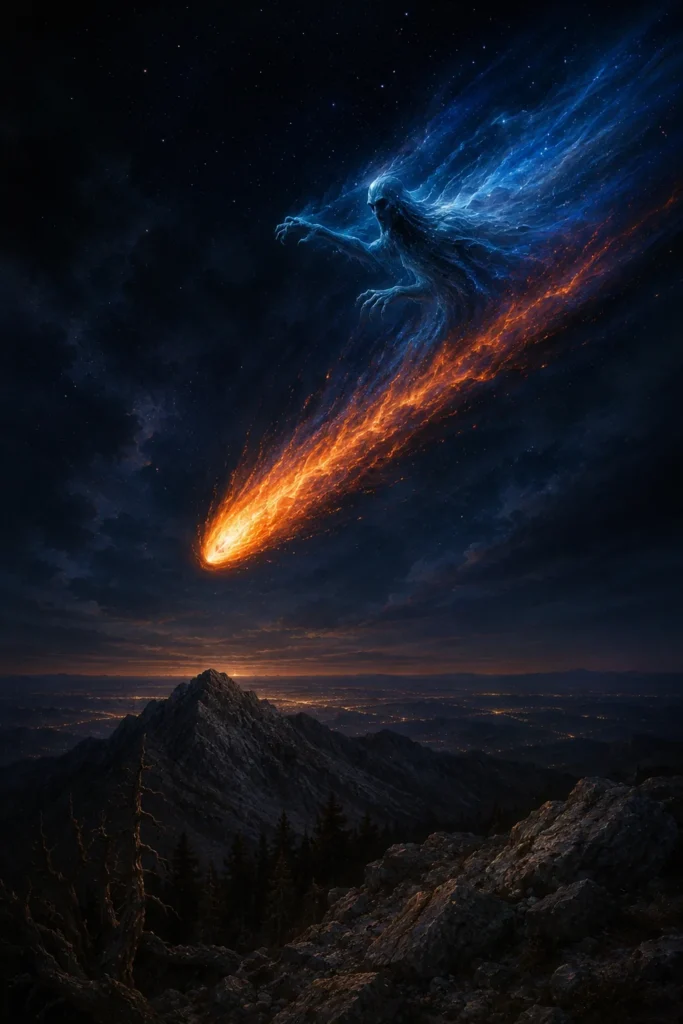
Appearance: physically resurrected corpse, sometimes as a wandering ball of light

Historical Classification
Period of the Texts
The tradition is orally transmitted and documented in tale collections of the Wabanaki peoples.
Area of Diffusion
Found among the Wabanaki peoples in the northeastern United States and eastern Canada.
Sources
Solid: the figure is recorded in tales such as The Lost Hunters of the Maliseet and in Abenaki witch stories.
Name and variants
Algonquian (Wabanaki): In English-language scholarly literature, Skadegamutc is rendered as ghost witch. This refers not to an ordinary deceased person but to an evil sorcerer or shaman who refuses to remain dead.
Form and effect
Appearance
The Skadegamutc is a physically resurrected corpse with man-eating and blood-drinking traits. In some versions he appears as a wandering ball of light in the open forest. He symbolises the danger that spiritual power, shamanism, may turn to evil and persist beyond death.
Effect
At night he kills and eats people and drinks their blood to sustain his immortality. He can hurl curses with powerful magic and, according to tradition, cannot be harmed by ordinary weapons.
Profile: Skadegamutc
The key aspects of the ghost witch at a glance.
Part of the Algonquian woodland cosmology of the Wabanaki with its powerful, ambivalent shaman figures.
Night travellers, hunters and unfortunate passers-by in the forest.
Physically resurrected corpse with man-eating and blood-drinking traits, in some versions appearing as a wandering ball of light.
Kills and eats people, drinks their blood for his own immortality, and hurls powerful curses.
Ordinary weapons have no effect; only burning the corpse destroys him for good.
A shaman who refused to stay dead
A Skadegamutc arises when an evil sorcerer or shaman, not an ordinary deceased person, dies and refuses to remain dead. The religious background is the Algonquian woodland cosmology with its powerful, ambivalent shaman figures.
The figure is recorded in tales such as The Lost Hunters of the Maliseet and in Abenaki witch stories. Unlike an ordinary dead person, an evil shaman carries his power beyond death, and it is precisely this power, turned to evil, that makes him a Skadegamutc.
Between cryptid lists and revenant belief
The Skadegamutc appears regularly in cryptid and horror collections on indigenous North American folklore, as well as in popular bestiaries; this reception is strongly geared towards the scare factor.
From a religious-studies perspective, the Skadegamutc is a classic case of revenant belief: the bad death of a powerful, morally burdened person produces a restless, dangerous undead being. The fire solution places him within the worldwide complex of revenant belief.
Fire as the only effective means
It is well documented that weapons achieve nothing and that fire is the decisive means: a Skadegamutc can only be destroyed for good by burning the corpse. This corresponds to a pattern widespread across many cultures of destroying revenants by fire.
In broader practice, a burning protective candle is regarded as a small echo of this fire protection, along with a worn amulet and mugwort as general protective means. According to tradition, however, only the fire that consumes the corpse itself can destroy him for good.
Blood-drinking revenants compared
The Skadegamutc corresponds to the Old Norse Draugr, the physically solid, malevolent revenant often of a powerful man, and the Romanian Strigoi, the undead being that emerges from a human with magical power and drinks blood as a revenant. What they share is the pattern of the blood-drinking, undead sorcerer whom only fire can defeat. Within North America, the Seminole Stikini stands alongside it as another feared figure.
Frequently asked questions about Skadegamutc
Who becomes a Skadegamutc?
Only an evil sorcerer or shaman, not an ordinary deceased person.
Why don’t weapons help?
It is a magically protected undead being; only fire destroys it.
Is it a vampire?
It has vampiric traits, such as blood drinking, but is more broadly a man-eating, cursed revenant.
Further links
Further reading:
- Strigoi – the Romanian revenant with the same blood motif
- Stikini – the Seminole relative in North American spirits-of-the-dead tradition
- Protective candle, Amulet, Mugwort – traditional protective means
- Protection Compass – an overview of protective means
Literature (selection)
Further standard works in the bibliography.
As a ghost-witch, the Skadegamutc remains above all an undead Wabanaki shaman: a reanimated corpse that refused to stay dead, invulnerable to ordinary weapons and only to be defeated permanently by fire.