Bhoot, the shadowless one with reversed feet
By Ralf Ittermann · last reviewed on
Bhoot is a spirit of Indian tradition.
No shadow, reversed feet: the signs of the restless dead. The shadowless figure with the reversed feet stands at the center of the profile. Bhoot is among the best-known restless spirits of India.
Bhoot is the restless spirit of a deceased person in India who cannot move on. The cause is a violent or premature death, or the failure of surviving relatives to perform the correct death rites.
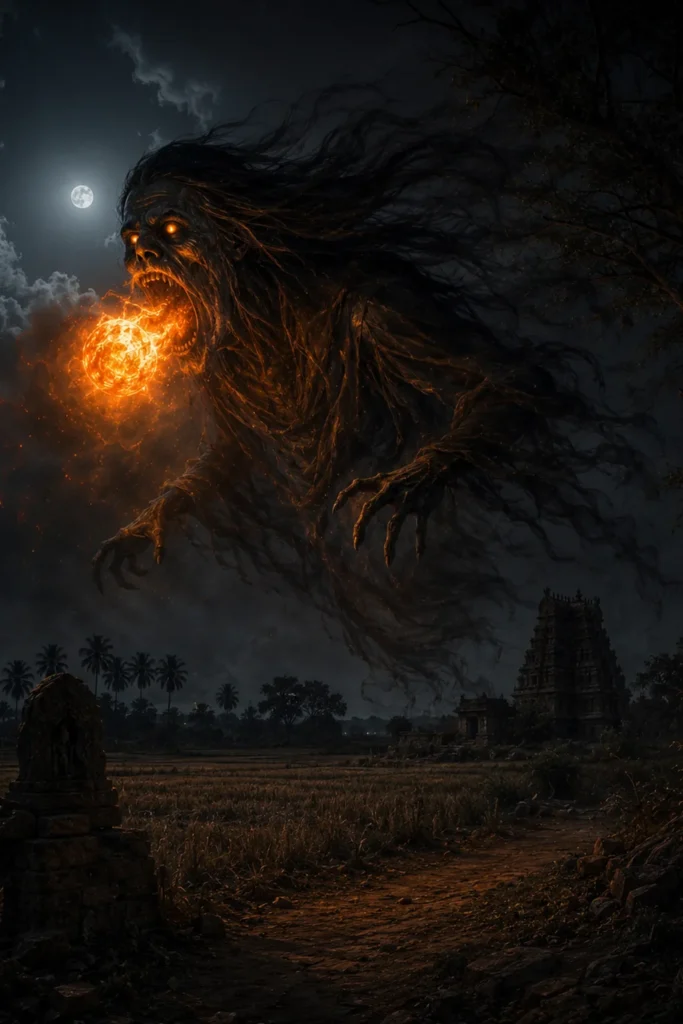
It usually appears in human form and white clothing and can transform into animals. Its telltale signs give it away: feet twisted backwards, a missing shadow, and a nasal voice. Belief in the bhoot is widespread across the entire Indian subcontinent, with particular density in Bengal and northern India.
The Bhoot is a revenant in the broadest sense: the twisted feet closely link it to the Churel, while it differs from the more powerful Brahmarakshasa in that it retains no special knowledge from its former life.
Type: Restless spirit of the dead, the unredeemed soul of a deceased person
Origin: Indian folk belief surrounding unredeemed souls and neglected death rites
Texts: an ancient term, systematically documented since Crooke (1896)
Period: traditional to modern, characteristics attested since the 19th century
Appearance: usually human form in white clothing, able to transform into animal form

Source context
Period of the Texts
The term itself is old; as a revenant concept, the Bhoot is well documented since the 19th century, primarily through William Crooke.
Area of Diffusion
The entire Indian subcontinent, with particular density in Bengal and northern India.
Sources
Solid: William Crooke’s 1896 collection is fundamental, supplemented by the overview works of Pattanaik and Dallapiccola.
Name and variants
Sanskrit: The term bhuta means both ‘been’ and ‘being’: it names what was once a human being and now persists as a remnant of itself.
Appearance
Appearance
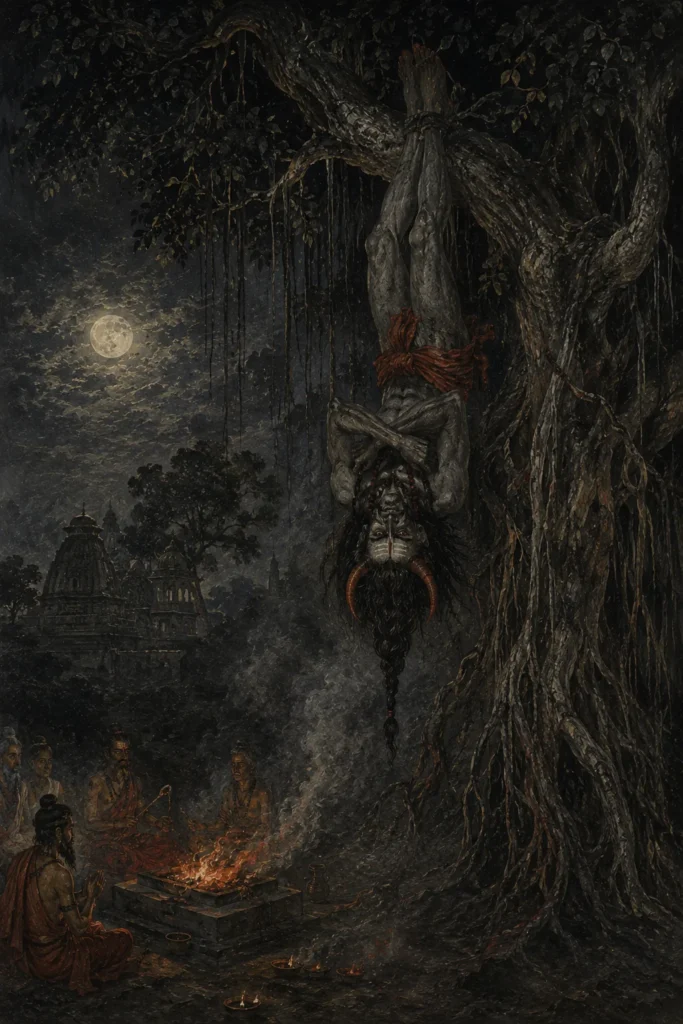
The Bhoot usually appears in human form and white clothing, but betrays itself through unmistakable signs: feet twisted backwards, no shadow, and a nasal voice. Because it avoids the earth, considered sacred, it hovers just above the ground and prefers to dwell in trees.
Effect
Bhoots seek out milk and immerse themselves in it; according to folk belief, whoever drinks the contaminated milk risks possession. In tales, an unsuspecting person unknowingly keeps the spirit company until it betrays itself through its signs.
Profile: Bhoot
The key aspects of the restless spirit of the dead at a glance.
Part of the Indian belief in revenants, concerning souls that cannot move on due to violent death or neglected rites.
Night travellers and lone wanderers, whom the Bhoot lies in wait for at places of death and significance.
Human form in white clothing, recognisable by backwards-turned feet and the absence of a shadow; able to transform into animal form.
Possession through contaminated milk and the unwitting entanglement of unsuspecting people in its restless presence.
Correct cremation and regular ancestor rites prevent a deceased person from becoming a Bhoot in the first place.
The Churel shares the reversed feet as a characteristic; the far more powerful Brahmarakshasa is the spirit of a Brahmin.
Bhuta: the soul that can neither leave nor stay
The Sanskrit term bhuta means both ‘been’ and ‘being’: it denotes what once lived and now persists as a remnant of itself. The Bhoot is the unredeemed soul of a deceased person that can attain neither rebirth nor an afterlife, whether due to a violent or premature death, unfinished business, or the failure of surviving relatives to perform the correct death rites. In 1896, William Crooke named the telltale signs by which a Bhoot can be recognised.
According to the teaching, a soul cannot be destroyed. Ritual specialists therefore perform a soul-pacifying ritual derived from the Atharvaveda, which still allows the Bhoot to complete its interrupted transition.
Bhoot in storytelling and children's literature
The Bhoot is firmly established in Bengali fairy-tale and children’s literature, for instance in the 1907 collection Thakurmar Jhuli, as well as in radio formats and in Indian and Bangladeshi horror anthologies.
In religious studies, the Bhoot is the folk expression of the Preta, the soul immediately after death. At the core of the concept lies the karmic non-redemption of a soul that could not attain ancestor status due to inadequate death rites or unnatural death. Warding it off therefore does not aim at destruction, but at the ritual closure the soul lacks.
Ancestor rites, iron, and burnt turmeric
Prevention addresses the root cause: correct cremation and regular ancestor rites are meant to prevent a deceased person from becoming a Bhoot in the first place. If one has nonetheless arisen, iron is considered an effective means; even a steel bangle is said to offer protection. The smell of burnt turmeric during smoke cleansing drives the spirit away, and it likewise avoids holy water and water in general. Invoking deities and mantras is also considered effective.
The Bhoot among the revenants
Frequently asked questions about the Bhoot
How can you recognise a Bhoot?
By three telltale signs: a missing shadow, a nasal voice, and feet turned backwards. It also hovers just above the ground and usually wears white clothing.
Can a Bhoot be killed?
No, the soul is considered indestructible. Instead, it is pacified through ancestor rites and encouraged to move on.
Why does it dwell in trees?
Because the earth is considered sacred and the Bhoot avoids contact with the ground, it withdraws into trees.
Further links
Further reading:
- Brahmarakshasa – the far more powerful spirit of a dead Brahmin
- Churel – the female spirit with the same reversed feet
- Revenant – the corresponding European concept
- Iron, smoke cleansing, holy water – traditional protective means
- Protection Compass – protective means at a glance
Literature (selection)
Further standard works in the bibliography.
As an Indian spirit, the Bhoot remains above all one thing: a restless dead person betrayed by a missing shadow and reversed feet, before the ancestor rites finally let it move on.