Chir Batti, the unexplained light of the Rann of Kutch
By Ralf Ittermann · last reviewed on
Chir Batti is a spirit of Indian folk tradition.
The colour-shifting orb of light that lures into the salt desert.
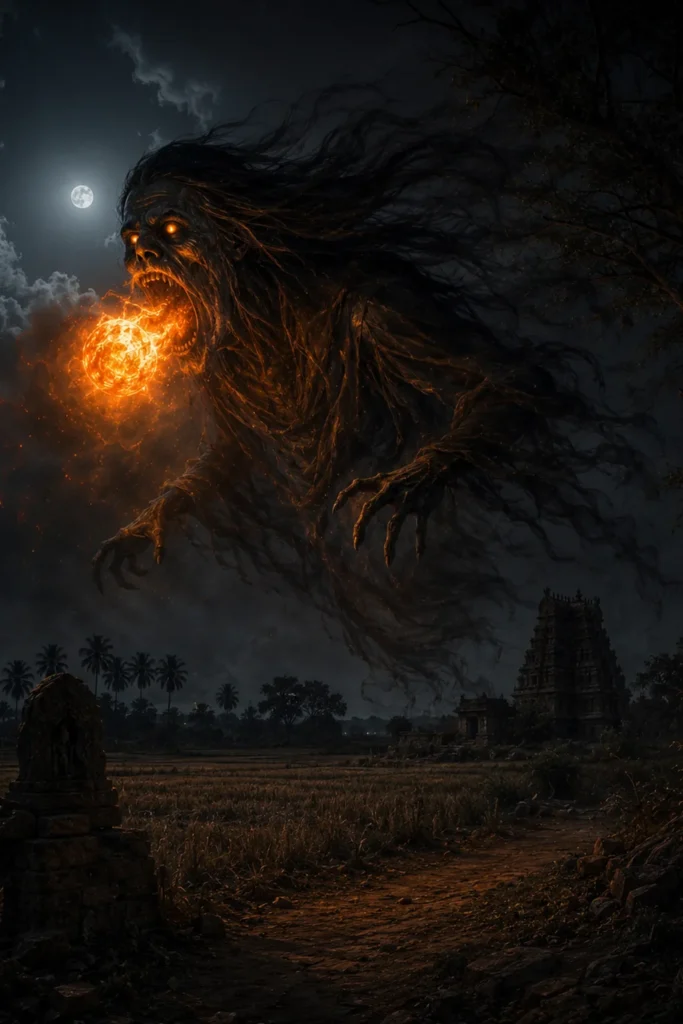
Chir Batti is the ghost light of the Rann of Kutch salt desert in Gujarat; the name literally means ghost light. On dark, moonless nights, it appears as a bright, colour-shifting orb of light hovering close to the ground.
Unlike beings with deep mythical roots, Chir Batti is above all documented in modern times: by local residents, naturalists and border soldiers who patrol the strip between India and Pakistan. Anyone who follows the light loses their way and ends up in thorn scrub or salt desert.
Type: Misleading ghost light, named natural phenomenon with a spirit interpretation
Origin: Rann of Kutch and Banni grassland, Gujarat
Texts: modern observer reports, 20th and 21st centuries
Period: documented in modern times
Appearance: bright, colour-shifting orb of light close to the ground

Source Context
Period of the Texts
Chir Batti is a modern-documented phenomenon: the reports date from the 20th and 21st centuries, not from old textual corpora.
Area of Diffusion
The Rann of Kutch and the Banni grassland in Gujarat, a harsh salt-desert landscape on the border between India and Pakistan.
Sources
Moderate: modern eyewitness reports from local residents, naturalists and border soldiers; a peer-reviewed monograph specifically on Chir Batti cannot be verified.
Name and variants
Kutchi-Sindhi: chir means spirit or ghost, batti light or lamp; Chir Batti is literally the ghost light. The name describes the phenomenon directly, without a mythological detour.
Being and effect
Appearance
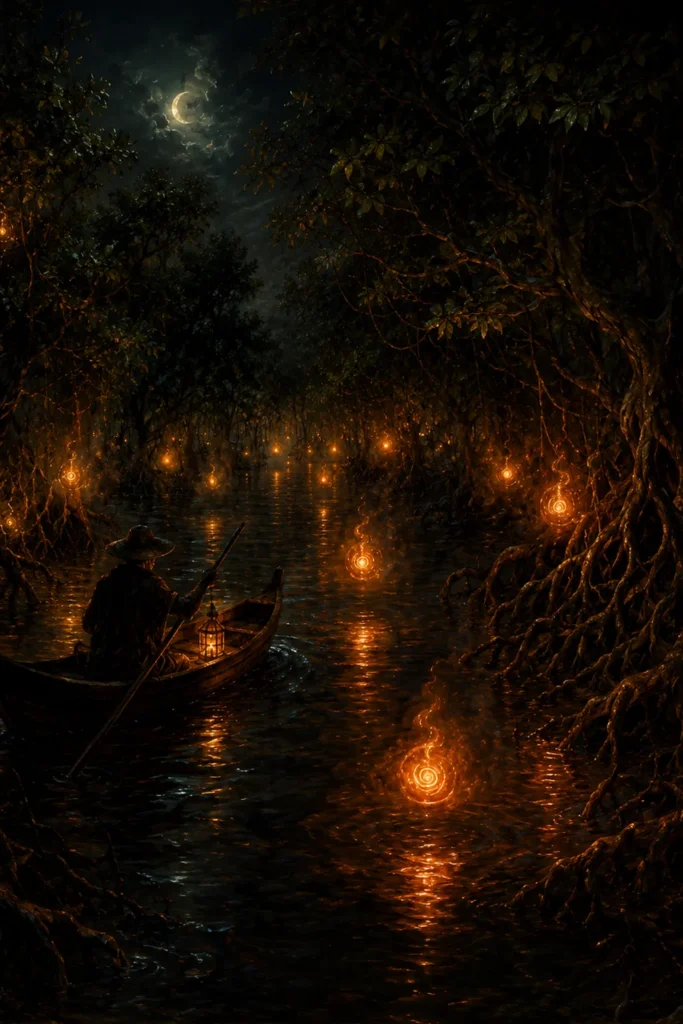
Chir Batti appears on moonless nights, often after eight in the evening, bright like a mercury-vapour lamp and changing colour between blue, red and yellow. It shows itself as a moving fireball or pear-shaped form that hovers roughly half a metre to three metres above the ground, moving sometimes quickly, sometimes slowly.
Effect
Chir Batti is considered misleading: whoever follows the light loses their way and ends up in thorn scrub or salt desert. It is not a killing being in the narrower narrative sense, but it is practically dangerous because it lures people into a hostile environment.
Profile: Chir Batti
The key aspects of the ghost light at a glance.
A named light phenomenon of the Kutch region with a ghost interpretation, without an elaborate cult and without an old textual tradition.
Night travellers, herders and border soldiers of the Border Security Force who patrol the border strip through the salt desert.
Bright, colour-changing ball of light in blue, red and yellow, pear-shaped or as a fireball, half a metre to three metres above the ground.
Misdirection: the light draws travellers off the path, into thorn scrub and salt desert, whose expanse is life-threatening without orientation.
No fixed rituals of defence are recorded; the practical defence is simply the warning not to follow the light.
The Bengali Aleya and the Australian Min-Min Light, two further regionally named ghost lights.
A ghost light with witnesses known by name
Chir Batti differs from most ghost lights in its evidence base: it is chiefly documented in modern times, by local residents, naturalists and border soldiers. Witnesses attested by name include the biologist Jugal Tiwari, with many sightings, as well as members of the Border Security Force who patrol the border strip.
The reports paint a remarkably consistent picture: moonless nights, a light as bright as a mercury-vapour lamp, colour changes between blue, red and yellow, movement close to the ground. Yet what could settle the matter is missing: convincing photographic or film evidence has so far not been obtained, an important caveat.
Interpretation between tourism and natural history
Chir Batti is popular as an Indian ghost light in travel and mystery media and has a regional link to tourism in the Rann Utsav area.
From a religious-studies perspective, Chir Batti shows how a modern, unexplained light phenomenon in a hostile landscape acquires a ghost interpretation. Two clarifications: the methane and phosphine oxidation explanation is plausible and generally accepted for will-o’-the-wisps, yet no settled scientific consensus exists for this particular site. And despite many sightings, there is so far no convincing photograph or video.
The only defence: do not follow
No fixed rituals of defence against Chir Batti are recorded; that should be stated honestly. The practical defence is simply the warning not to follow the light. Chir Batti is a named natural phenomenon with a ghost interpretation, not an elaborate cult, and the traditional handling of it is correspondingly sober: whoever travels through the Rann at night keeps to the path and their companions, not the light on the horizon.
Related lights from Bengal to Europe
Chir Batti is a classic will-o’-the-wisp phenomenon, directly comparable to the Bengali Aleya, the European will-o’-the-wisp and the Tamil fire-mouth motif of Kollivay Pey. Scientifically, it is classed among the family of marsh and ground-gas luminous phenomena. The Australian Min-Min Light also belongs to these regionally named, modern-day attested light phenomena.
Frequently asked questions about Chir Batti
What does Chir Batti mean?
Ghost light, from the Kutchi-Sindhi chir, spirit, and batti, light.
Is Chir Batti dangerous?
Not as an active being, but it can lure travellers into the hostile salt desert; the danger lies in the landscape.
Are there proof photographs?
No. Despite many sightings, there is so far no convincing photograph or video.
Further links
Further reading:
- Aleya – the marsh ghost light of Bengal
- Kollivay Pey – the Tamil fire-mouth spirit
- Min-Min Light – the Australian counterpart
- Salt, Amulet, Protection Candle – traditional protective means
- Protection Compass – protective means at a glance
Literature (selection)
Further standard works in the bibliography.
As the ghost light of the Rann of Kutch and will-o’-the-wisp of the salt desert, Chir Batti stands for a modern riddle: a repeatedly attested, never proven light phenomenon to which the people of the region give a ghost interpretation, without natural science having had the final word.