Min-Min Light, the orb of light of the Channel Country
By Ralf Ittermann · last reviewed on
The Min-Min Light is a spirit of Australian tradition.
The glowing orb that follows travellers at a distance.
The Min Min Light is the ghost light of the Australian outback in Channel Country around Boulia in Queensland. It appears as a blurred, glowing orb that hovers ahead of or follows travellers at a distance.
It belongs to a double tradition: probably to narratives of several Aboriginal cultures predating European colonisation, and to settler folklore, whose first widely reported sighting dates to around 1918 near the ruins of the Min Min Hotel.
Type: ghost light, pursuing light phenomenon of the outback
Origin: settler folklore and probably Aboriginal tradition, sightings reported from 1918
Texts: eyewitness accounts, plus an optical explanatory model (Pettigrew)
Period: probably pre-colonial tradition, settler reports from 1918
Appearance: blurred, glowing orb of light that keeps its distance

Source Context
Period of the Texts
Double tradition: probably pre-colonial narratives of several Aboriginal cultures and a settler folklore whose first widely reported sighting dates to around 1918.
Area of Diffusion
Channel Country around Boulia in western Queensland; the name derives from the ruins of the Min Min Hotel, a staging post east of the town.
Sources
Moderate: eyewitness accounts and collections such as Kozicka’s, plus the optical explanatory model of zoologist J. D. Pettigrew.
Name and variants
Name: The light is named after the ruins of the Min Min Hotel, a staging post east of Boulia in Queensland. The place name itself may be of Aboriginal origin; its derivation is uncertain.
Appearance and behaviour
Appearance
The Min Min Light appears as a blurred disc or glowing, often football-shaped orb that can grow, become brighter or dimmer, and take on colours such as red, orange, blue or green. It is typical for the light to keep its distance, hovering ahead of or following observers.
Effect
In the narrative, the light pursues lone travellers. Local warning holds that whoever the light catches up with will perish. Aboriginal interpretations probably see spirits in it.
Profile: Min Min Light
The key aspects of the ghost light at a glance.
Both probably pre-colonial Aboriginal tradition and settler folklore; both interpret the light as a spirit manifestation.
Lone travellers in the outback, whom the light hovers ahead of or follows at a distance.
Blurred disc or glowing, often football-shaped orb; it changes brightness and colour from red through orange to blue and green.
Pursuing warning sign of the narrative: whoever the light catches up with will perish, according to local warning.
Hardly any fixed protective rituals are recorded; what has been passed down are rules of behaviour, such as warning children not to follow the light.
The worldwide family of will-o’-the-wisps: the Argentine Luz Mala, the Indian Chir Batti, the Scottish Spunkie.
From the Min Min Hotel to a double tradition
The name comes from the ruins of the Min Min Hotel, a staging post east of Boulia in Queensland; the place name may be of Aboriginal origin, though its derivation is uncertain. Around 1918, the first widely reported sighting of settler folklore occurred near the hotel ruins.
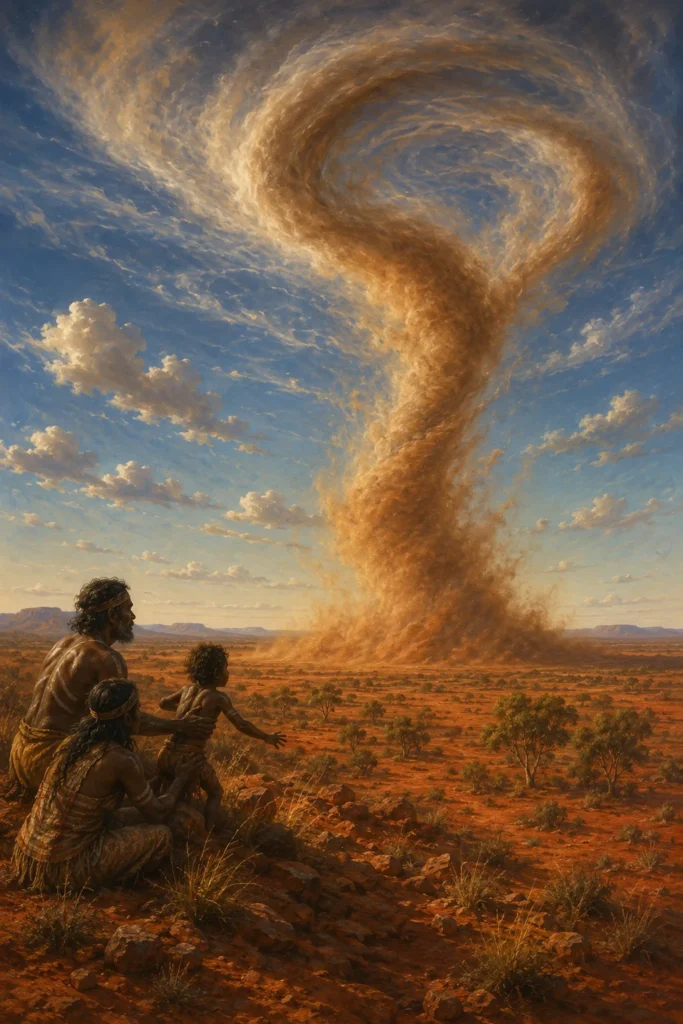
Yet the settler narrative is only the more recent half of the tradition: alongside it there probably exists a tradition of several Aboriginal cultures that predates European colonisation and interprets the light as spirits. The Min Min Light is thus a rare case in which probably pre-colonial tradition and settler folklore independently attributed meaning to the same phenomenon.
Explanatory models and classification
The Min Min Light is a central outback mystery with a tourism connection around Boulia, where a Min Min attraction exists, and it has been the subject of numerous media reports. Zoologist J. D. Pettigrew explained the phenomenon as an inferior mirage, a fata morgana in which light from distant sources is refracted across the curvature of the earth.
From a religious studies perspective, the Min Min Light shows how a light phenomenon of the outback is interpreted as a spirit both in probably pre-colonial Aboriginal tradition and in settler folklore. One clarification: Pettigrew’s fata morgana model is the most robust explanation, but not the only one, and it has not been conclusively proven.
Warnings instead of rituals
Specific, traditionally fixed protective rituals are barely documented; this should be honestly stated. What has been passed down are more rules of behaviour and warnings, such as cautioning children not to follow the light, than a formal protective custom. Protection from the Min Min Light in the narrative thus consists mainly in not pursuing it.
Ghost lights worldwide
The Min Min Light belongs to the worldwide family of will-o’-the-wisps and ghost lights, alongside the Argentine Luz Mala, the English will-o’-the-wisp, and American spook lights such as the Marfa Lights or the Hessdalen Lights in Norway. The Chir Batti of the Indian salt marshes and the Scottish Spunkie also belong to this family. The Min Min Light retains its own distinct profile through its pursuer motif: it keeps its distance, yet follows.
Frequently asked questions about the Min Min Light
Where does the Min Min Light get its name?
From the ruins of the Min Min Hotel east of Boulia in Queensland.
Is it just a settler myth?
No. Alongside settler folklore from 1918, a pre-colonial Aboriginal tradition likely exists as well.
What is the scientific explanation?
J. D. Pettigrew interprets it as an inferior mirage, a fata morgana of distant light sources.
Further links
Further reading:
- Luz Mala – the evil light of the Argentine plains
- Chir Batti, Spunkie – further ghost lights
- Mamu, Willy-Willy – further beings of Australian tradition
- Salt, Amulet, Protective Candle – traditional protective means
- Protection Compass – protective means at a glance
Literature (selection)
Further standard works in the bibliography.
Like no other will-o’-the-wisp, the Min Min Light shapes Australian outback storytelling: as the ghost light of Boulia, it combines a probably pre-colonial interpretation, settler folklore and a light phenomenon that remains not conclusively explained to this day.