Mamu, the devouring power of the Western Desert
By Ralf Ittermann · last reviewed on
Mamu are spirits of Aboriginal tradition in Australia.
The devouring spirit power that takes many forms.
Mamu is an evil spirit power of the Anangu, the Pitjantjatjara and Yankunytjatjara, in the Australian Western Desert. The word denotes not a single creature but a category of evil spirit power and, at the same time, its many embodiments.
Mamu are associated with illness, misfortune and dangerous places, and in the narratives are directed particularly at children. The belief is carried by the Anangu of the APY Lands; sacred particulars are, in keeping with the character of the tradition, omitted on this page.
Type: Category of evil spirit power and its embodiments
Origin: Anangu folk belief of the Pitjantjatjara and Yankunytjatjara
Texts: ethnographic documentation, chiefly Eickelkamp
Period: living folk belief, ethnographically documented
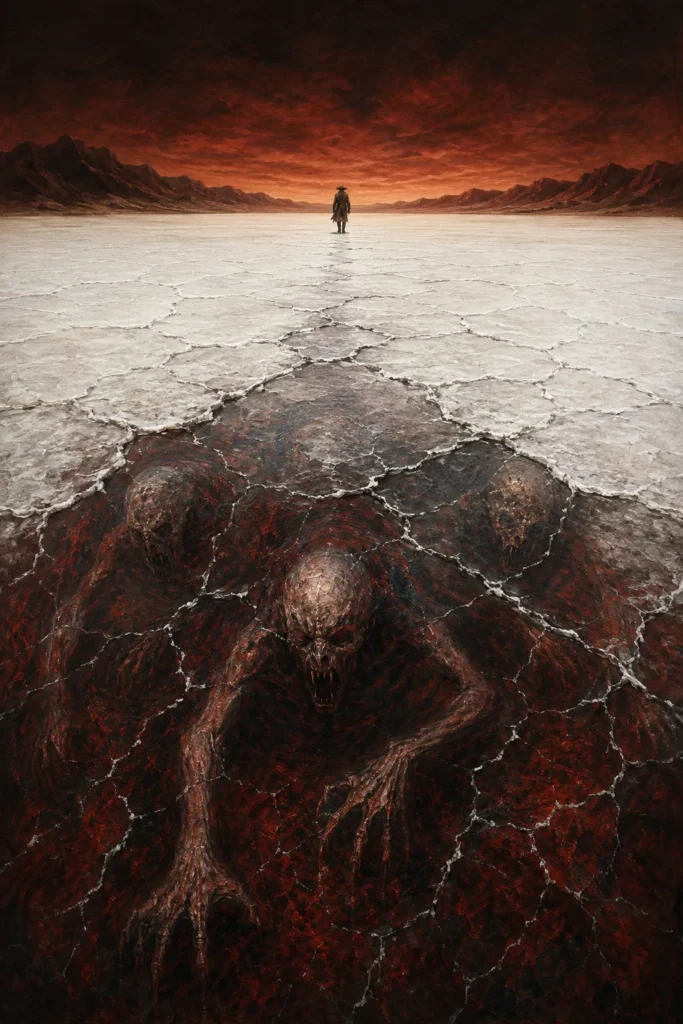
Appearance: shape-shifting; large eyes, sharp fangs

Region of origin and sources
Period of the Texts
Mamu belongs to the living folk belief of the Anangu and is ethnographically documented; the most important fieldwork was carried out by Ute Eickelkamp in Pukatja.
Area of Diffusion
The eastern Western Desert of Australia, particularly the APY Lands of the Pitjantjatjara and Yankunytjatjara.
Sources
Well documented through Eickelkamp’s fieldwork, along with dictionary and survey literature; the English-language literature nonetheless remains slim.
Name and variants
Western Desert language: mamu, a soul-destroying, devouring, malevolent power. The word denotes both the power itself and its many embodiments; in Anangu English it is often rendered as spooky spirit. This category character is the central point.
Nature and effect
Appearance
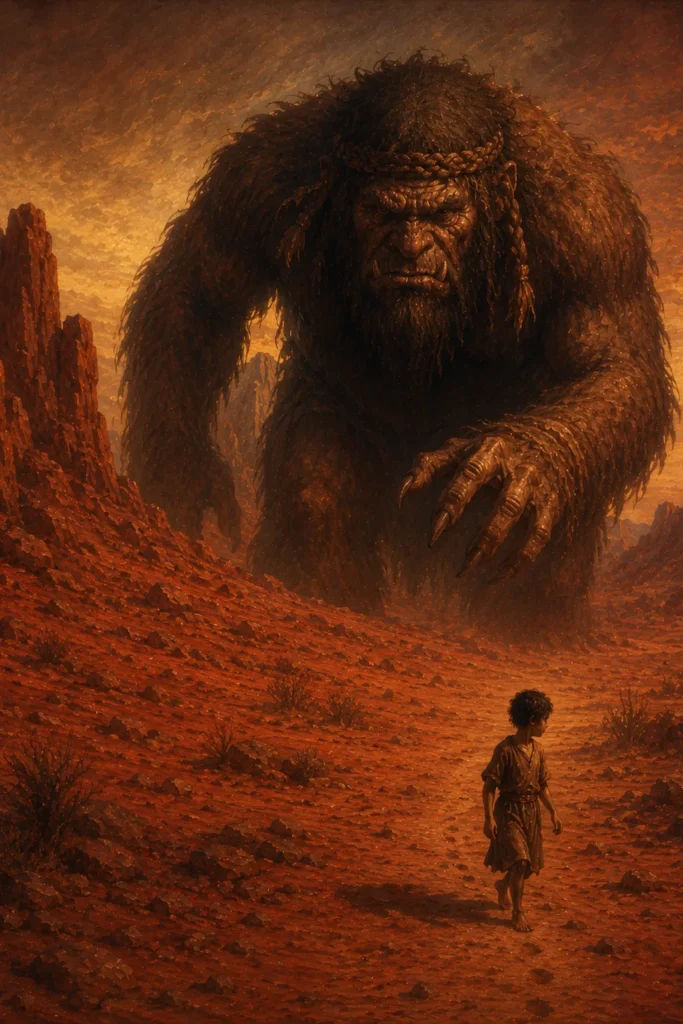
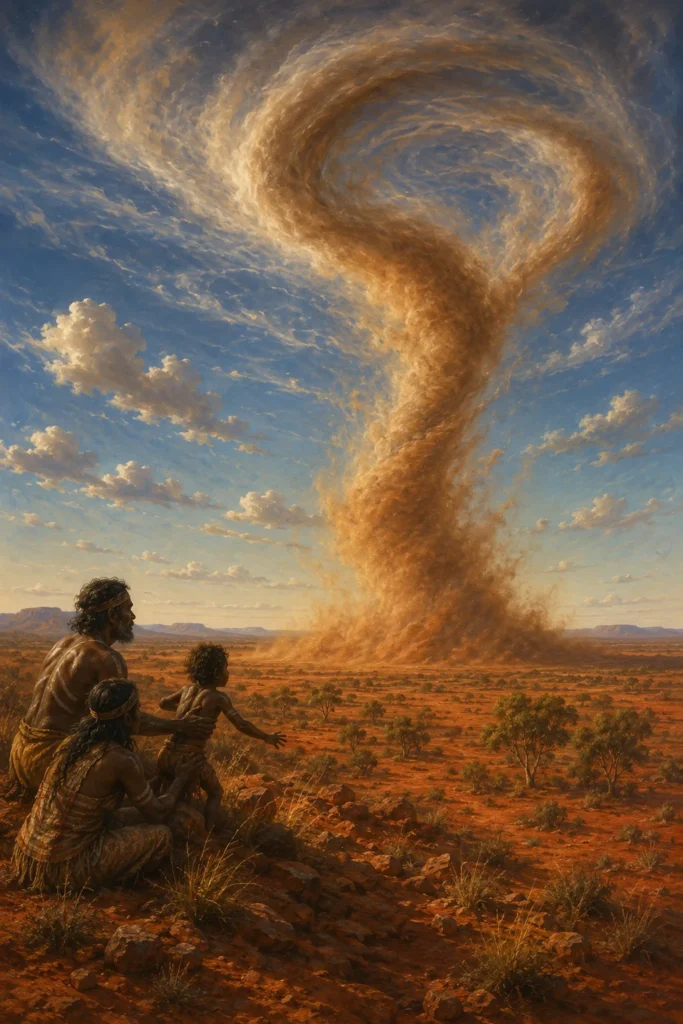
Mamu are highly variable, being shape-shifters. Recurring features are large protruding eyes, heads sometimes bald and sometimes hairy with long, upright hair, and sharp fangs. They can appear humanlike, as an animal or as a ball of fire, and dwell underground or in hollow trees.
Effect
Mamu are associated with illness, misfortune, spiritual attack and dangerous places, and are explicitly used to frighten children into cautious behaviour. From the contact era it is recorded that some older Anangu interpreted the mushroom cloud from the nuclear tests at Maralinga as Mamu wrath.
Profile: Mamu
The key aspects of the spirit power at a glance.
A central concept of the Anangu in the eastern Western Desert: a category of evil spirit power, often called spooky spirit in Anangu English.
Particularly children, whom the narratives caution to be careful, as well as dangerous places where Mamu are believed to be present.
Shape-shifting: humanlike, as an animal or as a ball of fire; recurring large protruding eyes and sharp fangs.
Illness, misfortune and spiritual attack; alongside this, the social function of frightening children into cautious behaviour.
Caution, avoidance and guidance from adults; the Ngangkari, the traditional Anangu healers, are regarded as specialists.
Pangkarlangu and Ngayurnangalku from the man-eater complex of the Western Desert.
A category, not a single being
Mamu is a word of the Western Desert language and denotes a soul-destroying, devouring, malevolent power, at once the power itself and its many embodiments. It is precisely this category character that distinguishes Mamu from named individual beings: to speak of Mamu is to name an entire class of spirit power, not a figure with a fixed biography.
The belief is carried by the Anangu of the APY Lands, the Pitjantjatjara and Yankunytjatjara. The most important ethnographic documentation comes from Ute Eickelkamp, whose fieldwork took place in Pukatja. In Anangu English the word still circulates today, usually rendered as spooky spirit.
Art, reception and classification
Mamu is a well-known motif in Western Desert art, especially in the work of Nura Rupert, whose 2006 painting Mamu is held by the Art Gallery of South Australia. The term circulates in Anangu English and in Uluru tourism.
From a religious-studies perspective, Mamu is a genuine, central Anangu concept. Key clarifications: it is a category of evil spirit power, not a single named being. The English-language literature is thin and repetitive. And any fixed form of appearance is uncertain, since the sources themselves emphasise its variability.
Avoidance, guidance and the Ngangkari
The Anangu regard Mamu as real presences to be avoided; caution and guidance from adults offer protection. The recognised specialists for harmful spirit powers are the Ngangkari, the traditional Anangu healers. Specific rituals are not depicted here, out of respect.
The man-eater complex of the Western Desert
Functionally, Mamu are comparable to the Western Desert man-eater complex, which includes the Pangkarlangu of the Warlpiri and the Ngayurnangalku of the Martu. Across cultures, they are close to the child-scare figures meant to warn children of real dangers.
Frequently asked questions about Mamu
What is Mamu?
An evil spirit power of the Anangu in the Australian Western Desert, associated with illness, misfortune and dangerous places.
Is Mamu a single being?
No, it is a category of evil spirit power and its many embodiments; this category character is precisely the central point.
Who protects against Mamu?
The traditional Anangu healers, the Ngangkari, are regarded as specialists in harmful spirit powers.
Further links
Further reading:
- Pangkarlangu – the child-eating ogre of the Warlpiri
- Ngayurnangalku – the man-eaters beneath the salt lake
- Amulet, smoke cleansing, salt – traditional protective means
- Protection Compass – protective means at a glance
Literature (selection)
Further standard works in the bibliography.
Anyone asking about Anangu spirits first encounters the Mamu: evil desert spirits in the broadest sense, which have no fixed form and precisely through this show how the Western Desert conceives of danger, as a category, not as a single monster.