Aleya, soul-lights over the Sundarbans
By Ralf Ittermann · last reviewed on
Aleya is a spirit of Bengali folk tradition.
Marsh lights that lure into ruin or show the way. The entry describes the soul-lights as wandering flames that either mislead travelers or guide them home. Aleya is described as a marsh spirit-light that wanders over the wetlands of Bengal.
Aleya is the marsh-light of Bengali folk belief in West Bengal and Bangladesh. The flickering, hovering lights above the marshes are regarded as the souls of drowned fishermen, still glowing above the deadly water.
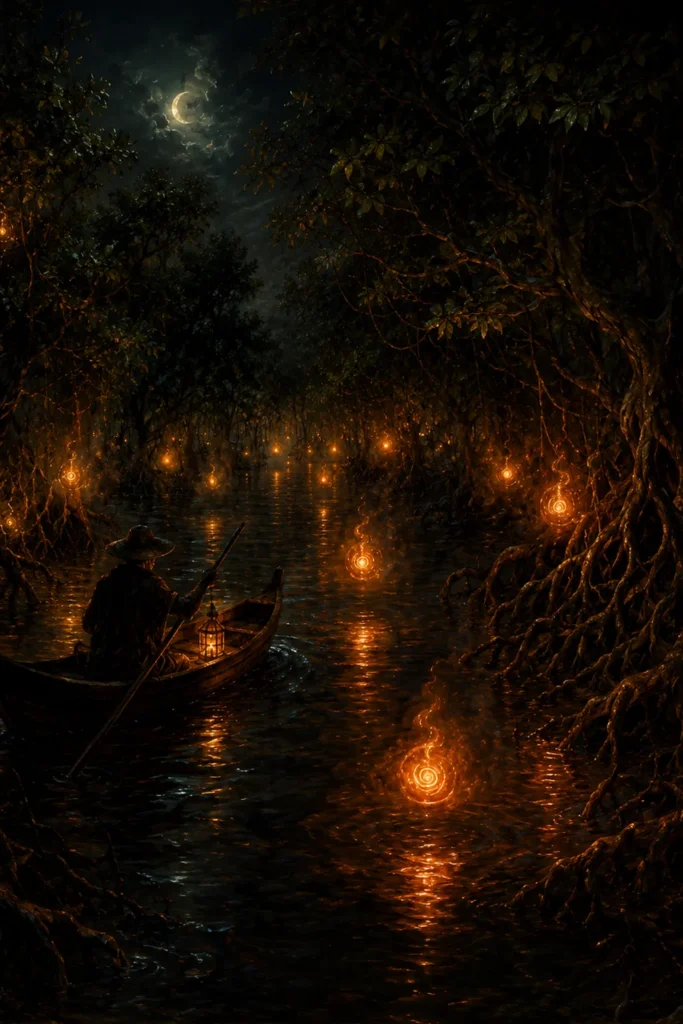
Unlike most ghost lights, Aleya has a pronounced dual nature: some lights lure the living into the swamps and to their drowning, while others show the right path and warn of danger. The belief is especially vivid in the tidal and mangrove swamps of the Sundarbans.
Type: Marsh-light, interpreted as the souls of the drowned
Origin: Bengali folk belief, rooted in bhoot folklore
Texts: Bengali ghost folklore, documented in the 19th and 20th centuries
Period: 19th century to the present
Appearance: flickering, hovering orbs of light over marsh and water
Region of origin and sources
Period of the Texts
The belief belongs to Bengali folk tradition and has been documented in the 19th and 20th centuries; it continues to this day.
Area of Diffusion
West Bengal and Bangladesh, especially the tidal and mangrove swamps of the Sundarbans, where fishermen and marsh dwellers encounter the lights.
Sources
Moderate: the evidence comes from Bengali ghost folklore, collected among others by McCulloch and Bhattacharyya.
Name and variants
Bengali: āleyā, derived from the word root for light and glow, ālo. The being is also known as Atoshi Bhoot, fire spirit. Aleya is the Bengali name for the marsh will-o’-the-wisp and is firmly rooted in bhoot folklore.
Appearance and behaviour
Appearance
Aleya appears as a flickering, hovering orb of light over swamps and water, like a lantern or torch in the distance, often described as a flying, glowing fireball. It embodies the souls of the drowned above the deadly marsh water.
Effect
Aleya is regarded as the spirit of drowned fishermen with a dual nature: some lights lure the living into the swamps and to their drowning, while others show the right path and warn of danger. This ambivalence distinguishes Aleya from the purely misleading Chir Batti.
Profile: Aleya
The key aspects of the marsh light at a glance.
Part of Bengali bhoot folklore, in which spirits are regarded as restless souls of the dead with an unresolved fate.
Fishermen and marsh dwellers: they encounter the lights above the water and must decide whether a light leads the way or lures them astray.
Flickering, hovering orb of light over swamp and water, like a distant lantern or torch, often described as a glowing fireball.
Dual effect: luring towards ruin and drowning on one hand, guidance and warning of danger on the other.
Rules of conduct rather than ritual: not following the lights and staying on the known paths and waterways.
Chir Batti in Kutch and Kollivay Pey in Tamil Nadu, both belonging to the ignis fatuus complex.
From the word root ālo to bhoot folklore
The name comes from the Bengali word root for light and glow, ālo; the being is also known as Atoshi Bhoot, fire spirit. Aleya is the Bengali name for the marsh will-o’-the-wisp and is firmly rooted in bhoot folklore, the world of belief in which spirits are regarded as restless souls of the dead with an unresolved fate.
Drowned fishermen are at the core of this interpretation: those who perished in the marsh water find no rest and continue to glow above the swamps as Aleya. The belief remains alive to this day, especially in the tidal and mangrove swamps of the Sundarbans, one of the most dangerous water landscapes of South Asia.
Reception and classification
Aleya is one of the best-known motifs in Bengali ghost folklore and appears in narratives as well as in travel and mystery writing, often under the label Bengali will-o’-the-wisp.
From a religious-studies perspective, Aleya is a prime example of the ambivalent interpretation of marsh lights as souls of the dead who can both threaten and protect. Two clarifications are important: the natural-science explanation as burning marsh gas is a hypothesis, not proof for the specific Bengali sightings. And Aleya primarily denotes the light itself; the attribution of spirits is the interpretation.
Rules of conduct rather than ritual
Elaborate rituals against Aleya are not reliably documented. The traditional practice is behavioural: not following the lights and staying on the known paths and waterways. General Bengali spirit-warding through amulets and protective formulas is conceivable but not specifically attested for Aleya. The fishermen’s own knowledge of the terrain therefore remains the best protection.
Aleya among the ghost lights
Aleya corresponds to Chir Batti in Kutch, the European will-o’-the-wisp, and the Tamil Kollivay Pey; all belong to the ignis fatuus complex. The interpretation as souls of the drowned resembles European will-o’-the-wisp legends about the souls of the unbaptised or the drowned. The Japanese death light Hitodama likewise interprets hovering lights as souls of the deceased.
Frequently asked questions about Aleya
What is Aleya?
The Bengali marsh-light regarded as the spirit of drowned fishermen, appearing above the marshes of West Bengal and Bangladesh.
Is Aleya always malevolent?
No. Some lights lure people to their ruin, while others show the way and warn of danger; it is precisely this dual nature that shapes the tradition.
Where does it occur?
Mainly in the marshes and mangrove swamps of the Sundarbans in West Bengal and Bangladesh.
Further links
Further reading:
- Chir Batti – the ghost light of the Kutch salt desert
- Kollivay Pey – the Tamil fire-mouth spirit
- Hitodama – the Japanese soul light
- Salt, Amulet, Protective candle – traditional protective means
- Protection Compass – an overview of protective means
Literature (selection)
Further standard works in the bibliography.
As a Bengali marsh light, Aleya represents the dark side of the water landscape: the lights are regarded as spirits of drowned fishermen, and anyone who encounters them never knows whether they will lead them home or lure them into the marsh water.