Hitodama, the floating human soul
By Ralf Ittermann · last reviewed on
Hitodama is a spirit of Japanese tradition.
The soul of a person, visible as a floating flame.
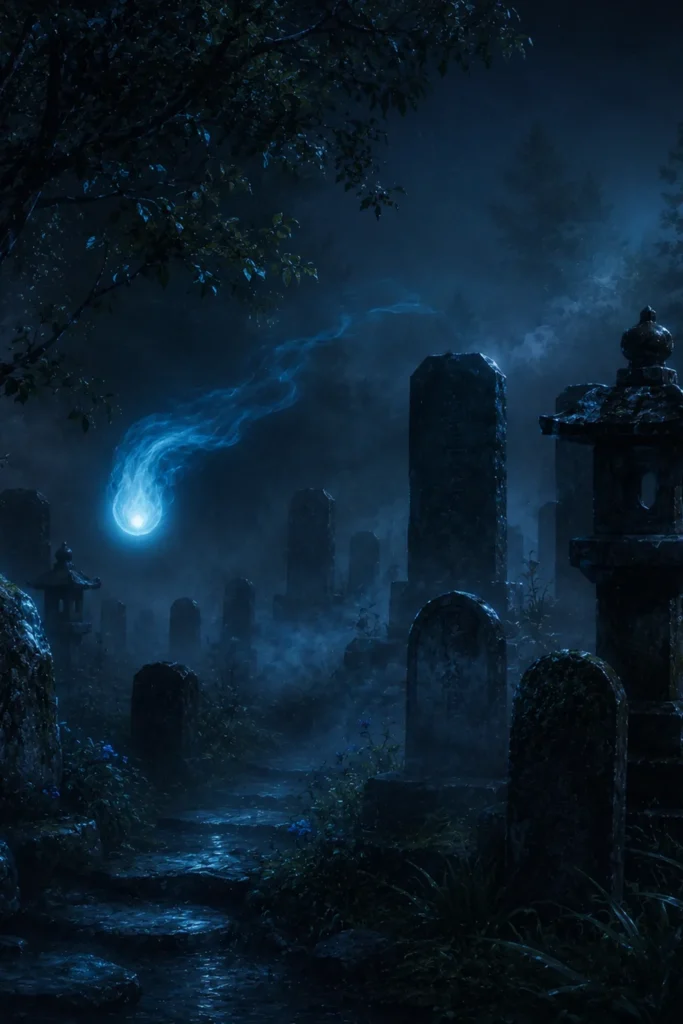
Hitodama, literally human soul, is in Japanese folk belief the soul of a person made visible as a floating flame. Such bluish or reddish glowing fireballs with a trailing tail are said to leave the body of the dying or the newly deceased and hover over graveyards and wetlands.
The belief is old and already hinted at in classical literature, for instance in the Man’yoshu poetry. Hitodama belongs to the numerous fire lights of Japanese folk belief and was frequently depicted in art during the Edo period. Unlike other night lights, it generally attacks no one: it is a sign, not an attacker, evidence that a soul has left the body.
Type: soul flame, the visible manifestation of a person’s soul
Origin: Japanese folk belief concerning death and the soul
Texts: allusions in the Man’yoshu poetry, widespread folk tradition, Edo-period art
Period: classical to modern
Appearance: floating bluish or reddish ball of flame with a tail
Textual history
Period of the Texts
Classical to modern: the belief has been traceable in folk tradition and literature since the medieval period and is already hinted at in the Man’yoshu poetry.
Area of Diffusion
All of Japan. Preferred sites of appearance are graveyards, marshes and wetlands, as well as the proximity of the dying.
Sources
Good: a wide body of folk tradition and Edo-period art, along with the overview works of Foster and Komatsu.
Name and variants
Japanese: hito means human, tama soul or ball: Hitodama is the human soul as visible fire. The name thus names exactly what folk belief saw in the phenomenon, the soul itself in the form of a glowing ball.
Appearance and behaviour
Appearance
Hitodama appears as a glowing ball in bluish, whitish or reddish tones, often with a long tail, floating low and slowly through the air.
Effect
It is regarded as a soul made visible and a sign of death or approaching death. Silent and usually appearing at night, it hovers over graveyards, marshes and near the dying. It is generally not aggressive, but is considered an eerie omen.
Profile: Hitodama
The key aspects of the soul flame at a glance.
One of the numerous fire lights of Japanese folk belief, interpreted within the framework of Japanese ideas about the soul.
The dying and the newly deceased: the flame is regarded as their soul, leaving the body and remaining visible for a while.
A bluish, whitish or reddish ball of flame with a long tail, frequently depicted in Edo-period art.
Sign of death: in folk belief, its appearance indicates that a soul has left the body or that death is near.
Prayers and Buddhist funerary rites for the soul in question; eerie places were avoided at night.
From the human soul to visible fire
The name goes straight to the core of the belief: hito, human, and tama, soul or sphere, together yield the human soul as visible fire. The idea is old and hinted at in classical literature, for instance in the Man’yoshu poetry, whose verses already know the soul light.
Within the Japanese world of belief, the Hitodama stands among a whole family of fire lights, yet retained its own, clearly defined meaning: it is neither a foreign power nor an illusion, but the human being itself at the moment of transition. In the Edo period it was frequently depicted in art and belonged firmly to the repertoire of uncanny night motifs.
Afterlife in art and popular culture
The Hitodama is omnipresent as a hovering soul light in Japanese art of the Edo period, in folk belief and in modern popular culture, for instance in anime, manga and video games. It ranks among Japan’s best-known fire phenomena.
From the perspective of religious studies, the Hitodama is a prime example of the worldwide interpretation of hovering lights as souls of the dead. Natural phenomena such as marsh gases over wetlands and optical illusions at night were interpreted within the framework of the Japanese concept of the soul.
Death customs and dealing with the soul flame
The Hitodama is a phenomenon of appearance and interpretation, not a cult being. Dealing with it belongs to death customs: its appearance was interpreted as a sign that called for prayers and death rites for the soul concerned. Against uncanny lights in general, folk belief made use of prayers, Buddhist death rites and avoiding certain places at night.
Soul lights in Japan and elsewhere
The Hitodama corresponds to the European will-o’-the-wisp and to the soul lights of other cultures, which are interpreted as fires of the dead. Within Japan it stands alongside the Onibi, the demon fire, and the Kitsunebi, the fox fire, with which it is often confused or equated. The distinction lies in the origin of the lights: the Hitodama is the soul of a human, the Onibi arises from grudge and the remains of the dead, and the Kitsunebi is the work of foxes.
Frequently asked questions about the Hitodama
What is a Hitodama?
The soul of a human, visible as a hovering flame, in Japanese folk belief. The name literally means human soul.
When does it appear?
Mostly at night near the dying or the recently deceased, as well as over cemeteries and wetlands, where the flame hovers low and slowly.
Is it dangerous?
As a rule it does not attack, but it is considered an uncanny sign of death and evidence that a soul has left the body.
Further links
Further reading:
- Japan – all beings of the Japanese tradition
- Onibi – the malevolent demon fire
- Kitsunebi – the deceptive fox fire
- Salt, Amulet, Protective Candle – traditional protective means
- Protection Compass – protective means at a glance
Literature (selection)
Further standard works in the bibliography.
As a Japanese soul flame, the Hitodama is the fire of dead souls in the most literal sense: not a foreign being, but the human being itself, visible for a moment as light.