Kollivay Pey, the night spirit with the fire mouth
By Ralf Ittermann · last reviewed on
Kollivay Pey is a spirit of Tamil folk tradition.
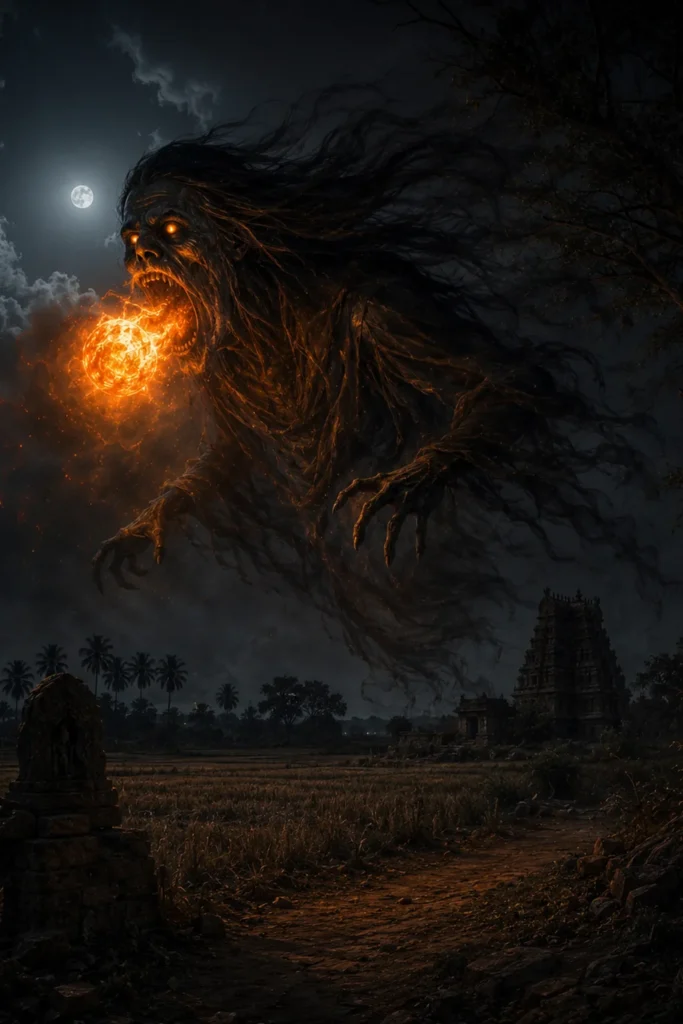
A fireball bursts from its gaping mouth. Kollivay Pey is feared among the Tamils as a demon whose mouth erupts in fire.
Kollivay Pey is a Tamil fire-mouth demon of folk belief: a spirit whose wide-open mouth spews fire. It appears at night in deserted places, in fields, near the sea and in forests.
In folk tradition, flaring field or marsh gas is interpreted as its fire mouth, which links it to the will-o’-the-wisp. The tradition is thin and mostly oral; a dedicated scholarly monograph on Kollivay Pey is lacking.
Type: Nocturnal fright-spirit with a fire-filled mouth, belonging to the class of the pēy
Origin: Tamil folk belief, Tamil Nadu
Texts: predominantly oral tradition and rural tales
Period: oral tradition into the present
Appearance: spirit with a wide-open, fire-filled mouth
Historical Classification
Period of the Texts
The Tamil folk belief surrounding Kollivay Pey is predominantly transmitted orally; a fixed textual period cannot be given.
Area of Diffusion
Tamil Nadu in South India: deserted places, fields, coastal areas and forests, the spaces of night-time travellers.
Sources
Very thin: oral and anecdotal tradition; a dedicated, citable monograph exclusively on Kollivay Pey cannot be verified.
Name and variants
Tamil: kolli means glowing ember or firebrand, vāy mouth, pēy or piśāsu demon or evil spirit; Kollivay Pey is the fire-mouth demon. The spellings vary but refer to the same being.
Form and Activity
Appearance
Kollivay Pey is described as a being with a wide-open mouth in which a fireball or a glowing sphere burns. It appears at night in deserted places, in fields, near the sea and in forests.
Effect
Kollivay Pey is a nocturnal fright-spirit; the fire blazing in its mouth is its identifying mark. In folk tradition, flaring field or marsh gas is interpreted as its fire mouth, which links it to the will-o’-the-wisp.
Profile: Kollivay Pey
The key aspects of the fire-mouth spirit at a glance.
Member of the Tamil ghost classes of pēy and piśāsu, recorded in rural narratives of Tamil Nadu.
Nocturnal wanderer of deserted places: in fields, near the sea, and in forests, where the fire-mouth appears in the dark.
Spirit with a wide-open mouth in which a ball of fire or a glowing sphere burns; described only at night.
Nocturnal spirit of fright: it startles wanderers, and its blazing mouth is linked to flaring field and swamp gas.
Not specifically documented; by analogy, general Tamil pēy defences such as protective deities, amulets and sacred ash.
The ghost lights Aleya and Chir Batti; the name structurally resembles that of the goddess Jwala Ji.
A fire-mouth between the pēy class and a gap in the record
The name is composed of kolli, glowing log or firebrand, vāy, mouth, and pēy or piśāsu, demon or evil spirit: the fire-mouth demon. Kollivay Pey belongs to the Tamil class of pēy and piśāsu; the evidence stems mainly from oral tradition and rural narratives, not from a dedicated academic monograph.
Notable is the structural closeness of the fire-mouth name to Jwalamukhi, the fire-mouthed one, as the goddess Jwala Ji is called, without any cultural relationship existing: here the nocturnal spirit of fright from folk belief, there the venerated temple fire of Shaktism.
Survival and classification
Kollivay Pey is regionally confined and barely known beyond its area; it survives in oral narrative tradition and in more recent forum and blog accounts.
From a religious-studies perspective, Kollivay Pey is an example of nocturnal fire phenomena being interpreted as a demon with a fiery mouth. Two clarifications: rationalising sources equate it with ignited methane, though this is a modern naturalistic interpretation, not the original folk belief. And spellings vary but refer to the same being.
Protection following the pattern of pēy defences
Specific defensive rituals tied to Kollivay Pey are not documented; this should honestly be noted as a gap in the record. Those affected likely resorted to general Tamil protective practices against pēy, such as invoking protective deities like Sudalai Madan or Ayyanar, amulets and sacred ash. Yet this is an inference by analogy from the Tamil spirit system, not direct evidence for Kollivay Pey itself.
Fire-mouth and will-o'-the-wisp: the parallels
Kollivay Pey is closer to will-o’-the-wisp and swamp-gas beings than to a venerated deity; the fire-mouth corresponds to ignited gas over fields and coastal marshes. Related are the Bengali Aleya, the ghost light Chir Batti and the European will-o’-the-wisp. The Japanese fox fire Kitsunebi also belongs among the nocturnal fire phenomena with a spirit interpretation.
Frequently asked questions about Kollivay Pey
What is Kollivay Pey?
A Tamil fire-mouth demon, a nocturnal spirit of fright, from whose mouth fire shoots out.
Is it well documented?
No. The tradition is thin and mostly oral; a dedicated academic monograph is lacking.
Is it connected to the will-o’-the-wisp?
Yes. In folk belief, flaring field and swamp gas is interpreted as its fiery mouth.
Further links
Further reading:
- Aleya – the swamp ghost light of Bengal
- Chir Batti – the ghost light of the Kutch salt desert
- Kitsunebi – the Japanese fox fire
- Salt, Amulet, Sage – traditional protective means
- Protection Compass – protective means at a glance
Literature (selection)
Further standard works in the bibliography.
As a Tamil fire demon, Kollivay Pey remains a figure of quiet tradition: the spirit with the fiery mouth survives in rural narratives, where at night unexplained fire appears over fields and coastal marshes.