Brahmarakshasa is a spirit of Indian tradition.
The spirit of a Brahmin, made more dangerous by his own knowledge. The profile portrays the Brahmarakshasa as a learned scholar whose own knowledge makes his restless spirit all the more dangerous. Described as a scholar bearing the demon’s horns, Brahmarakshasa combines learning and monstrous form in a way this entry sets out.
Brahmarakshasa is the powerful spirit of a Brahmin who, during his lifetime, misused his knowledge or committed evil deeds. Unlike the ordinary Bhoot, he retains his ritual knowledge beyond death and is thereby far more dangerous; when appeased, he can even become a protective spirit.
The tradition is largely text-based, found in the Manusmriti, the Puranas and classical story collections, and is widespread across the whole of India. Particularly in Maharashtra, Kerala and Karnataka, the Brahmarakshasa has its own temple cult.
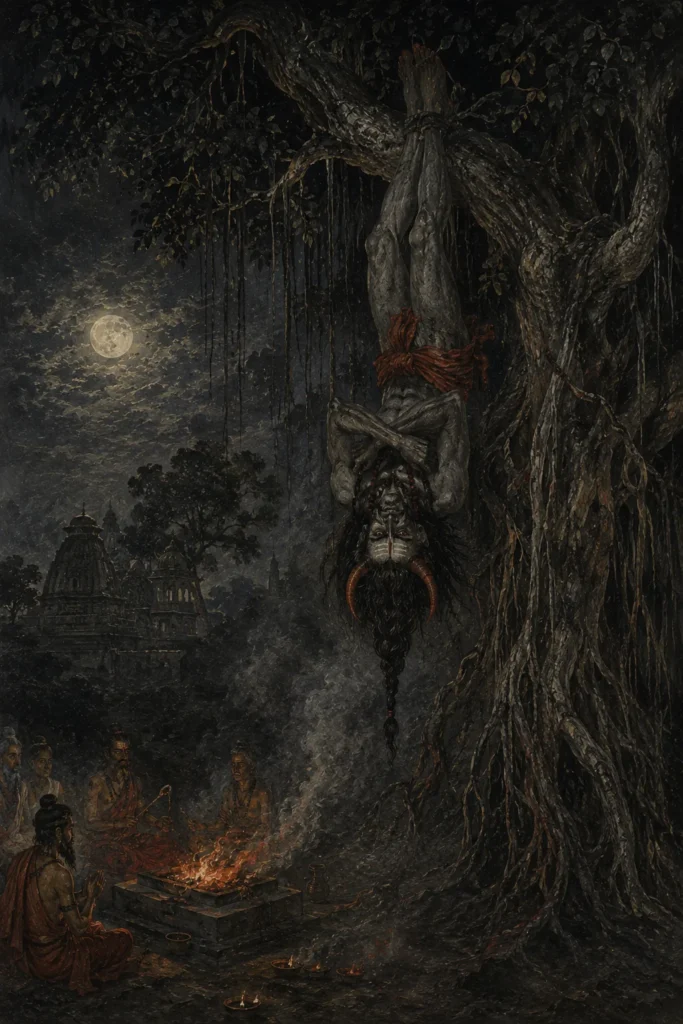
He seeks out liminal places such as banyan and peepal trees, cremation grounds and abandoned temples, where he disturbs above all Brahmins and ascetics during ritual and meditation.
Type: Powerful spirit of the dead of a Brahmin who retains ritual knowledge
Origin: Indian folk belief concerning Brahmins who misused their knowledge during their lifetime
Texts: Manusmriti, Puranas and classical story collections such as the Panchatantra
Period: largely text-based, still alive in temple worship today
Appearance: large and grim, with horns and a topknot, often hanging upside down in a tree
The tradition is largely text-based: it extends from the Manusmriti through the Puranas to classical story collections such as the Panchatantra and Singhasan Battisi.
The whole of India, with its own temple cult in Maharashtra, Kerala and Karnataka.
Good for textual references: the Manusmriti and the Puranas provide the central cases, supplemented by the reference work of Stutley and Stutley and the study by Saran and Pandey.
Sanskrit: The name combines the Brahmin, a member of the highest priestly caste, with the Rakshasa, India’s class of demons: a Brahmin who committed wrongdoing during his lifetime becomes, according to this teaching, a Brahmarakshasa himself.
Appearance
The dual nature is the core motif of the Brahmarakshasa: the horns of a Rakshasa and the topknot of a Brahmin combine in a large, grim figure. He dwells in liminal places, at banyan and peepal trees, at cremation grounds and in abandoned temples, often hanging upside down as a sign of his unnatural state.
Effect
The Brahmarakshasa is more dangerous than an ordinary spirit because he retains the knowledge acquired during his lifetime: he still commands the Vedas and the rituals, can manipulate mantras, disrupt ceremonies, and exploit small ritual errors with precision.
The key aspects of the learned spirit of the dead at a glance.
A text-based figure of folk Hinduism, anchored in the Manusmriti and the Puranas, and to this day the subject of its own temple cult.
Above all Brahmins and ascetics, whose rituals and meditation he disturbs.
Large and grim, with the horns of a Rakshasa and the topknot of a Brahmin, often hanging upside down in a tree.
Manipulates mantras and ceremonies, but when appeased can grant wishes and become a protective spirit.
Outer temple walls, puja and a continuously burning oil lamp in Maharashtra, Kerala and Karnataka.
The name combines the Brahmin, a member of the highest priestly caste, with the Rakshasa, India’s class of demons: a Brahmin who committed wrongdoing during his lifetime becomes, according to this teaching, a Brahmarakshasa. The Manusmriti names black magic, the seduction of other men’s wives and the theft of another Brahmin’s property as causes; the Puranas name the misuse of knowledge, the arrogance of scholarship and disrespect towards one’s own teacher. As examples, the Puranas relate the cases of Somasharma and Somadatta.
What distinguishes him from an ordinary spirit of the dead is his knowledge: the Brahmarakshasa continues to command the Vedas and the rituals and can manipulate mantras, disrupt ceremonies, and exploit small ritual errors with precision. One legend tells how he repeats a poet’s verses until the poet drives him away by speaking nasally himself, whereupon the spirit’s tree withers.
The Brahmarakshasa appears in the classical story collections Panchatantra and Singhasan Battisi and remains present today, among other places in the 2014 film Creature 3D and in the series Brahmarakshas.
From a religious studies perspective, the Brahmarakshasa combines the motif of the unredeemed dead with a pronounced caste dimension: precisely the bearer of the highest ritual purity and greatest knowledge becomes, through misuse, the most dangerous spirit, and knowledge itself becomes a weapon. Temple worship also shows the fluid transition between demon and local protective deity within folk Hinduism.
The basis lies in correct rites and karmic resolution, not in warding off. In Maharashtra, Kerala and Karnataka, the Brahmarakshasa is depicted on outer temple walls and appeased with puja and a continuously burning protective candle; in some cases he is worshipped as a demigod and protective spirit. This includes smudging and consecrated holy water as signs of ritual purity. If satisfied, he can grant wishes: the cult aims at binding and reconciliation, not destruction.
The Brahmarakshasa himself belongs to the class of Rakshasa, India’s demons. The motif of the tree-bound, knowing spirit of the dead is comparable to European ideas of the learned, cursed undead; functionally he is related to the Preta, the soul immediately after death. His caste affiliation makes him an Indian special case, distinct both from the ordinary Bhoot and from the Churel.
How does the Brahmarakshasa differ from an ordinary Bhoot?
He is specifically the spirit of a Brahmin and retains his ritual knowledge. This makes him far more powerful and able to manipulate ceremonies with precision.
Is he only evil?
No. Appeased through puja and an oil lamp, he can become a protective spirit and grant wishes; in South India he is widely worshipped.
Why does he hang upside down in a tree?
The tree and the reversed posture symbolise his liminal, unredeemed state between worlds.
Recommended internal links:
Further standard works in the bibliography.
As the spirit of a Brahmin, the Brahmarakshasa is a learned spirit of the dead in the truest sense: more dangerous than any ordinary deceased, because he retains everything he knew about rituals and mantras in life, and finds rest only through veneration, not through warding off.
Against its influence, cross-cultural tradition names these protective means:
Compare in the Protection Compass →Recommended protective means
The simplest protective means in this collection: 41 layers of fine gold 999, platinum, silver and silicon, manufactured in Ruhla, Thuringia. It requires no activation, is bound to no person, and is effective within a radius of around 50 meters, even without being worn.
Related Beings

Maria Makiling, the Diwata and protector of Mount Makiling. Origin, the pre-colonial name Dian Ma...

Mami Wata, the water spirit goddess with snake and mirror: origin between Africa and overseas, cu...

Lurking devourer of hope, protective amulet formulas against Rabisu and its role in Mesopotamian ...

Shedim, the classic demon concept of Judaism, between Talmud and incantation bowl, with Mesopotam...

The Vodyanoy is the male water spirit of Slavic folklore, lord of rivers, lakes, and millponds, c...

Nammu, the Sumerian primordial mother goddess and the primeval sea. Origin, the creation of human...