iWell Guard

Night Marchers, the nocturnal march of the dead warriors

Night Marchers are spirits of Hawaiian tradition.

Torches, drums and a deadly gaze in the night.

SpiritHawaii

Table of Contents

Night Marchers, spirit of Hawaiian tradition
Night Marchers

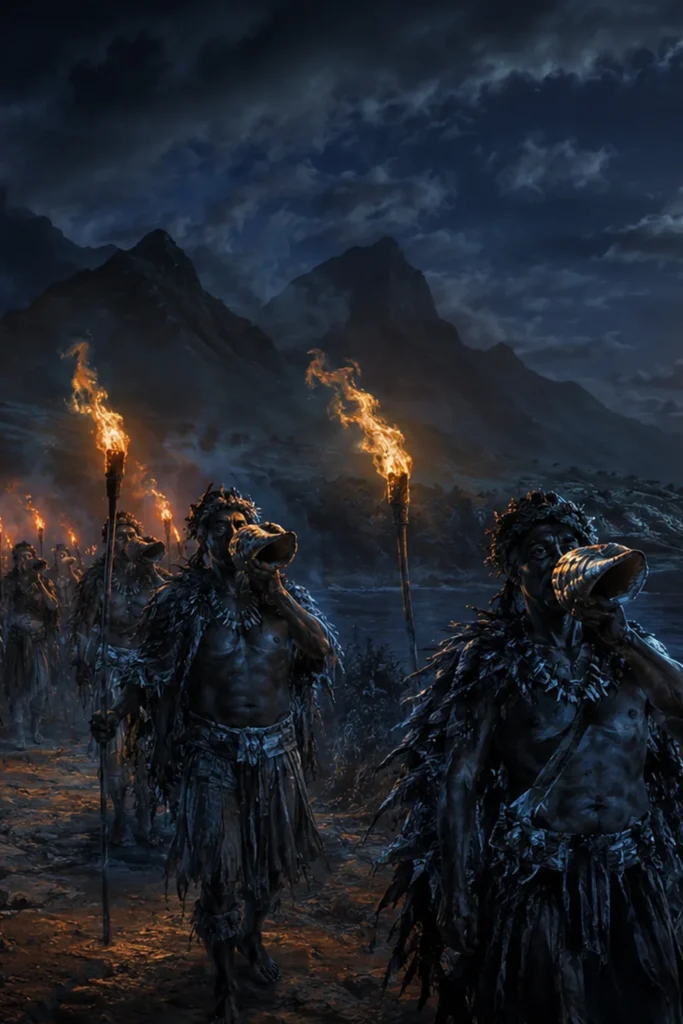
Night Marchers, in Hawaiian Huakaʻi Pō, are the ghostly procession of dead warriors and ancestors of Hawaii, who march at night on old paths with torches, drums and conch shell horns. Whoever sees them without having an ancestor among them faces the threat of death.

The tradition rests on classical Hawaiian ethnography, above all the work of Beckwith and Pukui, and remains alive to this day on all the main islands, particularly on old paths and temple sites.

At a glance: Night Marchers

Type: Procession of dead warriors, chiefs and ancestors
Origin: Hawaiian ancestral and divine world, all main islands
Texts: solid, above all Beckwith and Pukui
Period: classical Hawaiian ethnography and living tradition
Appearance: torches, drums and conch shell horns on old paths and temples

Source context

Period of the Texts

The tradition rests on classical Hawaiian ethnography and is at the same time a still living, orally transmitted tradition.

Area of Diffusion

All of Hawaii, on all main islands, concentrated on old paths and temple sites that once linked villages, temples and battlefields.

Sources

Solid: the main sources are the works of Martha Warren Beckwith and Mary Kawena Pukui, who systematically documented Hawaiian tradition.

Name and variants

Hawaiian: Huakaʻi Pō means march of the night; the rows of spirits themselves are also called ʻoiʻo.

Form and effect

Appearance

Typical signs are torches moving in formation in the distance, a rhythmic drumbeat, deep, ancient chanting and calls of conch shell horns. The procession follows paths that once linked villages, temples and battlefields. Symbolically, the Night Marchers embody the continuing presence and authority of the ancestors and the nobility in the landscape.

Effect

Whoever sees the Night Marchers risks an evil fate, possibly death, for themselves or relatives. Any sound or movement can draw the deadly gaze of a marcher. If, however, one’s own ancestor is in the procession, they can recognise and protect the person.

Profile: Night Marchers

The most important aspects of the Night Marchers at a glance.

Tradition

Part of the Hawaiian world of the ʻaumākua, the gods and the restless dead, with roots in classical Hawaiian ethnography.

Relates To

People who see the procession or happen to stand in its way, with the exception of those who have an ancestor of their own in the row.

Depiction

Rows of warriors, chiefs and ancestors with torches, accompanied by drumbeat, chanting and conch shell horn calls.

Sphere of Influence

Deadly danger for anyone who looks without having their own ancestor in the procession; protection only through recognition by an ancestor.

Approach

Lie flat, stay still, lower your gaze and invoke the ʻaumākua; known march paths are avoided at night.

Related

Cwn Annwn, the Santa Compaña and the Chindi as related figures of nocturnal processions of the dead and ancestor avoidance.

Huakaʻi Pō and the four moon nights of the gods

Huakaʻi Pō means march of the night; the rows of spirits themselves are also called ʻoiʻo. They are spectral processions of warriors, chiefs, ancestral spirits, the ʻaumākua, and in part gods, following old ceremonial paths.

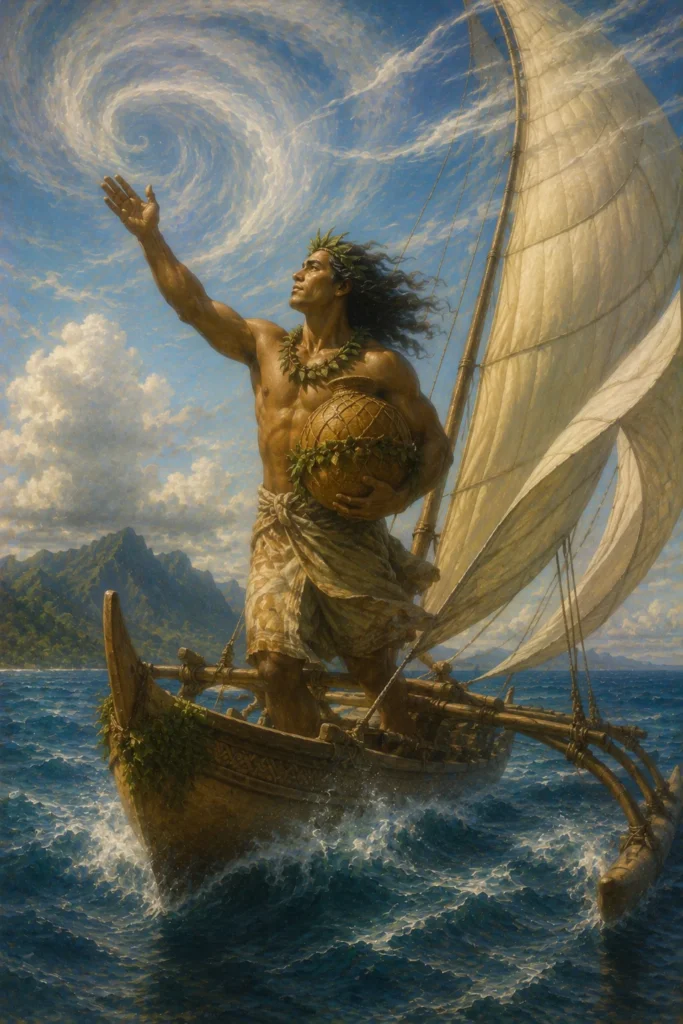
The religious background is the Hawaiian world of the ʻaumākua, the gods and the restless dead. The processions appear on certain nights, often in the four moon phases associated with the gods Kū, Lono, Kāne and Kanaloa.

Living tradition between warning sign and legend

The Night Marchers are a firm part of Hawaiian popular and everyday culture, present in travel and horror publications, on warning signs along march paths, in music, film and television series. Unlike some cryptids, the tradition in Hawaii is largely maintained as a living tradition taken seriously.

The Huakaʻi Pō belong typologically to the worldwide motif of the ancestral and death procession and, at the same time, to ancestor worship: the ʻaumākua combine aspects of protection and threat, depending on whether an ancestor of one’s own is in the row. The behaviour of lying flat and lowering the gaze is a ritualised gesture of reverence towards the passing ancestors and nobility.

Lying still before the procession of the ancestors

Reliably documented is the practice of lying flat on the ground when the Night Marchers approach, remaining still and lowering one’s gaze, so as not to look at the marchers. In some versions, nakedness is considered protective and humbly deflecting. Anyone who calls upon their ʻaumākua may hope for an ancestor in the procession; recorded is the call naʻu, mine, with which an ancestor claims the person and protects them from harm. Known marching paths are avoided at night.

In broader practice, a worn protective sign and the invocation of ancestors are considered protection, as are incense offerings and reverence towards the ʻaumākua. The light of one’s own candle accompanies the vigil during the feared marching nights.

Nocturnal death processions in cultural comparison

The Night Marchers correspond to the Germanic Wild Hunt, the ghostly procession across the night sky, the Welsh Cwn Annwn, the Hounds of Annwn, and the Galician Santa Compaña, the procession of the souls of the dead with candles. What they share is the pattern of the nocturnal death procession as an omen of death and a threshold between the living and the dead.

Frequently asked questions about the Night Marchers

What should one do when encountering the Night Marchers?

Lie flat on the ground, remain still and lower your gaze, and under no circumstances look at them. One can call upon one’s own ʻaumākua, in the hope that an ancestor will recognise them; the call naʻu, mine, is recorded for this purpose.

Why are some people safe from the Night Marchers?

Anyone with an ancestor of their own in the procession may be recognised, claimed and protected from harm by them. Without such an ancestor in the procession, danger threatens.

When and where do the Night Marchers march?

On certain moon nights associated with the gods Kū, Lono, Kāne and Kanaloa, on old ceremonial paths and near temples and battlefields.

Further links

Recommended internal links:

Literature (selection)

A selection of key sources and studies:
  • Beckwith, Martha Warren: Hawaiian Mythology. New Haven 1940.
  • Keauokalani, Kepelino: Kepelino’s Traditions of Hawaii. Honolulu 1932.
  • Pukui, Mary Kawena / Elbert, Samuel H.: Hawaiian Dictionary. Honolulu 1986.

Further standard works in the bibliography.

As huakai po, the Night Marchers remain Hawaii’s death procession, alive on all main islands: a nocturnal procession of torches, drums and ancestral voices, an encounter with which decides between life and death.

Classification & Protection

IVLEVEL
The Protection Compass assigns this being to influence level IV, Severe influence.

Against its influence, cross-cultural tradition names these protective means:

Compare in the Protection Compass →

Recommended protective means

iWell Guard

The simplest protective means in this collection: 41 layers of fine gold 999, platinum, silver and silicon, manufactured in Ruhla, Thuringia. It requires no activation, is bound to no person, and is effective within a radius of around 50 meters, even without being worn.

All protective means at a glance →