Poliʻahu, Pele's rival in a white mantle
By Ralf Ittermann · last reviewed on
Poliʻahu is a goddess of Hawaiian tradition.
The snow mistress, who freezes Pele’s lava with frost.
Poliʻahu, in simplified spelling Poliahu, is the Hawaiian snow and ice goddess of Mauna Kea and the best known of the four snow and ice goddesses of the high mountains. As mistress of snow, ice and cold above the treeline, she keeps volcanic activity in check in the north of the island.
Her nature is the counterpart to fire: in the famous sledding-race myth, the fire goddess Pele appears as a stranger to challenge her, opens lava flows, and is driven back south by Poliʻahu with snow. In some traditions she is regarded as a daughter of the sky father Wākea; she also appears in the tale of Lāʻieikawai.
Type: Snow and ice goddess of Mauna Kea
Origin: Hawaiian mythology, compiled by Westervelt and Beckwith
Texts: Westervelt 1916, Beckwith 1940, the tale of Lāʻieikawai
Period: classical compilations of Hawaiian tradition
Appearance: beautiful woman in a pure white snow mantle

Historical Classification
Period of the Texts
The figure belongs to Hawaiian mythology as recorded in the classical compilations; the most important versions come from Westervelt 1916 and Beckwith 1940.
Area of Diffusion
The island of Hawaiʻi with Mauna Kea: above its treeline Poliʻahu rules, and her presence belongs to this sacred mountain.
Sources
Well documented: Westervelt and Beckwith offer detailed versions, alongside the tale of Lāʻieikawai; however, many details such as genealogy and forms of worship vary between sources.
Name and variants
Hawaiian: Poliʻahu. According to Pukui and Elbert, the name is made up of poli, bosom or enfolding, and ʻahu, cloak or garment: roughly, ‘the one wrapped in a mantle’, an image for the snow mantle of Mauna Kea. The widespread translation ‘enfolded blossom’, by contrast, is uncertain.
Nature and effect
Appearance
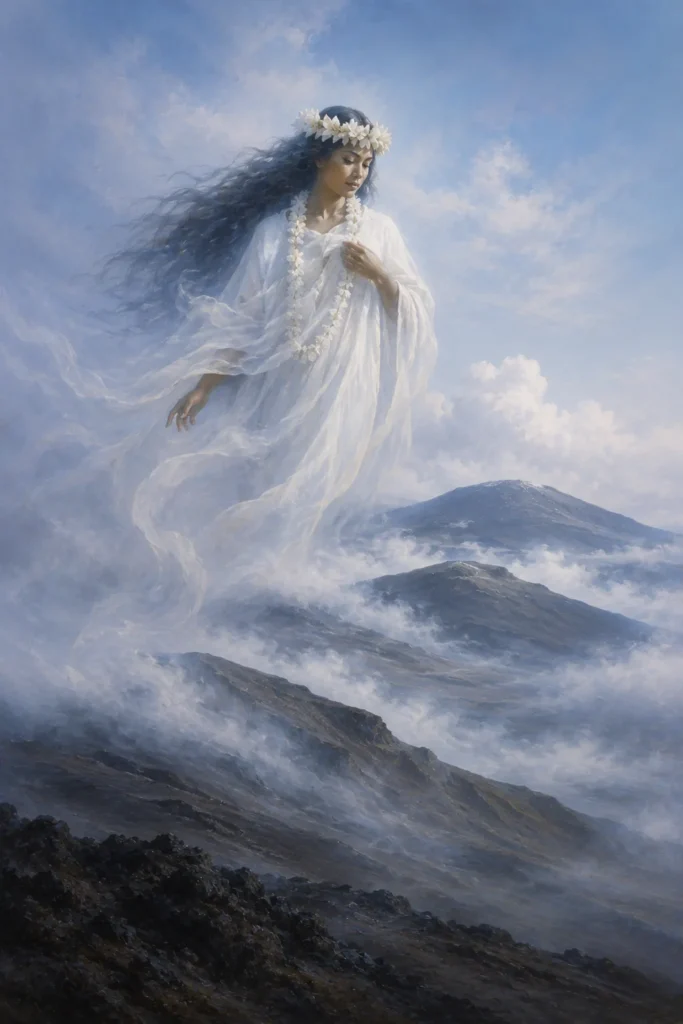
Poliʻahu appears as an exceptionally beautiful young woman in a pure white kapa mantle, the snow. She can lay aside the white mantle and instead wear a sun garment of golden light; the snow then withdraws to the peaks.
Effect
She is mistress of snow, ice and cold above the treeline of Mauna Kea, keeping volcanic activity in check in the north of the island. Her nature is the counterpart to fire.
Profile: Poliʻahu
The snow mistress of Mauna Kea in brief.
Best known of the four snow and ice goddesses of the high mountains; in some traditions a daughter of the sky father Wākea.
Snow, ice and cold above the treeline of Mauna Kea; her change of mantle determines how far the snow reaches.
Exceptionally beautiful young woman in a pure white kapa mantle; alternatively in a sun garment of golden light.
She keeps volcanic activity in check in the north of the island; according to the myth, the northern part of Mauna Kea has remained free of eruptions because of her.
Mauna Kea remains highly sacred to this day, a piko or navel of the Hawaiians; a specific Poliʻahu cult with temples is not securely attested.
Pele, the fire goddess, is her counterpart; the conflict between the two is a nature myth of cold and heat.
The one wrapped in a mantle: name and origin
The name explains the goddess: poli, bosom or enfolding, and ʻahu, cloak or garment, give, according to Pukui and Elbert, ‘the one wrapped in a mantle’, an image for the snow mantle of Mauna Kea. The most important sources are Westervelt 1916 and Beckwith 1940.
Beyond her role as mountain goddess, Poliʻahu is anchored in narrative tradition: in some traditions she is regarded as a daughter of the sky father Wākea, and she appears in the tale of Lāʻieikawai. At the same time, many details such as genealogy and forms of worship vary between sources; the figure is well documented, but not uniform in every respect.
The sledding race and its afterlife
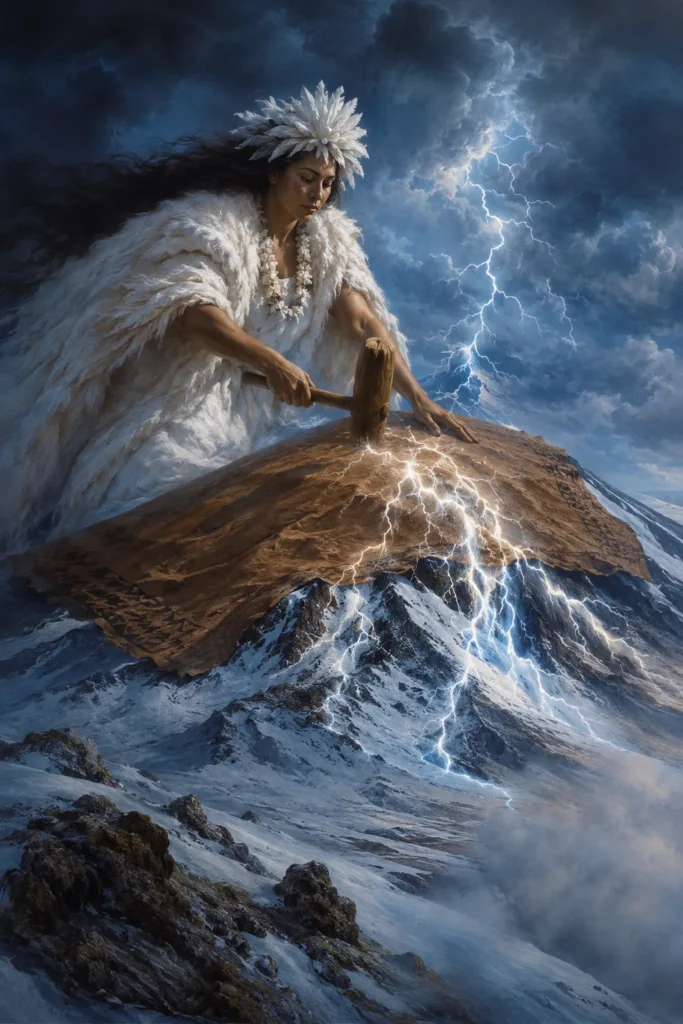
The sledding-race myth is famous: Pele appears as a stranger and opens lava flows during the race, but Poliʻahu throws snow on the lava, freezes it and drives Pele back to the south. The myth explains why the northern part of Mauna Kea remained free of eruptions. Today Poliʻahu is present in tourism, hula and popular culture.
From a religious-studies perspective, she is a well-documented main figure whose details vary between sources. Three clarifications are important: the translation ‘enveloped blossom’ is uncertain. She is not a queen of Hawaii in the historical sense, but a mountain and weather goddess. And the conflict with Pele is a nature myth, not evidence of a real rivalry between two religious parties.
The sacred mountain as a cultic space
Mauna Kea remains a highly sacred mountain to this day, a piko or navel of the Hawaiians; the summit region, Lake Waiau and the heights are places of cultural and spiritual practice. A specific historical Poliʻahu cult with temples, however, is not securely documented. Veneration of the goddess is closely tied to the sanctity of the mountain as a whole: whoever honours the mountain also honours its mistress.
Fire against ice: parallels
The motif of the snow and ice goddess against the fire goddess, Poliʻahu against Pele, is a nature myth of cold and heat; typologically Poliʻahu is comparable to other mountain weather goddesses. Within Hawaii she stands alongside her sisters Lilinoe, Waiau and Kahoupokane, with whom she forms the circle of the snow-mantle goddesses.
Frequently asked questions about Poliʻahu
Who is Poliʻahu?
The Hawaiian snow and ice goddess of Mauna Kea and the counterpart to the fire goddess Pele.
What does the sledding-race myth say?
Pele opens lava flows during the race, but Poliʻahu freezes the lava with snow and drives Pele back to the south; this is why the north of Mauna Kea remained free of eruptions.
Is the interpretation ‘enveloped blossom’ correct?
It is uncertain. More secure is ‘the one wrapped in a mantle’, an image for the mountain’s mantle of snow.
Further links
Further reading:
- Pele – the fire goddess and mythical adversary
- Lilinoe, Waiau, Kahoupokane – the sisters of the snow-mantle circle
- Amulet, Protective candle, Salt – traditional protective means
- Protection Compass – protective means at a glance
Literature (selection)
Further standard works in the bibliography.
In the sledding-race myth, the Hawaiian snow goddess has found her lasting image: as goddess of Mauna Kea, Poliʻahu freezes the lava of her rival and keeps the north of the island calm, a nature myth of cold and fire.