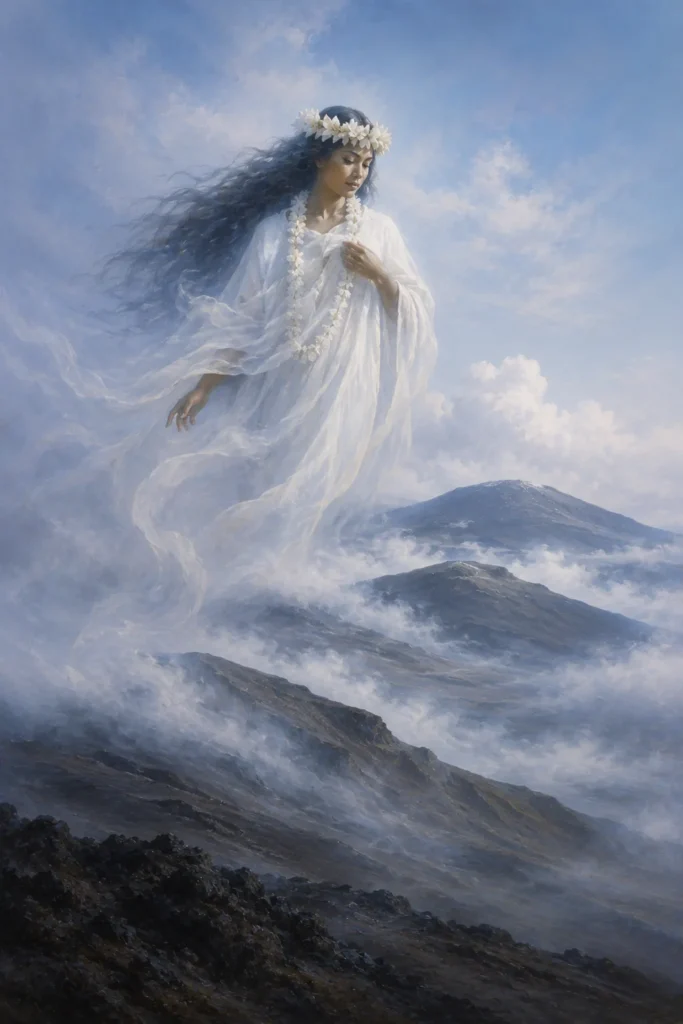
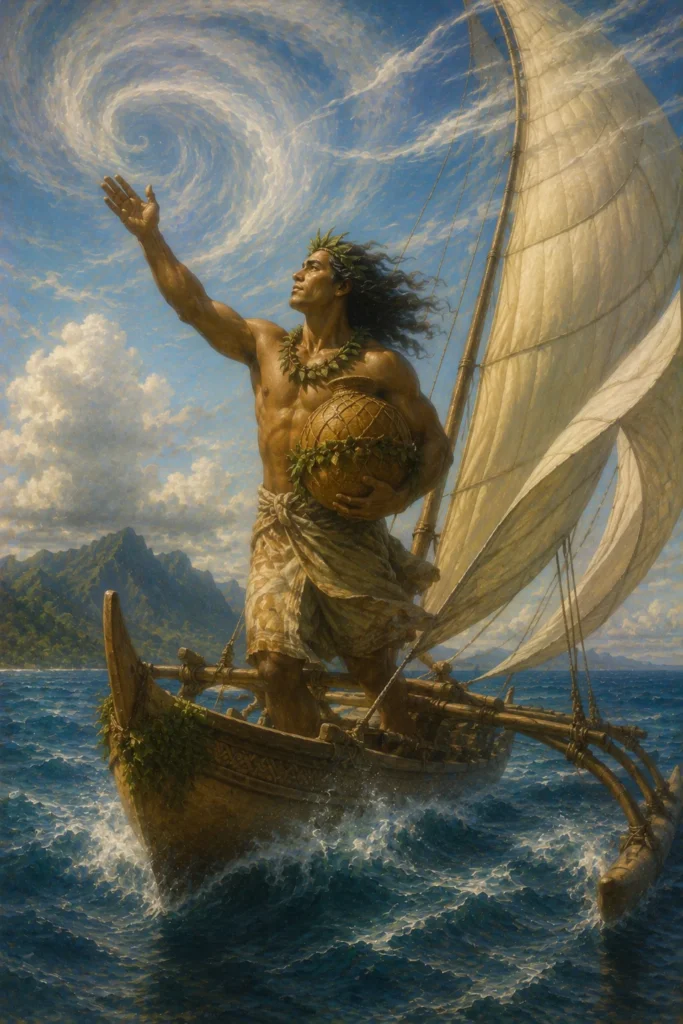
Laamaomao, mistress of the wind calabash
By Ralf Ittermann · last reviewed on
Laamaomao is a deity of Hawaiian tradition.
In her calabash wait all the winds of Hawaii.
Laamaomao is a Hawaiian-Polynesian wind deity whose calabash contains all the winds, which are summoned through name-chants. Whoever knows and sings the names of the winds gains access to the power of the gourd.
Laamaomao is the mythical root of wind control, which her descendant Pakaa exercises in practice: the line of descent runs from her through a granddaughter to Pakaa and his son Kuapakaa.
Type: Wind ancestor deity and mistress of the winds
Origin: Hawaiian legend, rooted in Polynesian tradition
Texts: Nakuina, Beckwith, Kalakaua
Period: Hawaiian tradition, recorded in writing from the 19th century onward
Appearance: no fixed pictorial form, embodied in the wind gourd

Context of Tradition
Period of the Texts
Hawaiian legend, recorded in writing in the 19th and early 20th centuries; the main witnesses are Nakuina, Beckwith and King Kalakaua.
Area of Diffusion
Hawaii and Polynesia: the figure is Hawaiian in character but has counterparts throughout Polynesia.
Sources
Recommended: Nakuina’s The Wind Gourd of Laamaomao, Beckwith’s Hawaiian Mythology and Kalakaua’s collection of legends carry the tradition.
Name and variants
Hawaiian: maomao carries the connotation of distant or removed, hence translations such as distant wind, which is plausible but not strictly established. Gender varies: in the Pakaa cycle female, as the ancestor and owner of the calabash; in the tradition recorded by King Kalakaua, male.
Appearance
Appearance
Laamaomao has no fixed pictorial form; she is embodied by the wind gourd, the ipu o Laamaomao. The gourd is her sign and at the same time her place of action.
Effect
The calabash contains all the winds of Hawaii, which can be summoned through name-chants. The line of descent runs from Laamaomao through a granddaughter to her son Pakaa and his son Kuapakaa. Laamaomao is thus the mythical root of wind control, which Pakaa exercises in practice.
Profile: Laamaomao
The most important aspects of the wind ancestor deity at a glance.
Hawaiian-Polynesian wind ancestor deity, firmly established in Hawaiian Studies; the female version is regarded as a distinctively Hawaiian development.
Seafarers and wind ancestors: Laamaomao is a giver of wind, whose gourd decides favourable passage.
No fixed pictorial form: Laamaomao is embodied in the wind gourd, the ipu o Laamaomao.
Mistress of the winds and mythical root of wind control; the winds follow the traditional name-chants.
An independent temple cult is not prominently attested; her power lies in the gourd and the traditional wind names and chants.
Pakaa as heir to the calabash; in New Zealand her counterpart is Raka-maomao, the opposite pole to the storm god Tawhirimatea.
From ancestor to wind gourd: the line of descent
The name is Hawaiian; maomao carries the connotation of distant or removed, hence translations such as distant wind, which is plausible but not strictly established. In the Pakaa cycle Laamaomao is female, the ancestor and owner of the calabash; in another tradition, recorded by King Kalakaua, male. The female version is regarded as a distinctively Hawaiian development, since the corresponding wind deity elsewhere in Polynesia is male.
Her power lies in the wind gourd: the calabash contains all the winds of Hawaii, which are summoned through name-chants. The line of descent runs from Laamaomao through a granddaughter to her son Pakaa and his son Kuapakaa; thus the divine source of the winds becomes a family tradition of wind control.
Reception and classification
Laamaomao gives her name to Nakuina’s classic The Wind Gourd of Laamaomao and is firmly established in Hawaiian Studies.
In terms of religious studies, Laamaomao is a benevolent wind ancestor deity and giver of wind. Important clarifications: her gender depends on the source, female in the Pakaa cycle, male in Kalakaua, no contradiction, but variance in tradition; and she is not identical with Pakaa, but rather the source and ancestor, while Pakaa is the acting heir.
Wind names and chants instead of a temple cult
An independent temple cult is not prominently attested for Laamaomao; her power lies in the gourd and the traditional wind names and chants. Whoever knew the names of the winds and invoked them in song commanded the power of the calabash. No further cult forms are attested; the knowledge itself was the cult.
Raka-maomao, Raka and Raa: one deity, many names
The same Polynesian wind deity appears as Raka-maomao in New Zealand, the god of ordinary winds as opposed to the storm god Tawhirimatea, as Raka in the Cook Islands and as Raa in the Society Islands, and is compared to the Samoan Faatiu. By sound law, the Polynesian r and k correspond to the Hawaiian l and glottal stop. Laamaomao is clearly distinct from Pakaa: she is the ancestor and source of the wind power, he the heir who exercises it in practice.
Frequently asked questions about Laamaomao
Who is Laamaomao?
A Hawaiian-Polynesian wind deity whose calabash contains all the winds, which are summoned by name-chants.
Is Laamaomao male or female?
It depends on the source: female in the Pakaa cycle, male in Kalakaua; elsewhere in Polynesia the corresponding deity is male.
How is she related to Pakaa?
She is the ancestress and source of wind control, Pakaa the acting heir who takes over the calabash.
Further links
Further reading:
- Pakaa – the wind master who inherits the calabash
- Tawhirimatea – the Maori storm god as a counterpart
- Hine-Tu-Whenua – the goddess of favourable sailing winds
- Amulet, Protective candle, Salt – traditional protective means
Literature (selection)
Further standard works in the bibliography.
As a Hawaiian wind deity, Laamaomao lives on in an object: the calabash of the winds, from which the named winds rise at the chant of her heirs, from Pakaa to Kuapakaa.