Kahoupokane, the kapa-beater of Hualālai
By Ralf Ittermann · last reviewed on
Kahoupokane is a goddess of Hawaiian tradition.
Her kapa-beating is regarded as thunder, lightning and rain. Legend names Kahoupokane the kapa-beater of Hualālai, her rhythm heard in rolling thunder.
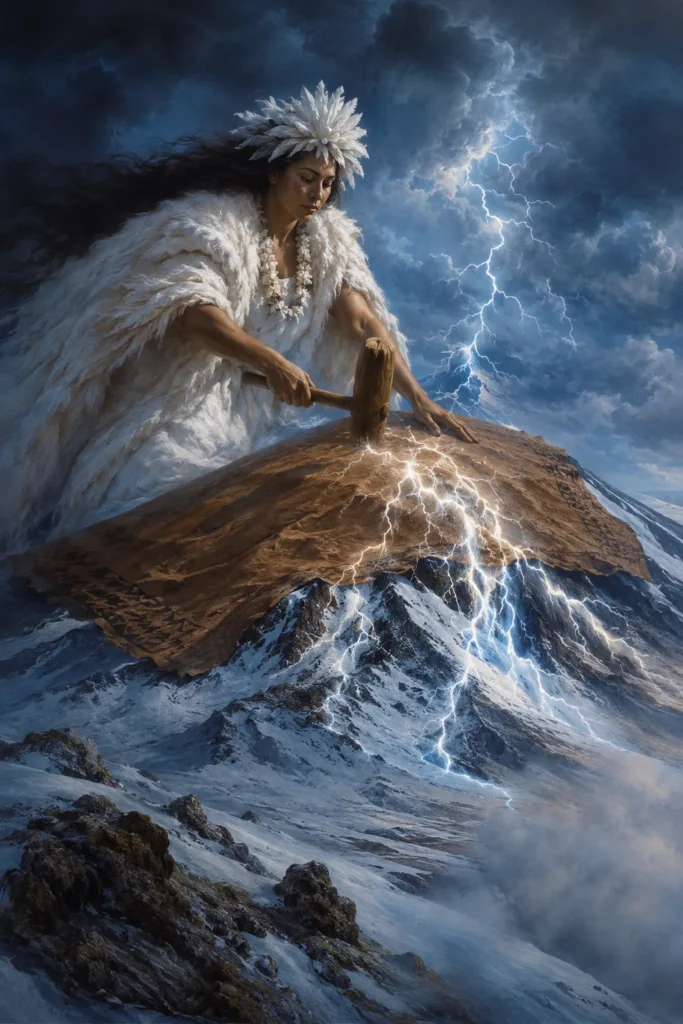
Kahoupokane is the Hawaiian snow and kapa goddess of Hualālai and the fourth of the snow-mantle goddesses. As a master kapa-maker she beats the bark-cloth, and this beating is interpreted as weather events: thunder, lightning and rain are held to be her handiwork.
At the same time, she is the most weakly attested of the four sisters. In 1916, Westervelt described her as possibly a goddess of Hualālai of whom little more than the name is known; Beckwith, in 1940, lists her as one of Poliʻahu’s companions.
Type: Snow and kapa goddess of Hualālai
Origin: Hawaiian mythology, compiled by Westervelt and Beckwith
Texts: Westervelt 1916, Beckwith 1940
Period: classical compilations of Hawaiian tradition
Appearance: maiden in a white snow mantle, kapa maker
Source context
Period of the Texts
The few surviving records belong to the classical compilations of Hawaiian mythology: Westervelt 1916 and Beckwith 1940.
Area of Diffusion
Hualālai on Hawaii: the classical source assigns the goddess to this mountain, even though she is often loosely attributed to Mauna Kea.
Sources
Very thin: little more than the name has come down, along with the brief notes in Westervelt and Beckwith.
Name and variants
Hawaiian: Kahoupokane. The name cannot be reliably segmented, and there is no generally accepted translation; the goddess thus bears a name whose meaning remains open.
Appearance and effect
Appearance
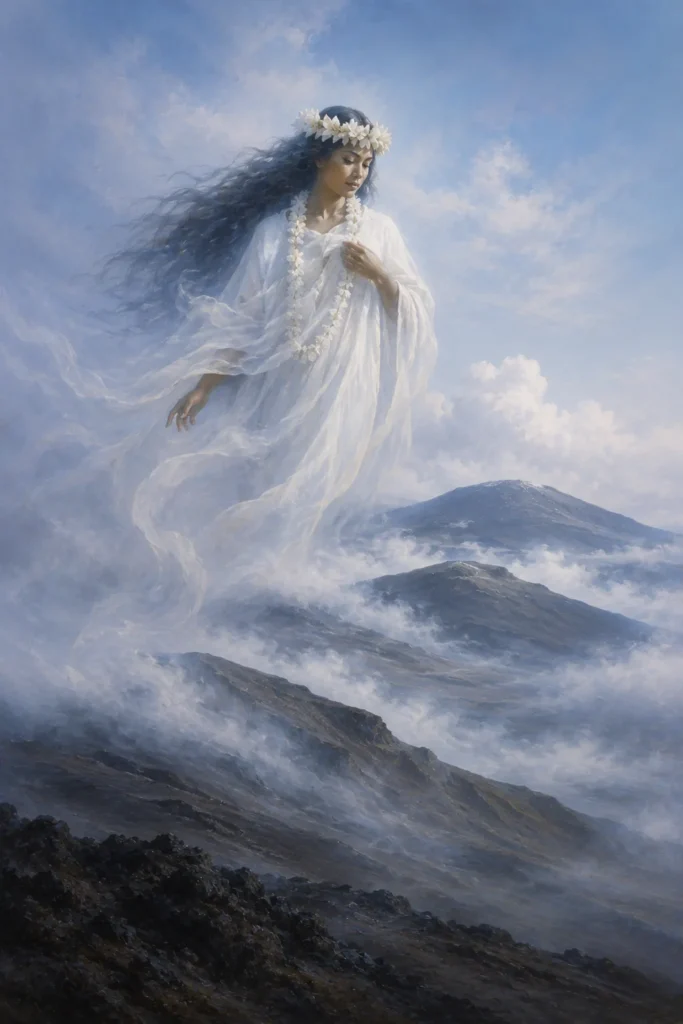
Kahoupokane appears as a maiden in a white snow mantle and, at the same time, as a master kapa-maker who beats the bark-cloth.
Effect
She is mistress of the rare snow on Hualālai. A widespread motif interprets her kapa-beating with mallet on anvil as thunder, lightning and rain; the weather events are understood as her handiwork. This beating motif is popularly transmitted, but in its earliest form the sources are thin.
Profile: Kahoupokane
The profile of the kapa goddess in brief.
Fourth of the Hawaiian snow-mantle goddesses, listed by Beckwith as one of Poliʻahu’s companions; the most weakly attested of the circle.
The rare snow on Hualālai and the weather that tradition attributes to her kapa-beating.
A maiden in a white snow mantle who, as master kapa-maker, works the bark-cloth with a mallet.
Mistress of the snow on Hualālai; thunder, lightning and rain are held to be the sound and result of her handiwork.
An independent cult is not reliably attested; almost nothing but the name has survived.
Typologically related to weaving and craft goddesses who cause natural phenomena; within Hawaii, sister of Poliʻahu.
A name without meaning: the state of the sources
Kahoupokane belongs to the figures whose tradition has shrunk almost entirely to the name. The name cannot be reliably segmented, and no generally accepted translation exists. In 1916, Westervelt called her possibly a goddess of Hualālai of whom little more than the name is known; Beckwith, in 1940, lists her as one of Poliʻahu’s companions.
All the more remarkable, then, is the one motif associated with her: the kapa-beating that produces thunder, lightning and rain. It is widespread in popular tradition, yet thin in its earliest textual basis, and that is exactly how it should be read: as a vivid image resting on a narrow textual foundation.
Afterlife in the retellings
Kahoupokane appears chiefly in modern summaries of the four sisters; the thunder-through-kapa motif is often cited in these accounts.
From a religious-studies perspective, she is the most weakly attested of the four; Westervelt himself states that little more than the name is known, and the thunder-kapa detail should be marked as popular but thin on sources. Two clarifications matter: she is often loosely attributed to Mauna Kea, but the classical source assigns her to Hualālai. And the four goddesses are distributed across Mauna Kea, Haleakalā and Hualālai, so speaking of four sisters of one mountain is a simplification.
Traces of cult on Hualālai
An independent cult of Kahoupokane is not reliably attested; almost nothing but the name has survived, and this should be stated honestly. Unlike Mauna Kea with its well-attested sacred sites, no specific veneration of this goddess can be demonstrated for Hualālai. Her survival is owed to the narrative circle of the four sisters, not to any cult practice of her own.
Craft that makes weather: parallels
Frequently asked questions about Kahoupokane
Who is Kahoupokane?
The Hawaiian snow and kapa goddess of Hualālai and the fourth of the snow-mantle goddesses.
How does she generate weather?
Her kapa-beating is said to produce thunder, lightning and rain; the motif is popular but thin on sources.
Which mountain does she belong to?
Hualālai, not Mauna Kea, to which she is often loosely attributed.
Further links
Further reading:
- Poliʻahu – the best-known sister of the circle
- Lilinoe, Waiau – the other snow-mantle goddesses
- Amulet, protective candle, salt – traditional protective means
- Protection Compass – an overview of protective means
Literature (selection)
Further standard works in the bibliography.
The fact that a Hawaiian snow goddess survives as barely more than a name makes Kahoupokane a borderline case of tradition: the kapa goddess of Hualālai nonetheless preserves, in the beating motif, a distinctive image of weather as craft.