iWell Guard

Waiau, guardian of the sacred crater lake

Waiau is a goddess of Hawaiian tradition.

The lake at the summit is sacred, its goddess almost forgotten.

GoddessHawaii

Table of Contents

Waiau, the lake goddess of Mauna Kea
Waiau

Waiau is the Hawaiian goddess of Lake Waiau, a small sacred crater lake near the summit of Mauna Kea at around 3970 metres. She is one of the four snow-mantle goddesses, sister of Poliʻahu, and closely identified with the glittering mountain lake, whose namesake and guardian she is.

The place is better documented than the person, however: the lake is among the holiest sites of Mauna Kea, while the goddess’s story was already regarded as nearly forgotten by 1916. Westervelt explicitly suspected a still-unexcavated legend linking the maiden Waiau to the lake.

Overview: Waiau

Type: lake and guardian goddess of Lake Waiau
Origin: Hawaiian mythology, compiled by Westervelt and Beckwith
Texts: Westervelt 1916, Beckwith 1940
Period: classical compilations of Hawaiian tradition
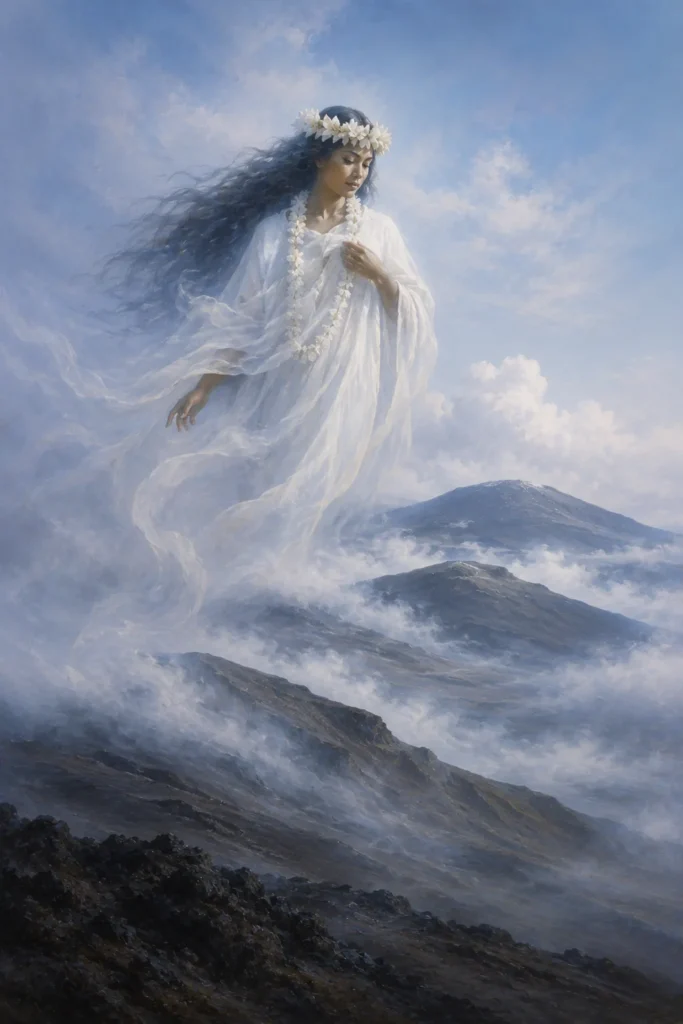
Appearance: maiden in a white mantle

Region of origin and sources

Period of the Texts

The notes on the goddess appear in the classical compilations of Westervelt 1916 and Beckwith 1940; no elaborated narrative has survived.

Area of Diffusion

Mauna Kea on Hawaii, or more precisely Lake Waiau near the summit: a small crater lake at around 3970 metres altitude.

Sources

Thin, with one peculiarity: the place is far better documented than the person; the sanctity of the lake is well established, the goddess’s mythology barely so.

Name and variants

Hawaiian: Wai-au means water deep enough for bathing, or swirling water, from wai, fresh water, and au, current or eddy. Westervelt interprets the name as deep enough for the goddess’s bath.

Description

Appearance

Waiau appears as a maiden in a white mantle and is closely identified with the mountain lake bearing her name.

Effect

She is the guardian goddess of the sacred lake. The lake was sometimes said to be bottomless, reaching to the heart of the mountain; in reality, however, it is only a few metres deep, and depth estimates vary widely.

Profile: Waiau

The guardian of the mountain lake in brief.

Cultural Context

One of the four snow-mantle goddesses and sister of Poliʻahu; her figure is barely elaborated, while the lake is all the more sacred.

Responsible for

Lake Waiau, near the summit of Mauna Kea: she is namesake and guardian of the small crater lake.

Depiction

A maiden in a white mantle, almost identified as one with the glittering mountain lake.

Function

Guardian goddess of the sacred lake; the legend of the bottomless lake reaching to the heart of the mountain belongs to her place.

Dealing with it

Rituals and offerings at the lake; traditionally the umbilical cord of newborns, the piko, was deposited there.

Parallels

Typologically a lake and spring goddess, comparable to the mountain lake nymphs of other cultures; her closest relative is Poliʻahu.

Deep enough for the goddess's bath: the name

Wai-au means water deep enough for bathing, or swirling water, composed of wai, fresh water, and au, current or eddy; Westervelt interprets the name as deep enough for the goddess’s bath. Waiau is namesake and guardian of Lake Waiau near the summit of Mauna Kea at around 3970 metres.

The evidence is limited to Westervelt 1916 and Beckwith 1940. No elaborated narrative of the goddess has survived; Westervelt explicitly suspected a still-unexcavated legend linking the maiden to the lake.

An almost forgotten legend

As early as 1916, the tradition was regarded as nearly forgotten; Westervelt reckoned with a lost legend, still to be uncovered, about the maiden Waiau and her lake.

In religious-studies terms, Waiau is a benevolent lake goddess whose figure is barely elaborated; what is established above all is the sanctity of the lake, not a rich mythology of the person. Two clarifications are important: the bottomless lake is legend, not geography, the lake is shallow. And Waiau is not identical with the lake, but its mythical guardian, whose exact story is lost.

Rituals at Lake Waiau

Lake Waiau remains one of the holiest sites of Mauna Kea to this day, a place of rituals and offerings; traditionally, the umbilical cord of newborns, the piko, was deposited there. A specific cult of Waiau as goddess, however, is poorly documented: the sanctity belongs to the place. The goddess stands behind the lake, not before it.

Lake and spring goddesses compared

Waiau represents the type of a lake and spring goddess, comparable to the mountain lake nymphs of other cultures. Within Hawaii she stands alongside her sisters Poliʻahu, Lilinoe and Kahoupokane, whose circle divides the high mountains of the islands among themselves.

Frequently asked questions about Waiau

Who is Waiau?

The Hawaiian goddess of the sacred crater lake, Lake Waiau, on Mauna Kea, and sister of Poliʻahu.

Is the lake bottomless?

No. That is legend; in reality the lake is only a few metres deep, even though depth estimates vary widely.

How well is the goddess documented?

Thinly. What is established above all is the sanctity of the lake; the goddess’s story is considered lost.

Further links

Recommended internal links:

Literature (selection)

A selection of key sources and studies:
  • Westervelt, William D.: Hawaiian Legends of Volcanoes. Boston 1916.
  • Beckwith, Martha Warren: Hawaiian Mythology. New Haven 1940.
  • Pukui, Mary Kawena / Haertig, E. W. / Lee, Catherine: Nānā i ke Kumu. Honolulu 1972.

Further standard works in the bibliography.

Waiau shows how a place can outlast its mistress: the crater lake remained sacred while the story of the goddess of the crater lake was lost; as Poliʻahu’s sister, she lives on chiefly within the circle of the four snow-mantle goddesses.

Classification & Protection

ILEVEL
The Protection Compass assigns this being to influence level I, Minor influence.

Against its influence, cross-cultural tradition names these protective means:

Compare in the Protection Compass →

Recommended protective means

iWell Guard

The simplest protective means in this collection: 41 layers of fine gold 999, platinum, silver and silicon, manufactured in Ruhla, Thuringia. It requires no activation, is bound to no person, and is effective within a radius of around 50 meters, even without being worn.

All protective means at a glance →