Lilinoe, the fine mist as a goddess
By Ralf Ittermann · last reviewed on
Lilinoe is a goddess of the Hawaiian tradition.
Her name is the natural phenomenon itself: fine mist and haze.
Lilinoe is the Hawaiian goddess of fine mist and haze, one of the four snow-mantle goddesses and sister of Poliʻahu. She embodies the veils of mist that envelop peaks and slopes, and is connected both with Mauna Kea and with Haleakalā.
In Beckwith she is counted among Poliʻahu’s companions and arranges her hair soft and fine as a cloud. On Haleakalā on Maui she takes on a second aspect: there she is regarded as goddess of the extinguished fires and of the barrenness that keeps the eruptions of the old cinder cones in the crater in check.
Type: Mist and cold goddess, one of the four snow-mantle goddesses
Origin: Hawaiian mythology, compiled by Westervelt and Beckwith
Texts: Westervelt 1916, Beckwith 1940
Period: classical compilations of Hawaiian tradition
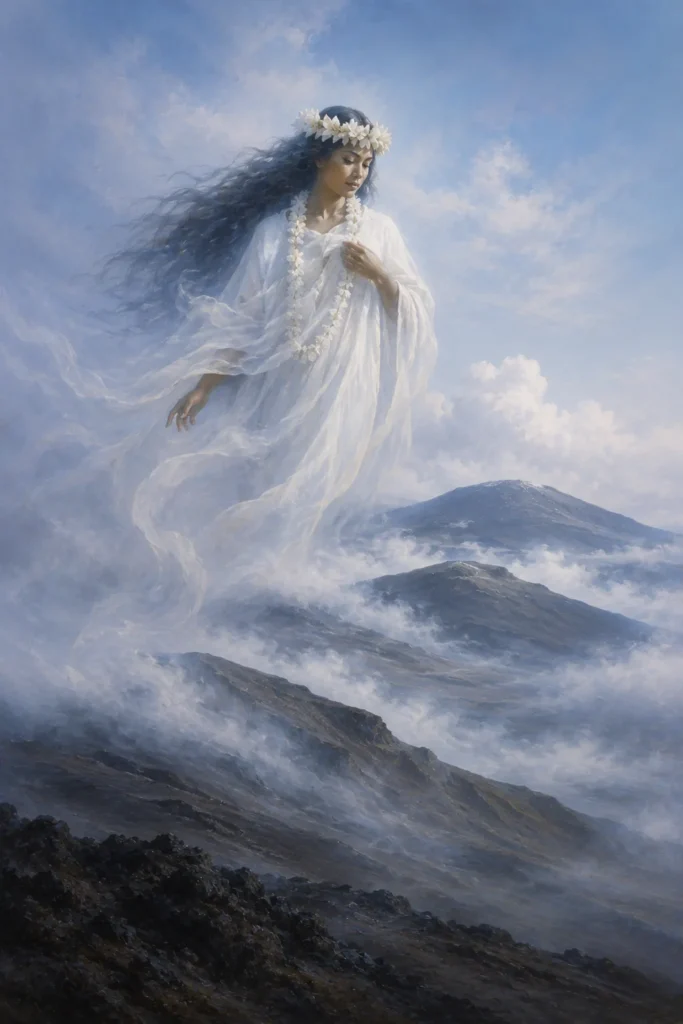
Appearance: maiden in a white mantle
Context of tradition
Period of the Texts
The evidence comes from the classical compilations of Hawaiian mythology by Westervelt 1916 and Beckwith 1940; Westervelt himself already called the legends very obscure.
Area of Diffusion
Mauna Kea on Hawaiʻi and Haleakalā on Maui: the sources assign Lilinoe to both mountains.
Sources
Thin: as early as 1916 the tradition was regarded as obscure, and much about the figure is reconstruction from names and brief notes.
Name and variants
Hawaiian: lilinoe means fine mist, drizzle or haze and is at the same time a personal name. The name is thus the natural phenomenon itself: to say Lilinoe is to name the haze the goddess embodies.
Appearance
Appearance
Lilinoe appears as a maiden in a white mantle and embodies the veils of mist and fine rain that settle over peaks and slopes.
Effect
She is mistress over fine mist and haze. On Haleakalā on Maui she is also regarded as goddess of the extinguished fires and of the barrenness that keeps the eruptions of the old cinder cones in the crater in check.
Profile: Lilinoe
The most important features of the mist goddess at a glance.
One of the four snow-mantle goddesses; in Beckwith a companion of Poliʻahu, whose hair she arranges soft and fine as a cloud.
Mountain mist and peaks: the veils of mist on Mauna Kea as well as the crater of Haleakalā with its extinguished fires.
A maiden in a white mantle, barely distinguishable from the veils of mist she embodies.
Fine mist, drizzle and haze; on Haleakalā also the barrenness of the crater, whose old cinder cones she keeps calm.
A dedicated cult is not securely documented; her name survives prominently as a place name on Haleakalā.
Typologically a personification of mist and haze, comparable to mist spirits in other cultures; within Hawaii sister of Poliʻahu.
From the word for mist to companion of the snow goddess
Lilinoe is Hawaiian for fine mist, drizzle or haze and at the same time a personal name; the goddess and the phenomenon share the same word. She is documented in Westervelt 1916 and Beckwith 1940. Beckwith names her as one of Poliʻahu’s companions, who arranges her hair soft and fine as a cloud, an image that draws the mist goddess entirely from her function.
The tradition nonetheless remains slight: Westervelt already described the legends as very obscure, and much about the figure is reconstruction. What can be grasped are the name, the connection to two mountains and her role in her sister’s retinue.
Place names, genealogies and interpretation
In some genealogies Lilinoe is the wife of the flood survivor Nana-Nuʻu, with a cave dwelling on Mauna Kea. Today she is present chiefly through place names and in retellings of the four sisters.
From a religious-studies perspective, Lilinoe is a benevolent mist and cold goddess; her core statements are documented, yet Westervelt himself stresses that the legends are very obscure, and much is reconstruction. Two clarifications belong here: she is not to be confused with the fire sphere, she is mist and cold. And the assignment to Haleakalā or Mauna Kea is no contradiction, the sources assign her to both mountains.
A name that survives as a place
A dedicated cult of Lilinoe is not securely documented; the tradition is very thin, and this should be stated honestly. What has remained is the name itself: it survives prominently as a place name on Haleakalā. Thus the mist goddess has inscribed herself less in rituals than in the landscape, where her word still designates a place today.
Mist figures compared
Within Hawaii, Lilinoe is the sister and companion goddess of Poliʻahu; alongside her stand Waiau as guardian of the crater lake and Kahoupokane as the kapa goddess. Typologically, Lilinoe is a personification of mist and haze, comparable to the mist spirits of other cultures.
Frequently asked questions about Lilinoe
Who is Lilinoe?
The Hawaiian goddess of fine mist and haze and sister of Poliʻahu; her name denotes the natural phenomenon itself.
Which mountain is she bound to?
To Mauna Kea and Haleakalā; the sources associate her with both mountains, and this is not a contradiction.
How well is she documented?
Thinly. As early as 1916, Westervelt described her legends as very obscure; much of it is reconstruction.
Further links
Further reading:
- Poliʻahu – the sister and snow goddess of Mauna Kea
- Waiau, Kahoupokane – the other sisters of the circle
- Amulet, protective candle, salt – traditional protective means
- Protection Compass – an overview of protective means
Literature (selection)
Further standard works in the bibliography.
Precisely because her name is the phenomenon itself, the Hawaiian mist goddess remains tangible where her stories have faded: as sister of Poliʻahu and as a place name on Haleakalā, Lilinoe has retained the fine mist of the summits to this day.