Hi’iaka, full name Hi’iakaikapoliopele (‘Hi’iaka in the bosom of Pele’), is the youngest sister of the volcano goddess Pele and the heroine of one of the central myth cycles of the Hawaiian tradition. She is the patron of hula, healing, forested habitats, and stands at the same time for loyalty and self-assertion.
Hi’iaka, sister of Pele, is a central figure in the Pele Cycle of Hawaiian mythology.
Hi’iaka is one of Pele’s many sisters. The group of Hi’iaka sisters includes several women bearing the name Hi’iaka with different epithets. This plurality can be read as a multiple existence or as poetic aspects of a single figure.
Martha Beckwith and Mary Kawena Pukui document the complexity of the Hi’iaka family. From a religious-studies perspective, Hi’iaka is a figure who operates across several domains: hula, healing, forest flora, loyalty. This multidimensionality is typical of Polynesian Atua, who are not defined by a single attribute.
The religious tradition in which Hi’iaka stands, similarly to Maori theology, knows no systematic doctrine and no closed body of teaching. What reality the Atua possess they gain in practice: in karakia, in the gatherings on the marae, in the whakapapa recitations.
In religious studies, this practice-based theology is regarded as an independent contribution to the field; Mary Ann Boord and Edward Tregear have systematically elaborated it in their religio-ethnographic studies of Polynesia.
Those who research Hi’iaka encounter a fundamental difficulty of Polynesian religious studies: numerous sources date from the colonial nineteenth century and are colored by the perceptions of missionaries and ethnologists. More recent scholarship therefore works continually on a decolonization of these materials by placing Polynesian voices at the center and critically questioning Western ordering concepts.
When Polynesian religion is placed alongside other indigenous religions of Oceania, Australia, and Southeast Asia, a double characteristic becomes apparent: it remains remarkably consistent in its core motifs while at the same time adapting locally.
This tension between universality and locality, tangible in the Hi’iaka material as much as elsewhere, forms an important subject of investigation in Pacific religio-ethnology.
The name Hi’iaka means ‘rising cloud’ or ‘cloud that ascends’. The prefix Hi’i denotes carrying, holding in the arm. The story of Hi’iaka ‘in the bosom of Pele’ points to the mythic beginning: Hi’iaka was brought to Hawai’i as an egg carried by Pele in her armpit, and hatched there.
The multitude of sisters sharing the same main name is linguistically interesting: epithets reveal function or geographic affiliation. Pukui describes this practice as typical of Hawaiian theology, in which a ‘name’ carries multiple aspects.
The fact that several sisters bear the name Hi’iaka and that numerous epithets also circulate is illuminating from a linguistic-historical perspective: such an abundance of names points to an oral tradition that has differentiated richly across regions.
The linguistic depth of Maori and Hawaiian theonyms is documented in the lexicographic works of Bruce Biggs and Hugh Clarke, research that is at the same time fundamental for understanding the kinship of the Polynesian languages.
The epithets of the Hi’iaka sisters are in many cases more than mere ornament. They encode specific ritual functions and are fixed within the karakia formulas. The tohunga, the ritual specialists, knew exactly which epithet was to be invoked in which situation. This precisely regulated liturgical practice is examined by Charles Royal and Pou Temara.
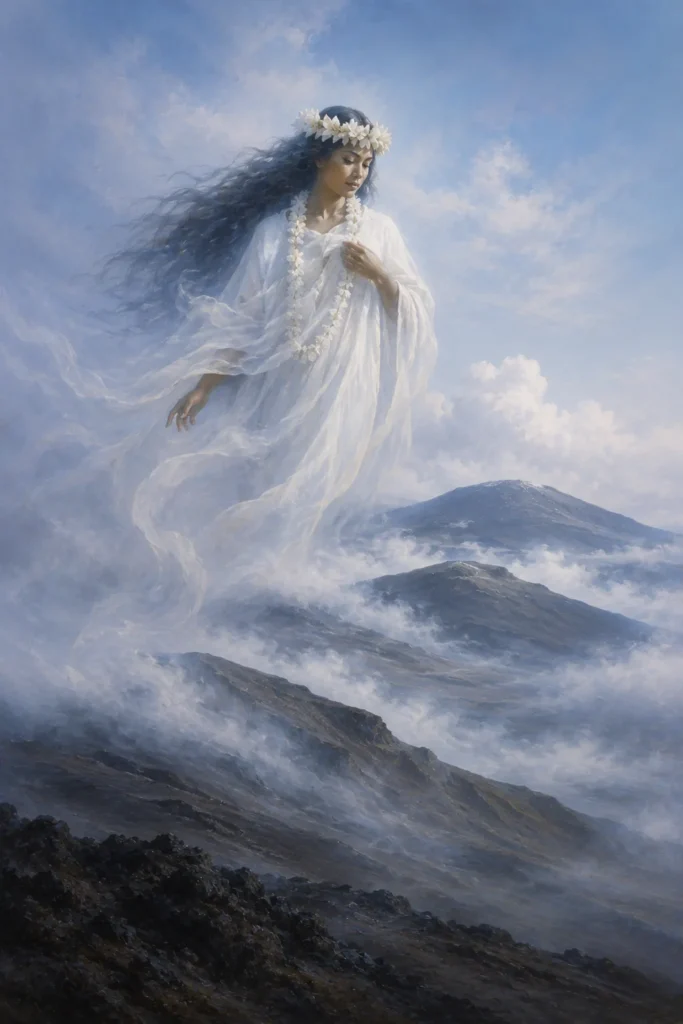
Hi’iaka is traditionally depicted as a young, beautiful woman adorned with flowers, herbs, and ferns. Her favorite flower is the red lehua blossom of the ohia tree (Metrosideros polymorpha), which grows in volcanic areas.
The ohia-lehua connection is mythologically central: ohia and lehua are lovers whom Pele transformed into a tree and its blossom; Hi’iaka mourns for them.
Pictorial representations of Hi’iaka usually show her dancing, wearing a lei (flower garland) of lehua blossoms. In the modern hula tradition, Hi’iaka appears in numerous mele (songs) and choreographies as a central point of reference.
Over the past five decades, the carving arts of the Maori and Hawaiians have experienced an impressive renaissance. Cliff Whiting, Robyn Kahukiwa, Wright Bowman, and Sam Ka’ai are among the artists who have developed both traditional forms and contemporary interpretations.
In their works the Atua, Hi’iaka among them, take on varied forms; their iconographic presence thus extends into contemporary art.
Polynesian art cannot be separated from its cosmological significance. Every spiral (koru), every ornament, and every line carries phenomenological meaning in religious studies, including where Hi’iaka is depicted with lehua blossoms and ferns. Roger Neich, Damian Skinner, and other art historians have systematically explored these layers of meaning.
The central myth surrounding Hi’iaka is her journey to Kaua’i to fetch Lohi’au, Pele’s beloved. Pele lies in a trance and sends Hi’iaka out.
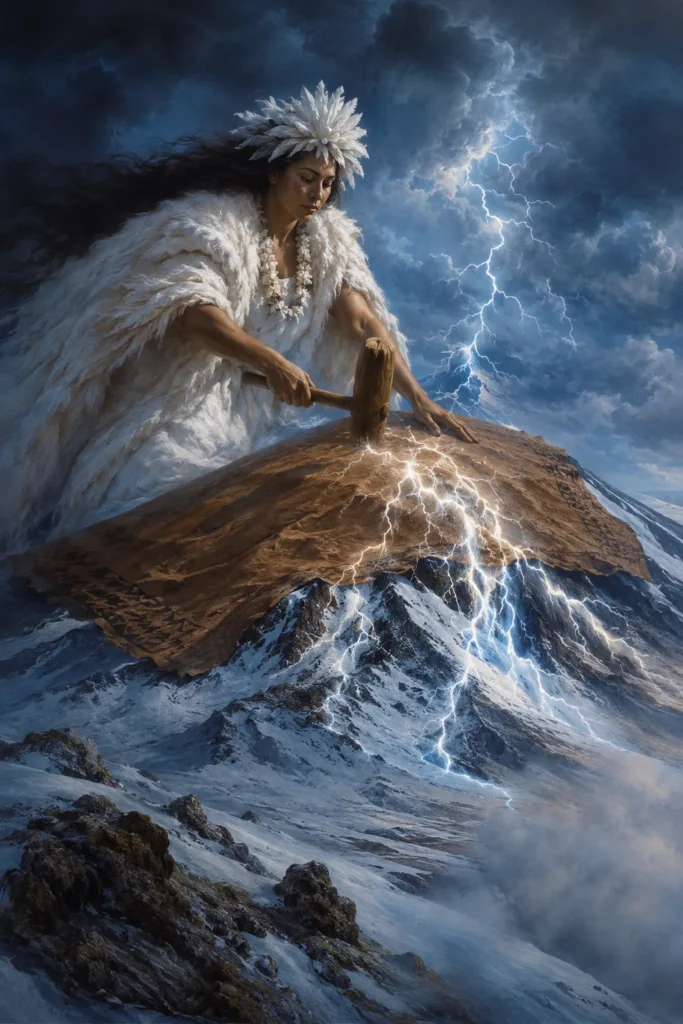
Hi’iaka receives three gifts: a skirt of lehua leaves, the power of lightning, and her friend and companion Wahine’oma’o. She promises to return in 40 days, and makes only one condition: that Pele must not touch her forest or her friend Hopoe.
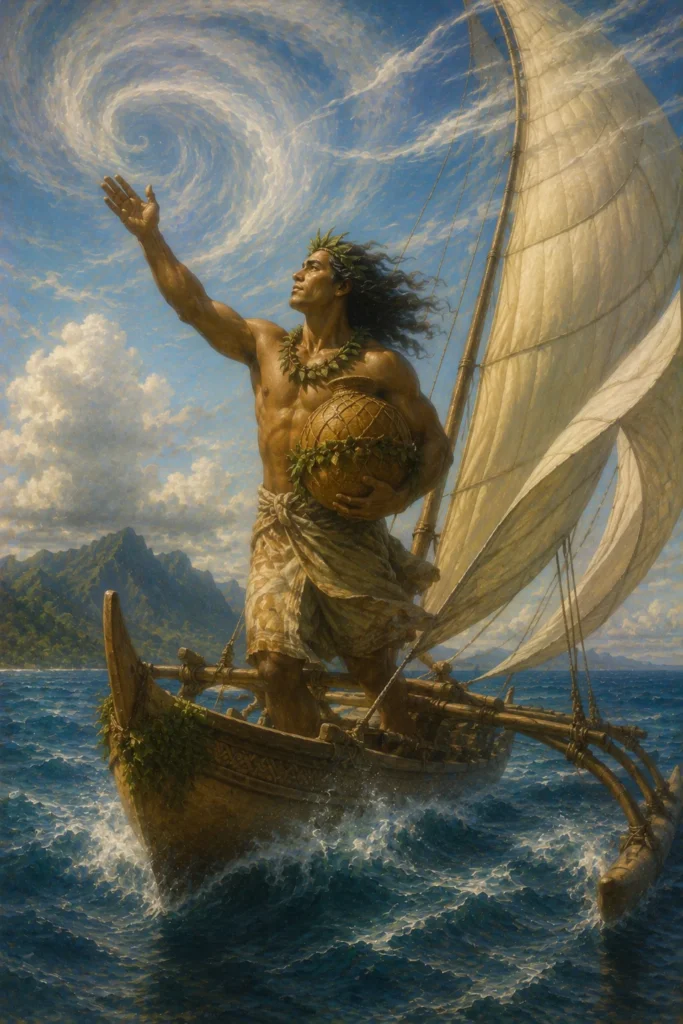
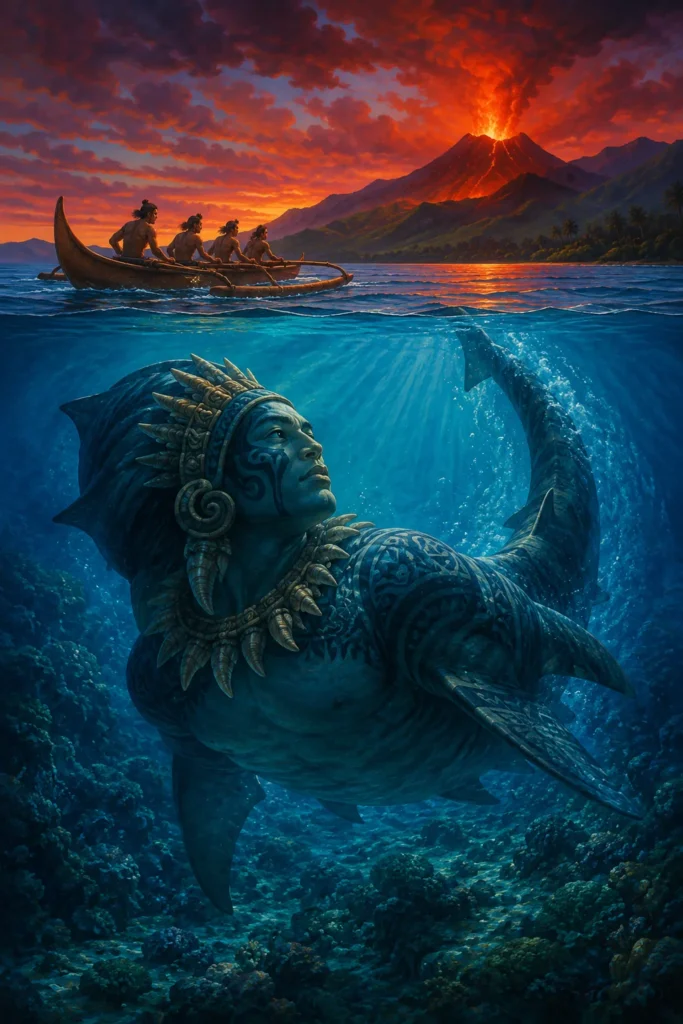
On the journey Hi’iaka experiences numerous adventures. She battles Mo’o (dragon women), heals the sick, raises Lohi’au from the dead, and overcomes stormy seas.
The journey takes longer than promised; Pele grows impatient and destroys Hi’iaka’s forest and Hopoe with lava flows. This complex narrative is preserved in several records, most importantly in Nathaniel Emerson (1915) and Ka’ili (2006).
The Hi’iaka-Pele Cycle should not be understood in religious-studies terms as a closed narrative, but rather as a network of stories that mutually illuminate each other and are weighted differently within individual tribal traditions.
This rhizomatic, network-like structure poses methodological challenges to research, but at the same time opens hermeneutic depth. Divergent versions of a story are not regarded as ‘wrong’ or ‘corrupted’, but as equally valid regional expressions.
The Hi’iaka-Pele Cycle is not merely preserved in memory but actively passed on: in karakia, in the speeches on the marae, and in teaching. It is therefore lived practice, not a decommissioned archive. The language programs for Te Reo Maori and Olelo Hawai’i have considerably strengthened this vitality over the past three decades.
Hi’iaka is traditionally regarded as one of the protective goddesses of hula. Another important hula goddess is Laka, who in some traditions is understood as one of the Hi’iaka sisters.
Hula is not ‘dance’ in the Western sense, but rather a comprehensive religious, physical, and poetic practice that combines mele, movements, costume, plants, and ancestral reference.
Hula halau (hula schools) traditionally honor Hi’iaka or Laka as their protective deity. Before every performance and every lesson a pule is spoken, and an altar is set up with plants and offerings. This practice is alive today and widespread at many hula halau worldwide.
The fact that Hi’iaka is venerated as patron of hula, a practice that unites dance, song, and ritual, reveals a fundamental characteristic of Maori and Hawaiian religion: ritual and everyday activity are interwoven.
Religious systems that sharply separate the sacred from the profane do not know this; here the references to the Atua permeate all of life. This religiosity anchored in the lifeworld itself is the subject of phenomenological religious studies by Mason Durie, Charles Royal, Lilikala Kame’eleihiwa, and other contemporary Polynesian scholars.
How closely ritual practice and everyday life are intertwined can also be read from language: terms such as mana, tapu, aroha, or hauora belong today to the general English of Aotearoa and are used outside religious contexts as well.
The fact that Maori theology has inscribed itself in everyday language in this way documents its deep cultural impact.
Hi’iaka is also a patron of healing in the Hawaiian tradition. Within the cycle itself she brings Lohi’au back to life twice. She knows the plants, karakia, and rites that save life. Traditional healers (Kahuna La’au Lapa’au) partly invoke Hi’iaka as the source of their knowledge.
From a religious-studies perspective, the connection of dance, healing, and knowledge of nature is typically Polynesian. These domains are not separate but form an integrated knowledge system. Hi’iaka represents this knowledge system as a whole. Mary Kawena Pukui (Nana I Ke Kumu, 1972) describes this connection in detail.
Polynesian religion remains alive above all at marae and heiau, those sites that serve at once as gathering places and cult sites. Every marae and every heiau possesses its own whakapapa, its own traditions, and its own Atua references, including in Hi’iaka’s role as healer those linked to healing rituals.
A visit to a marae begins with the powhiri, the ritual by which the tangata whenua receive their guests in a ceremonial welcome. This is not ceremonial folklore, but lived religious practice, and it ranks in religious studies among the best-documented Polynesian welcome rituals.
In the twentieth and twenty-first centuries the cult practice has changed considerably. Where the tohunga once stood at the center, the ritual is today often carried by the kaumatua, the elders, as well as the marae committees. From a sociology-of-religion perspective this shift is illuminating; Manuka Henare and Mason Durie discuss it in their research.
Hi’iaka is honored in the Hawaiian tradition through hula, through karakia, and through plant rituals. Those who enter the forest to gather lehua, maile vines, or awa (kava) first ask Hi’iaka’s permission. This practice has been partly revived today within the framework of cultural practices in Hawai’i.
Protective practices in Hi’iaka’s domain focus on correct behavior in nature and on the proper invocation before important performances or healing rituals. The concern is not with magical protective objects in the Western sense, but with the ritual cultivation of the relationship with the goddess.
On the subject of protection, a clarification is worthwhile from a religious-studies perspective: the Western understanding proceeds from the effective amulet, while the Polynesian proceeds from the cultivated relationship. Protection here is not based on magico-causal effect, but is structured relationally and ritually.
One who stands in relationship with an Atua such as Hi’iaka and maintains this relationship is considered ‘protected’, not because an object is effective, but because an existing relation is cosmologically binding. In the anthropology of religion this idea is discussed under the concept of ‘relational ontology’.
Protective practice is also a field where tradition and modernity meet. Smartphone applications with karakia, online guides to protection rituals, and virtual marae visits show that Polynesian religion is adopting new media for its practice. This modernization should not be understood as a dilution, but as an adaptable further development.
Hi’iaka can be compared with other dance and healing goddesses worldwide: Sarasvati (Vedic, music and knowledge), Terpsichore (Greek, dance), Brigid (Celtic, healing and poetry). The combination of dance, knowledge, and healing in a single figure is not uncommon.
More important than universals is the specifically Hawaiian form. Hi’iaka is not only the protective goddess of a practice, but the heroine of a concrete narrative cycle. This narrative density is a specific characteristic.
Such universal structures of religious experience have been systematically illuminated by Joseph Campbell and Mircea Eliade. As fundamental as their works are, they must nevertheless be rethought for the concrete Polynesian contexts without sliding into a pan-globalizing simplification. More recent Polynesian scholarship places great importance on this context-sensitive interpretation.
In global Indigenous Studies research, the parallels between Polynesian and other indigenous religions are systematically being elaborated. Linda Tuhiwai Smith set methodological standards with Decolonizing Methodologies (1999), whose impact reaches internationally beyond Polynesia.
Hi’iaka has been a central figure in the Hawaiian renaissance since the 1970s. The revival of hula as ritual practice, not as a tourist attraction, is closely linked to Hi’iaka. The Merrie Monarch Festival, the most important hula event in Hawai’i, is a place where the Hi’iaka tradition is annually renewed.
In literature and film Hi’iaka is less well known than Pele or Maui, but is gaining increasing visibility. Marie Alohalani Brown’s studies open a modern feminist reading. A deeper classification within the Polynesian religious family as a whole reveals the cultural specificity of the Hawaiian form.
In the international debate, Polynesian religion has increasingly gained recognition as an independent religious system and is no longer dismissed as mere ‘mythology‘ or ‘folklore‘. The fact that terms such as mana, tapu, mauri, and whakapapa have entered the specialist vocabulary of religious studies documents this change.
Their use, however, demands a contextual sensitivity that cannot be assumed without prior grounding.
How Polynesian religions are taken up in popular culture, in Disney productions, in tourism, in esoteric literature, is the subject of critical debate. Where does adequate mediation take place, and where is it simplified or distorted? These questions are being addressed forcefully and publicly in Aotearoa and Hawai’i.
Important contributions on Hi’iaka come from Nathaniel Emerson, Martha Beckwith, Mary Kawena Pukui, Marie Alohalani Brown, and Ka’ili. Emerson’s 1915 work is the classical record; Ka’ili’s 2006 edition is the most recent Hawaiian-internal treatment. Brown opens a feminist approach.
Hi’iaka is a living figure in a living tradition, sustained equally by hula halau, cultural organizations, and academic research.
The exchange between Polynesian-internal knowledge traditions and academic research today rests on a firm institutional foundation: the Royal Society of New Zealand (Te Aparangi), the Maori Studies Department of Auckland University, the University of Hawai’i at Manoa, and the Te Punga Tipu Foundation.
These institutions ensure that Polynesia is not only researched, but that the research is also carried by Polynesia itself.
A link to global religious studies is formed by those studies that use Polynesian theology as a case example for a non-Western religiosity. Such comparative work is methodologically demanding, but opens new perspectives on how religion is to be understood as a cultural phenomenon.
The best-known and most densely transmitted narrative surrounding Hi’iaka is her journey from the island of Hawai’i to Kaua’i, recorded in numerous versions of the Hawaiian tradition and published in several newspaper series in the late nineteenth and early twentieth centuries.
The trigger is a commission from her older sister, the volcano goddess Pele: Hi’iaka is to fetch the young man Lohi’au, whom Pele has desired in a dream, and bring him back within a fixed deadline. The condition is that she may not touch him herself.
The journey unfolds as a sequence of encounters with hostile spirit beings, lizard creatures known as mo’o, and place-bound powers, which Hi’iaka overcomes with ritual and combative competence. She is accompanied by her friend Wahine’oma’o and at times by the dancer Hopoe, whose later destruction by Pele becomes the turning point.
For while Hi’iaka is absent, Pele herself does not exceed the agreed deadline in the expected way, but reacts with mistrust and anger, sends lava over the forests Hi’iaka loves, and kills Hopoe. When Hi’iaka, released from her obligation by loss and broken trust, finally embraces Lohi’au after all, the conflict escalates entirely.
From a religious-studies perspective, the narrative is illuminating in several respects. It links topography and myth: almost every stopping point corresponds to a real place, a wahi pana, a named and meaningful location, so that the story simultaneously constitutes a kind of landscape memory.
It is also closely connected with hula, since Hi’iaka is regarded as the patron goddess of this dance and many songs of the tradition take up episodes of the journey.
Research, for example the editorial work on the versions by Ho’oulumahiehie and Nathaniel Emerson, points out that the written versions were editorially reworked and tailored for a changed audience. The tension between loyalty, commission, and personal feeling that the myth plays through is regarded by many interpreters as its actual core.

The cult of Hi’iaka is closely connected with hula as a ritual dance practice and with the volcanic landscapes of Hawai’i. Her veneration takes place traditionally within the halau hula, the dance schools, in which songs, plant knowledge, and genealogies are passed on to the sister of the volcano goddess Pele.
The cult survived the period of missionary activity within dance, song, and family traditions.
Related key terms: Hi’iaka Hawaii Hula Pele Lohi’au Ohia Lehua Hopoe.
iWell Guard connects with the cultural-historical tradition of wearable protective objects, in the tradition of Polynesia / Maori and many other cultures worldwide. 41 layers, real gold, platinum, silver, crafted in Germany. 30-day return policy.
Individual experiences may vary. Not a medical device. No healing promises.