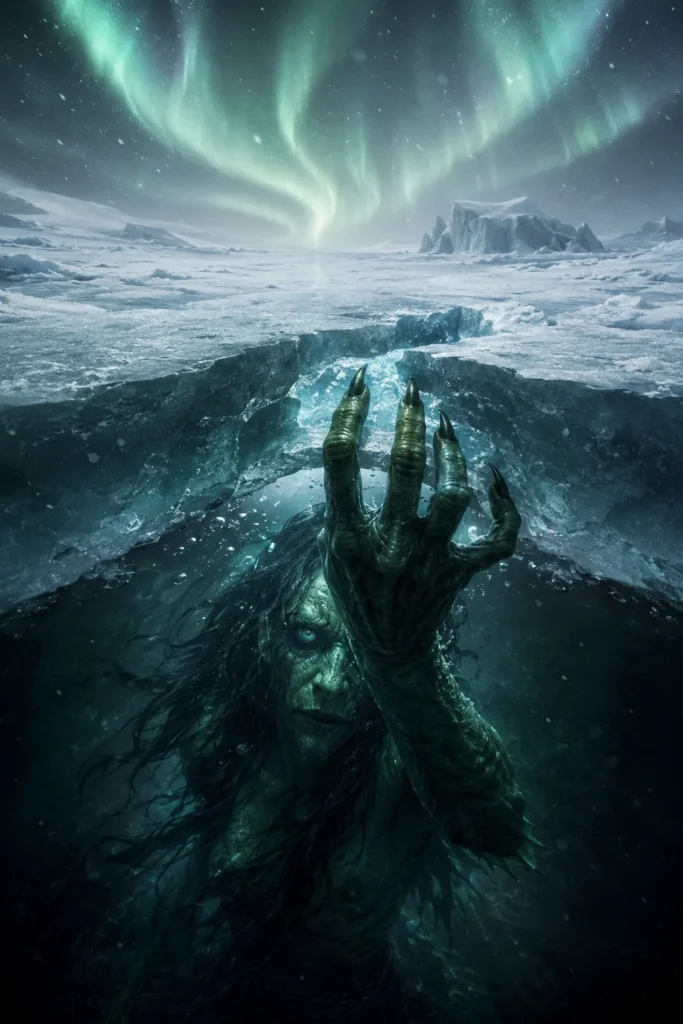
Qailertetang: Sedna's Weather Companion and Guardian of Animals
By Ralf Ittermann · last reviewed on
In the Baffin Inuit tradition, Qailertetang is the companion of the mistress of the sea Sedna, regarded as a weather spirit and guardian of animals.
Franz Boas described her in his records at the end of the 19th century, thereby making her accessible to religious studies research. In terms of religious studies, she is an instructive case of a regionally rooted helper figure.

Profile: Qailertetang
Qailertetang: the most important aspects at a glance. The following fields summarise origin, effect, appearance, function, protection and parallels.
Qailertetang comes from the tradition of the Baffin Inuit and is regarded there as a companion of the sea mistress Sedna. Franz Boas described her at the end of the 19th century in The Central Eskimo (1888). Almost everything known about her rests on this one ethnographic description.
As Sedna’s companion, Qailertetang watches over the animals and is responsible for the surrounding weather. Shamans seeking help turned, in some records, to Sedna and additionally to Qailertetang.
In Boas’s records she appears as a large, strong figure who lives with Sedna in a house on the sea floor. She is hardly depicted visually and rarely appears in contemporary Inuit art.
Her most important task is weather regulation: on Sedna’s behalf she can deliberately send storm or clear skies. She also guards the entrance to Sedna’s house and decides whether a shaman is admitted. In part she takes over the household chores of the mutilated Sedna.
Qailertetang protects the sea mistress from unwanted visits. Whoever did not approach her respectfully enough was turned away or suffered harm in some records from Iglulik. In the autumn festival the actions of the disguised person served to appease the sea powers and to secure hunting success.
Qailertetang belongs to the auxiliary and companion figures of great deities. Comparable are Iris as messenger of Hera in the Greek tradition, Saraswati as companion of greater deities in some Hindu traditions and the Akkas of the Sami tradition as daughters of Madderakka.
Classification and brief profile
Qailertetang is a rather less well-known but significant figure of the Inuit pantheon. In the Baffin tradition she appears as Sedna’s companion, while at the same time having her own functions as a weather spirit and guardian of animals.
In terms of religious studies, she is an example of the non-systematic diversity of Inuit religious history, in which numerous more differentiated figures exist alongside the great ones.
Franz Boas first systematically described her figure in The Central Eskimo (1888). Later mentions rely on his records without fundamentally changing the picture. Qailertetang remains a regionally rooted figure whose significance outside the Baffin region is less pronounced and whose treatment in religious studies is not yet complete.
Her function as a weather spirit adds a more personalized dimension, tied to Sedna, to the overarching role of Sila. She is not the weather itself, but an agency that can regulate the weather on Sedna’s behalf.
In terms of the phenomenology of religion, this mediating function is a phenomenon in its own right and distinguishes her from both Sila and Sedna.
Regionally rooted in the Baffin tradition, Qailertetang has been examined in recent research using expanded methodological approaches that combine ethnographic precision, linguistic source criticism, and a comparative perspective.
Since this rather little-known figure has not yet been fully studied, the participation of the Inuit knowledge community is especially important, as it is today itself part of this research and corrects older, partly colonially shaped Western attributions.
A complementary perspective is provided by the religious-sociological question of Qailertetang’s function within the social order of the traditional Inuit community.
As a weather spirit and guardian of animals acting on Sedna’s behalf, she stands for a religious structure that was not separated from social practice but closely interwoven with it. This interweaving forms a distinct field of research within the anthropology of religion, which Frédéric Laugrand and Jarich Oosten in particular have studied systematically.
Name and etymology
The name Qailertetang has not been conclusively explained linguistically. Boas and later researchers suspect a meaning in the area of weather or animal husbandry.
The ending -tetang may be related to verbs of watching or carrying, which would fit the function of guardian. In terms of religious studies, this linguistic uncertainty is a methodological problem, because etymology often gives clues to the historical depth of a figure.
In the Baffin sources, the name appears in several slight variations, such as Qailertaq or Qailerteq. This variation is linguistically normal and not significant for religious studies, but it should be noted when working with the sources in order to avoid confusion.
The fact that the name has no transparent etymology is remarkable in comparison with other Inuit deity names. In terms of religious studies, this may point to an older, possibly pre-Inuit linguistic layer, although this thesis cannot be substantiated. Caution in matters of religious history is methodologically advisable here.
In the broader discourse of comparative religious studies, Qailertetang fits into the pattern of circumpolar religious topography.
The fact that this topography remains structurally stable across thousands of kilometers is, in terms of the phenomenology of religion, among the most remarkable findings of the discipline and remains a subject of ongoing scholarly discussion to this day.
Description and functions
In Boas’s records, Qailertetang is described as a large, powerful figure who lives together with Sedna in a house at the bottom of the sea.
She partly takes over Sedna’s household work, which is restricted by her mutilation. In terms of the phenomenology of religion, this complementary function is interesting and a phenomenon in its own right.
Her primary function, however, is weather regulation. While Sedna controls the animals, Qailertetang, as Sedna’s companion, watches over the animals and is also responsible for the surrounding weather. In some records, shamans seeking help had to address not only Sedna but also Qailertetang. In terms of the phenomenology of religion, this dual addressing is a phenomenon in its own right.
Iconographically, she is hardly depicted. In contemporary Inuit art she appears rarely, which reflects her lesser cultural prominence compared to Sedna. In terms of religious studies, this asymmetry of visual presence is a finding in its own right and reflects the hierarchy of religious attention.
Qailertetang in shamanic practice
According to Boas’s records, shamans who undertook the journey to Sedna often first encountered Qailertetang. She was the keeper of the entrance to Sedna’s house and decided whether the shaman was admitted. This gatekeeper function gives her a distinct ritual significance and makes her the threshold guardian of the otherworld.
In some Iglulik records she is described as very strict. Anyone who approached her without sufficient respect was turned away or suffered harm.
This strictness mirrors her role as a protective spirit who guards the mistress of the sea against unwelcome visits. In terms of the phenomenology of religion, this function is a phenomenon in its own right.
The role of antechamber keeper is, in terms of the phenomenology of religion, a pattern in its own right that appears in many shamanic traditions. Before the meeting with the highest power, there regularly stands a lower but dangerous agency that tests the worthiness of the petitioner. This pattern is well documented in religious studies.
Qailertetang and the weather
Qailertetang’s weather function differs from the global Sila function through its personal, directed form. While Sila is an atmospheric, all-encompassing entity, Qailertetang is an agent who can deliberately send storm or clarity. In the Baffin sources she is held responsible for sudden storms and for ritual calming.
This doubling of atmospheric and personalized weather regulation is, in terms of the phenomenology of religion, a pattern in its own right.
It shows that Inuit religion does not bundle all functions into a single weather agency, but distributes different aspects of the weather across different figures. In terms of the phenomenology of religion, this distribution is typical of non-systematic theologies.
In terms of religious studies, a more precise investigation of the relationship between Qailertetang and Sila would be desirable, but it is hindered by the state of the sources. Both terms appear in different records, without a systematic theology having been worked out. In terms of religious studies, this research gap is remarkable.
Qailertetang in the annual festival
In The Central Eskimo, Boas describes an annual festival in which a shaman dressed up as Qailertetang and symbolically moved through the camp. This festival took place in late autumn and was connected with preparation for winter. In terms of the phenomenology of religion, it is a phenomenon in its own right.
The disguised shaman performed ritual acts intended to recall the taboos of the coming winter. Women and men were symbolically separated and reunited, which was meant to stabilize the social order for the harsh winter season.
In terms of religious studies, this is one of the few clearly documented festivals of the Inuit tradition and is particularly informative from a religious-sociological standpoint.
The Qailertetang festival has no direct parallel in other Inuit regions, which underscores its regional specificity. In Iglulik there were comparable Tivajut festivals, but these were connected with other spirits. In terms of religious studies, this regional differentiation is an important methodological indication of the diversity of Inuit religion.
Comparison with other helper figures
In terms of religious studies, Qailertetang belongs to the class of helper and companion figures of great deities. Comparable are Iris of the Greek tradition as messenger of Hera, Saraswati in some Hindu traditions as companion of greater deities, or the Akkas of the Sami tradition as daughters of Madderakka.
The asymmetry between the main and the companion figure is, in terms of the phenomenology of religion, typical and not a weakening of the companion figure but its specific position. Qailertetang is not a weak Sedna, but an independent agency with her own field of function. This functional independence must be recognized in religious studies.
This multilayered quality of the Inuit divine world corresponds to the non-systematic nature of its theology. There is no polytheism in the Greek sense with clearly delimited areas of responsibility, but rather a web of relationships.
In terms of the phenomenology of religion, this relational theology is a model in its own right and clearly distinguishes the Inuit tradition from hierarchical polytheisms.
Mission and oblivion
Qailertetang is one of the figures that have largely fallen into oblivion through missionary activity and modernization. Because she was closely bound to shamanic practice and had no economically dominant role, her presence declined with the disappearance of public shamanism.
In contemporary Inuit culture she is known only to a small group of people interested in culture.
This asymmetry of memory compared to Sedna is, in terms of the phenomenology of religion, typical: the great figures survive cultural ruptures better than the specialized companion figures. From a religious-sociological standpoint, this is a finding in its own right.
A revival of Qailertetang within indigenous religious discourse has not yet taken place to the extent that would correspond to her place in religious history. In terms of religious studies, this gap in research and memory is remarkable and should be addressed.
Research and current state
Research on Qailertetang draws primarily on Boas’s records. Later researchers have mentioned her without devoting a separate study to her. A more in-depth treatment in religious studies would be desirable, especially in comparison with other weather spirits of the circumpolar region.
Pamela Stern and Birgitte Sonne have pointed to the significance of Qailertetang in their overarching works. A monograph is still lacking. In terms of religious studies, this research gap is symptomatic of the marginalization of regionally rooted helper figures in the great syntheses.
In religious studies discussion, Qailertetang is an example of how important regional differentiation is in Inuit religious history. A pan-Inuit theology drawn from the great figures alone would be reductive and would overlook important regional specifics. In terms of religious studies, this methodological insight is fundamental.
Lexicon cross-references
Qailertetang in the Sedna festival according to Franz Boas
The most important single source for Qailertetang is the description of an autumn festival that Franz Boas gave in his study The Central Eskimo (1888) on the basis of his stay on Baffin Island in 1883 and 1884. Boas describes a ritual that was connected with the change of season and in which two disguised persons appear who embody mythical beings.
One of these figures is Qailertetang, described as a being who, in this tradition, appears as companion or attendant of the sea goddess whom Boas recorded under the name Sedna.
The disguised person moves ponderously, wears a mask and women’s clothing, and is identified with Qailertetang. In the course of the ritual, actions are performed that serve to appease the powers of the sea and to secure hunting success for the coming dark season.
Boas’s account is so significant because it represents one of the few ritually documented rituals of the central Arctic from the late 19th century. At the same time, it must be read with caution: at the time of recording, Boas was at the beginning of his career, working under difficult conditions and relying on interpreters. Later research has noted that his rendering of names and roles does not in every case capture the inner view of the narrators. In Boas’s material, Qailertetang appears above all as a ritual figure and companion being, not as an independently narrated deity with an elaborated cycle of myths. What is known about her depends almost entirely on this one ethnographic description.
A source-poor figure: what is established and what is not
Qailertetang belongs to the beings of Inuit tradition about whom only very little is reliably known, and a serious account must explicitly name this thinness of the source situation.
Essentially, the knowledge rests on Franz Boas and a few later mentions, which for their part largely rely on Boas. There is no broad tradition confirmed by several independent collectors.
It appears established that Qailertetang was known in a particular region of the central Canadian Arctic, especially in the area around Baffin Island, as a being connected with the sea goddess and with seasonal rituals.
Almost everything else remains uncertain: the gender is given differently, the precise function fluctuates between companion of the sea goddess, weather being, and protective spirit, and whether Qailertetang had her own mythology beyond the ritual described by Boas cannot be clarified.
This situation is typical of many beings of Inuit religion. Unlike the mythologies of Eurasia, which are supported by extensive textual traditions, the knowledge here hangs on a few ethnographic snapshots, which moreover arose during a phase of profound colonial upheaval. In terms of religious studies, Qailertetang is therefore an example of how strongly the state of transmission determines the image of a being. Anyone who asserts more about her than Boas provides is moving into the realm of speculation. The appropriate stance is to name precisely the little that is known and to leave the great gaps standing as gaps, instead of filling them with analogies from other regions.
Literature (selection)
- Franz Boas: The Central Eskimo (Washington 1888)
- Knud Rasmussen: Intellectual Culture of the Iglulik Eskimos (Copenhagen 1929)
- Daniel Merkur: Powers Which We Do Not Know (Moscow ID 1991)
- Frédéric Laugrand and Jarich Oosten: Inuit Shamanism and Christianity (Montreal 2010)
- Birgitte Sonne: Worldviews of the Greenlanders. An Inuit Arctic Perspective (Fairbanks 2017)
- Pamela Stern: Historical Dictionary of the Inuit (Lanham 2013)
Related key terms: Qailertetang Baffin Inuit weather spirit Sedna’s companion gatekeeper Tivajut Boas.
iWell Guard and traditions of protection
iWell Guard ties in with the cultural-historical tradition of portable objects of protection, in the tradition of the Inuit and many other cultures worldwide. 41 layers, solid gold, platinum, silver, made in Germany. 30-day right of return.
Personal experiences may vary. Not a medical device. No promise of healing.