Qalupalik, the warner beneath the pack ice
By Ralf Ittermann · last reviewed on
Qalupalik is a demon of Inuit tradition.
A green-skinned sea being that drags unsupervised children beneath the ice. The account places this being beneath the pack ice, watching for children left unsupervised near the edge.
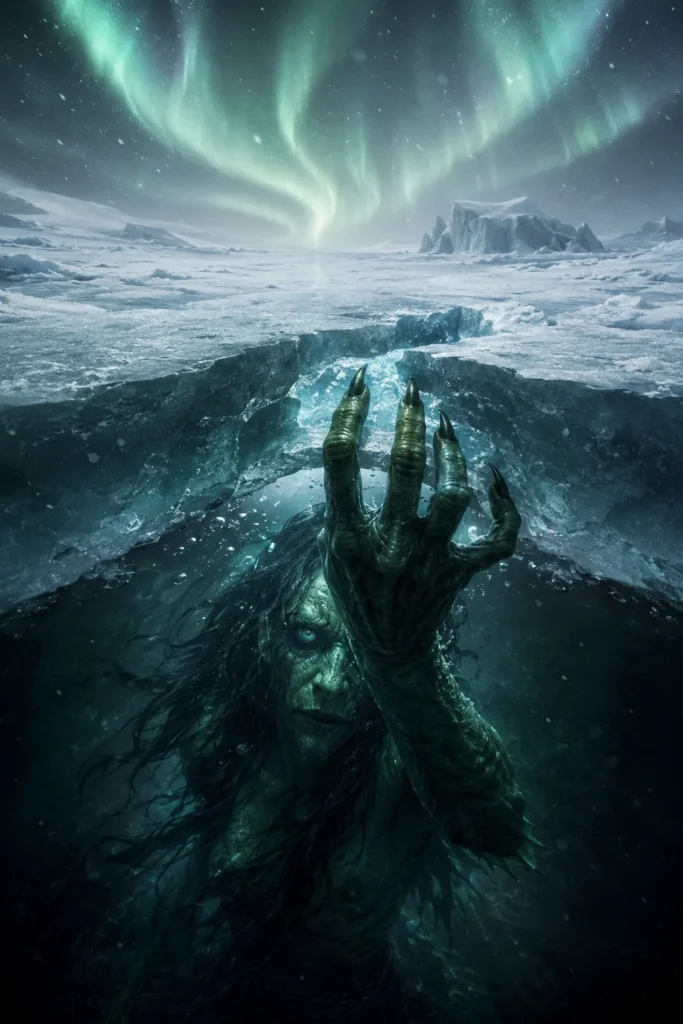
According to tradition, the Qalupalik lurks beneath the sea ice of Canada and Greenland: green-skinned, slimy, with long nails. It is said to seize children and carry them into the depths in an amauti.
Franz Boas recorded the tale in 1888. It keeps children away from the brittle ice edge.
Type: sea being and cautionary figure to frighten children
Origin: oral Inuit tradition
Texts: Franz Boas, 1888
Period: recorded in writing since 1888
Appearance: green-skinned, long nails
Source Context
Period of the Texts
Passed down orally, recorded in writing by Franz Boas in 1888.
Area of Diffusion
Arctic coasts and pack-ice areas in Canada and Greenland.
Sources
Documented ethnographically since Boas; the exact title reference of his record is still considered to require verification.
Name and variants
Inuktitut: Qalupalik is the singular, Qallupilluit the plural of the same figure.
Appearance and Effect
Appearance
Human-like, green slimy skin, long hair and webbed fingers.
Effect
It lurks beneath the ice and seizes unsupervised children, allegedly to stay young.
Profile: Qalupalik
The key aspects at a glance.
Cautionary figure of Arctic Inuit tradition, recorded in writing since 1888.
Unsupervised children at the edge of the sea ice.
Green, slimy skin, long hair, long nails.
Educational warning against the life-threatening ice edge.
Supervision and vigilance rather than banishment or a warding ritual.
The sea mistress Sedna, her father Anguta, and the Slavic Rusalka from related water traditions.
Franz Boas and the Motif of the Brittle Ice Edge
The name appears in the singular as Qalupalik, in the plural as Qallupilluit. Franz Boas documented the narrative tradition in 1888. Beneath the ice, it lies in wait for children and carries them off in an amauti.
According to popular belief, it needs the children to stay young. What matters is the educational function: it warns of the life-threatening spot.
From Warning Call to Children's Book
The Qalupalik became widely known through children’s books, above all The Qalupalik by Elisha Kilabuk and Joy Ang, published by Inhabit Media in 2011.
In terms of religious studies, it is a pedagogical cautionary figure, not a cult being but a figure to frighten children.
Supervision Rather than Banishment
At its core is not a banishment formula but a rule: children should not go to the ice edge unsupervised. In Kilabuk’s version, it can be outwitted by an alert child.
Amulet, bells and salt are considered protective signs.
Arctic Sea Beings and Figures That Frighten Children
The Qalupalik belongs to the Arctic sphere around the sea mistress Sedna and her father Anguta. The Slavic Rusalka is closely related to it. Among the water-spirit beings, it remains without a direct counterpart.
Frequently Asked Questions about the Qalupalik
What purpose does the Qalupalik story serve?
It keeps children away from the dangerous ice edge.
Can one escape it?
In some versions, yes, for an alert child.
Literature (selection)
Further standard works in the bibliography.
Anyone searching for the Qalupalik in Inuit legends or asking about a sea being of the Arctic means the same figure: a green-skinned warner at the brittle ice edge.