Ahuizotl, the water dog with the deadly grasping hand
By Ralf Ittermann · last reviewed on
Ahuizotl is a demon of Aztec tradition.
Dog-like water being with a deadly grasping hand on its tail. The entry places the fear of the deadly grasping hand within the Aztec world of belief.
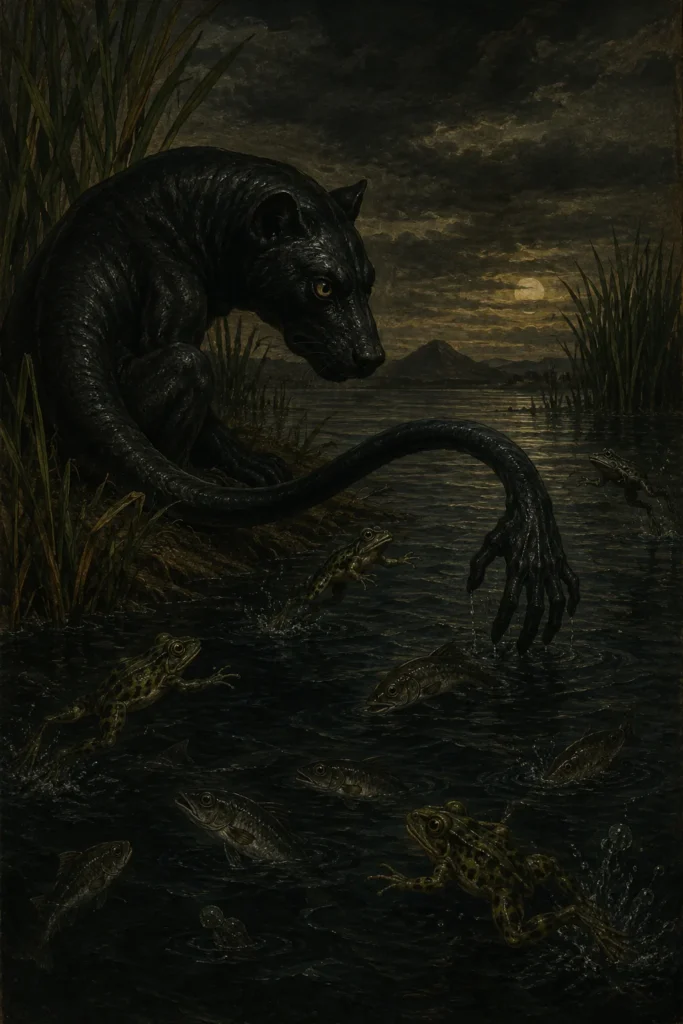
The Ahuizotl is the water demon of the Aztecs, a dog-sized being with smooth black fur and a human-like hand at the end of its tail. It lurks in deep waters around Tenochtitlan, drags people down with this grasping hand and drowns them.
Popularly it was called water dog, since its name is composed of the Nahuatl words for water and thorn. At the same time, the Ahuizotl was considered a tool of the rain gods, choosing its own victims: according to tradition, those who drowned entered the water paradise of Tlalocan.
Type: Aztec water demon, dog-like being with a grasping hand on its tail
Origin: central Mexico, lakes and waters around Tenochtitlan
Texts: Sahagún’s Florentine Codex and pictorial glyphs of the 16th century
Period: 16th century, Aztec tradition
Appearance: dog-sized, smooth black animal with a human-like hand at the end of its tail
Textual history
Period of the Texts
16th century: The Ahuizotl is documented in the natural-history eleventh book of the Florentine Codex and in pictorial glyphs such as the Codex Telleriano-Remensis and the Codex Mendoza.
Area of Diffusion
Central Mexico, especially the lakes and waters around Tenochtitlan, the heart of the Aztec empire.
Sources
Good: Sahagún’s natural history, codex depictions and surviving stone sculptures document the being.
Name and variants
Nahuatl: atl means water, huitztli thorn: Āhuitzotl is interpreted as a spiny water being. Popularly it was simply called water dog.
Appearance
Appearance
The core feature of the Ahuizotl is the human-like grasping hand at the end of its curled tail, with which it seizes its prey. Its fur is black, smooth and water-repellent and bristles when it climbs out, which explains the interpretation as spiny. As a lure it imitates the whimpering of an infant or makes frogs and fish leap up en masse at the surface to draw fishermen to the shore.
Effect
The Ahuizotl is an active man-catcher at the water’s edge. It lurks in deep waters, pulls victims down with the tail hand, drowns them and tears out their eyes, nails and teeth with sharp fangs. The body drifted back to the surface after a few days; fishermen feared capsized boats and sometimes offered the being part of their catch to appease it.
Profile: Ahuizotl
The key aspects of the water demon at a glance.
Aztec water demon of Nahua folk belief, documented in Sahagún’s Florentine Codex and in pictorial glyphs of the 16th century.
People at the edge of deep waters, especially fishermen and the curious who follow its luring calls.
Dog-sized, smooth black animal with pointed ears and a human-like hand at the end of its tail.
Drowning and robbing: It pulls victims into the depths and robs the drowned of their eyes, nails and teeth.
Avoiding deep spots, respect for the priests of the rain gods and a share of the catch as appeasement.
The water goddess Chalchiuhtlicue and the horse-like Kelpie as drowning parallels elsewhere.
From spiny water being to enforcer of the water gods
The name āhuitzotl is composed of the Nahuatl atl, water, and huitztli, thorn, and is interpreted as spiny water being; popularly it was simply called water dog. The Florentine Codex of Bernardino de Sahagún describes in the natural-history eleventh book a small, smooth, black, rubbery-looking animal with pointed ears, a long tail and a hand at the end of its tail, as well as hands like a raccoon or monkey. It lives in deep bodies of water and pulls anyone who comes to the edge of its territory into the depths with its tail hand.
Religiously, the Ahuizotl is closely linked to Chalchiuhtlicue and her companion Tlaloc: in some versions it guards the lakes and fish, in others it is sent out by the water gods to gather particular people. The drowned victims were considered chosen and reached the water paradise of Tlalocan, whether out of special worthiness or as punishment for offences such as hoarding jade, which actually belonged to the gods. Pictorial glyphs record the being in the Codex Telleriano-Remensis and the Codex Mendoza.
From ruler's name to cryptid legend
The Aztec ruler Ahuítzotl, who reigned from 1486 to 1502, bore the name and the being as an emblem, recorded in the Codex Mendoza; the anti-Porfirian magazine El Hijo del Ahuizote also took up the name. In modern cryptozoology and popular culture, in bestiaries, series and games, the Ahuizotl appears as a water-dog creature and, in German-speaking regions, as an Aztec water demon.
From a religious-studies perspective, the Ahuizotl links the concrete danger of the water, drowning and capsizing, with cosmology and the concept of the afterlife: violent death is reinterpreted as religious election into Tlalocan, and the recovery of the body is a priestly right. Zoologically, the being is associated with real animals such as the prehensile-tailed water opossum or the otter, suggesting a fusion of natural observation and myth. Functionally, it is a classic warning figure that reinforces rules of behaviour at the water’s edge with fear of death.
Priestly right and quiet appeasement
An Ahuizotl victim was considered chosen by the water gods, their death leading into Tlalocan. The body was too sacred for ordinary touch, so only priests of the rain gods were allowed to recover it; if a layperson touched it, they themselves risked becoming the next victim or falling ill. Burial in a house surrounded by water is recorded in tradition. Fishermen appeased the being by leaving it part of their catch. Tradition knows no effective means of defence in the sense of a weapon; protection lay in avoiding deep spots and respecting the priests’ rules. In folk custom, a drawn Protective Circle on the shore, purifying salt against the harmful powers of water, and a worn amulet are considered general protective signs for staying near deep waters.
Water-catching beings in comparison
The Ahuizotl acts on behalf of the water gods Tlaloc and Chalchiuhtlicue, to whose realm Tlalocan it guides the victims. As a water being that pulls people into the depths and takes something from them, it is structurally close to the Japanese Kappa. Other drowning water beings include the Germanic Nix, the Scottish Kelpie and the Chilean Nguruvilu.
Frequently asked questions about the Ahuizotl
How does the Ahuizotl kill?
It pulls people into deep water with the hand at the end of its tail, drowns them and then robs them of their eyes, nails and teeth. The body drifted back to the surface after a few days.
How does it lure its victims?
It imitates the crying of an infant or makes frogs and fish leap to the surface to draw fishermen and the curious to the dangerous water’s edge.
What happened to the victims?
Those who drowned were considered chosen by the water gods and entered the water paradise of Tlalocan. Only priests of the rain gods were allowed to recover the body.
Further links
Further reading:
- Chalchiuhtlicue – the Aztec water goddess acting on behalf of Tlaloc
- Kelpie, Nguruvilu – other drowning water beings
- Protective Circle, Salt, Amulet – traditional protective means
- Protection Compass – overview of protective means
Literature (selection)
Further standard works in the bibliography.
The Ahuizotl is known as a being of the water depths: as an Aztec water demon, it drags people beneath the surface with the hand on its tail and steals the eyes, nails and teeth of the drowned.