Babi, demon of the Egyptian tradition
By Ralf Ittermann · last reviewed on
Babi is a demon of the Egyptian tradition.
A baboon-shaped underworld demon between violence, potency and purification.
Babi
Babi is a lesser-known but distinctive figure of Egyptian demonology. His connection to sexual potency, violence and purification makes him an ambivalent threshold figure.
Unlike Bes or Taweret, he does not act protectively in everyday life but appears among the dead, as a threat, as an examiner and as a potent force without which the solar barque could not sail.
His baboon-shaped iconography stands in direct proximity to Thoth, who likewise has a baboon aspect, though there as the god of wisdom and writing. Babi is the demonic side of the baboon motif: archaic, wild, sexualized. Both figures show how fluidly the Egyptian tradition distributes its animal forms between the divine and the demonic.
Babi at a glance
Type: Underworld demon, threshold being
Origin: The underworld; in some texts the “firstborn of Osiris”
Texts: Pyramid Texts, Coffin Texts, Book of the Dead
Period: Old Kingdom to New Kingdom (rarer thereafter)
Distribution: Egypt
Warding off: Invocations in the Book of the Dead, invocation of Thoth, purification formulas
Classification
Period of the texts
The earliest evidence is found in the Pyramid Texts of the Old Kingdom; his fuller characterization develops in the Coffin Texts of the Middle Kingdom and in the Book of the Dead of the New Kingdom.
In later periods Babi is named independently less often, but he remains present as a figure in the netherworld books.
Area of distribution
The evidence comes from the Egyptian core region, especially from burial contexts. Whether the baboon demons in magical papyri from Egypt go back to Babi is hard to say in individual cases; he is, however, not translated into Hellenistic transmission traditions.
State of the sources
The most important sources are Coffin Texts and Book of the Dead spells, in which Babi appears as a guardian, a threatener and at the same time a potentially helpful force.
The evidence is heterogeneous: he may appear dangerous in one spell and supportive in the next. This ambivalence is not a contradiction but part of his nature.
Name and variants
Egyptian: Bꜣbꜣ or Bꜣbj, “Bab(i).”
Other spellings: Baba.
Title: “Firstborn of Osiris” in some Book of the Dead spells, a familial integration that is not, however, carried through systematically.
Babi is one of the few Egyptian figures in which name and function are closely linked: the name has an archaic, almost pre-lexical quality in its sound. Etymologically it is associated with terms for “baboon” and “firstborn,” though the derivation has not been conclusively established.
Characteristics
Appearance
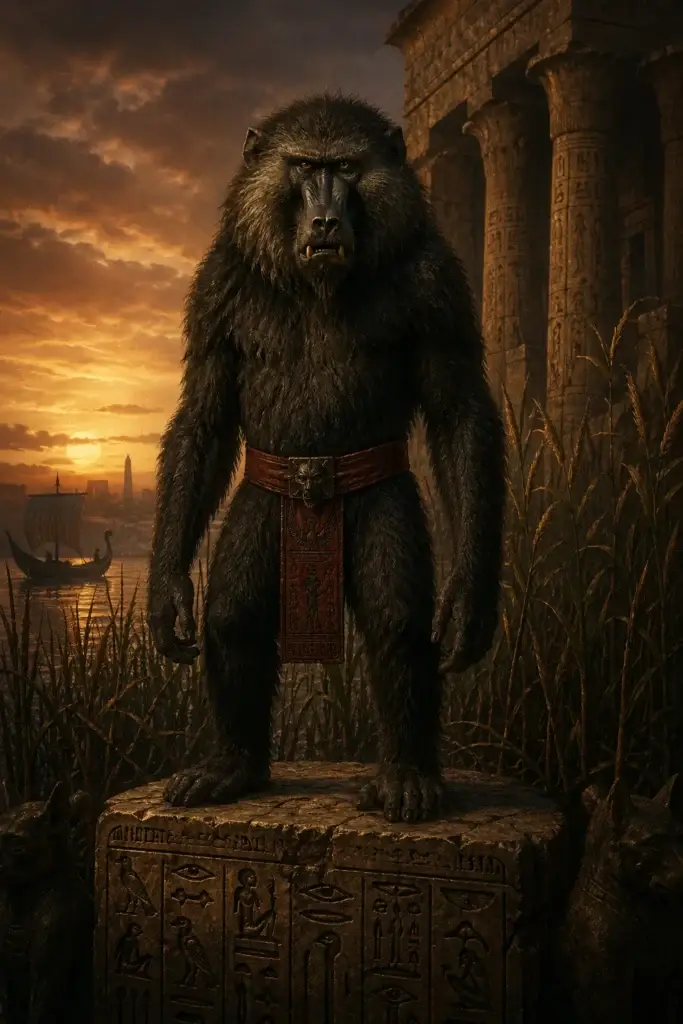
Babi appears as a baboon, often upright and with an erect phallus. This iconography is deliberate: it points to the potent, unbound, dangerous side of baboon imagery. Depictions show him with red lips or bloody teeth as a sign of his flesh-eating aspect.
Behavior
In some texts Babi attacks the deceased, gnaws at their limbs or blocks their passage. In other texts his phallus becomes the mast of the solar barque; without him there is no solar voyage. This dual function makes him a typical threshold being: dangerous and necessary at once.
Sphere of action
The underworld and its transitions. Babi has no interest in the living; his activity begins after death. Specifically: on the path through the afterlife, during examinations, at gates, at the transition to the solar barque.
Mythological origin
His title “firstborn of Osiris” suggests a connection to Osirian theology without working it out systematically. More plausible than genealogy is his role as a primordial aspect: Babi is what remains of the primal forces after the world was ordered, and what can be put to ritual use.
Profile: Babi
The most important aspects of Babi at a glance. You will find the detailed treatment of name, description, warding off and parallels in the following sections.
An ancient baboon figure of the underworld, with the occasional title “firstborn of Osiris.” No closed genealogy.
The deceased on the path through the afterlife. Babi does not act upon the living but during the examinations of the underworld and at the transition to the solar barque.
A baboon, upright, often with an erect phallus and bloody lips. Depicted as archaic and deliberately untamed.
He may attack the deceased or block their path; but he can also supply indispensable potency for the solar voyage. Two-faced, dangerous and functional at the same time.
Invocations in the Book of the Dead that call Babi by name and confine him within his limits. Invocation of Thoth in his divine baboon aspect has a stabilizing effect.
Thoth in his baboon aspect (the divine side of the same image); chthonic animal demons in Greco-Roman magic; trickster figures as threshold beings worldwide.
Protective practice
Rituals for warding off
Babi is not warded off in everyday life but in the funerary cult. Grave furnishings contained Book of the Dead spells that name Babi explicitly and keep him at a distance.
At the same time his power was put to use: some spells expressly ask that his phallus, as the mast of the barque, remain stable.
Invocations
The Book of the Dead spells concerning Babi often take the form: “I am the one who knows Babi, I know his name, he shall have no power over me.” This is a typically Egyptian apotropaism through knowledge of the name: whoever knows the name controls the being.
Amulets and protective symbols
Specific Babi amulets are rare. Protective effect was achieved above all through the Book of the Dead furnishings of the tomb. General amulets (the Udjat eye, the heart scarab) also served against Babi without naming him explicitly.
Babi, parallels in other cultures
Egyptian parallel: Thoth: Within Egypt, Thoth in his baboon aspect is the most important parallel. Thoth stands for wisdom, writing and cosmic order; Babi for violence, potency and the archaic. Both share the animal form and thus represent the two sides of the baboon motif in the Egyptian world of symbols.
Greco-Roman magic: In late antique magical papyri from Egypt, demonic baboon names appear in invocations. Whether these go back directly to Babi is hard to determine in individual cases, but the pattern is recognizably related.
The trickster motif worldwide: The combination of dangerousness and ritual necessity, of disorder and indispensability, is found in many cultures as a trickster motif: for example Loki (Germanic), Coyote (Indigenous North American traditions), Eshu (Yoruba). Babi belongs structurally to this family.
Babi in the Pyramid Texts and Coffin Texts
Babi, also attested in the form Baba, is an ancient Egyptian deity in baboon or ape form who already appears in the Pyramid Texts of the Old Kingdom.
He is thus among the early-attested beings of the Egyptian pantheon. In these early texts Babi is a powerful, distinctly dangerous figure whose strength is to be made serviceable to the deceased king.
A recurring motif emphasizes Babi’s raw, unbridled strength, especially his sexual potency and his association with aggression. Several spells highlight his virility; in the Coffin Texts of the Middle Kingdom the idea appears that Babi’s phallus is the bolt or the gate of heaven, which links his power to access to cosmic realms.
Babi is also regarded as a being that lives on the entrails or the blood of the deceased and that lurks in the darkness.
In terms of the history of religion, Babi is an example of those ambivalent powers of early Egyptian religion whose dangerousness was not denied but made usable for one’s own purposes.
The deceased or the ritual text claims Babi’s power instead of merely fearing it. The baboon form points to real observations: in Egypt the baboon was regarded as an aggressive, loud, sexually conspicuous animal.
Babi embodies the threatening side of this animal symbolism, while other baboon deities, for example in connection with Thoth, represent an entirely different, wisdom-related side.
Babi in the judgment of the dead and in the tale of the contest of the gods
Babi also appears in the scene of the judgment of the dead, though in a peculiar role.
In Spell 125 of the Book of the Dead, which describes the judgment in the Hall of the Two Truths, Babi is mentioned at one point; the deceased declares that he wishes to keep Babi away or to subdue him.
Here Babi is regarded as a threat who could deny the deceased entry into the afterlife or become dangerous to him, for instance by delivering him to a destructive power.
Another well-known mention is found in the mythological tale of the contest between Horus and Seth for kingship, as transmitted on a New Kingdom papyrus. In this tale Babi appears during the assembly of the gods and grossly insults the sun god Re, whereupon Re withdraws in offense.
Babi appears here as an uncontrolled, offensive being who violates the dignity of the highest gods without this having serious consequences for him. The episode underscores his character as an embodiment of the excessive and the provocative.
These two appearances show Babi at the edges of the ordered world of the gods: dangerous in the judgment of the dead, unruly in the assembly of the gods.
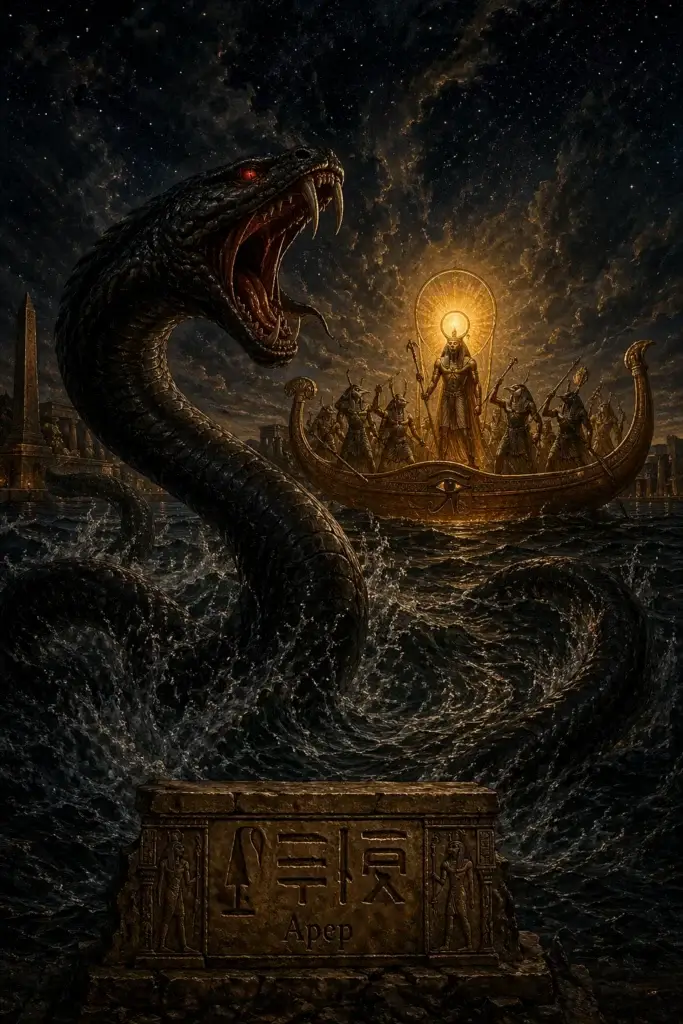
He is not an adversary of order in the sense of a cosmic enemy like the serpent Apophis, but he stands for a force that does not quite submit to order.
Scholarship therefore interprets Babi as a figure who personifies the threatening and the instinctual, which Egyptian religion knew and named but relegated to the margins.
The ambivalent protective function and the later transmission
Despite his threatening character, Babi could also be called upon positively, and precisely in this lies his distinctiveness in the history of religion. His raw strength and his association with virility and potency made him a being whose protection one might seek for the deceased in the afterlife, for instance to ward off certain dangers.
In some texts Babi appears as a being who preserves the deceased from certain dangers in the afterlife or who is connected with control over darkness and dangerous waters.
This dual usability, threatening and protective at once, is typical of many Egyptian powers and is no contradiction in Egyptian thought. A dangerous being whose power one draws to one’s own side is an effective protector precisely because of its dangerousness.
Throughout the whole of Egyptian history Babi remains a rather marginal but continuously attested deity. Unlike the great gods, he received, as far as the sources reveal, no developed temple cult with its own priesthood.
His presence is largely confined to the religious texts and to individual mentions. In the Late Period and in Greco-Roman times he recedes.
Scholarship has so far treated Babi less extensively than the central deities of the pantheon, which is due to the thin source material scattered over the millennia.
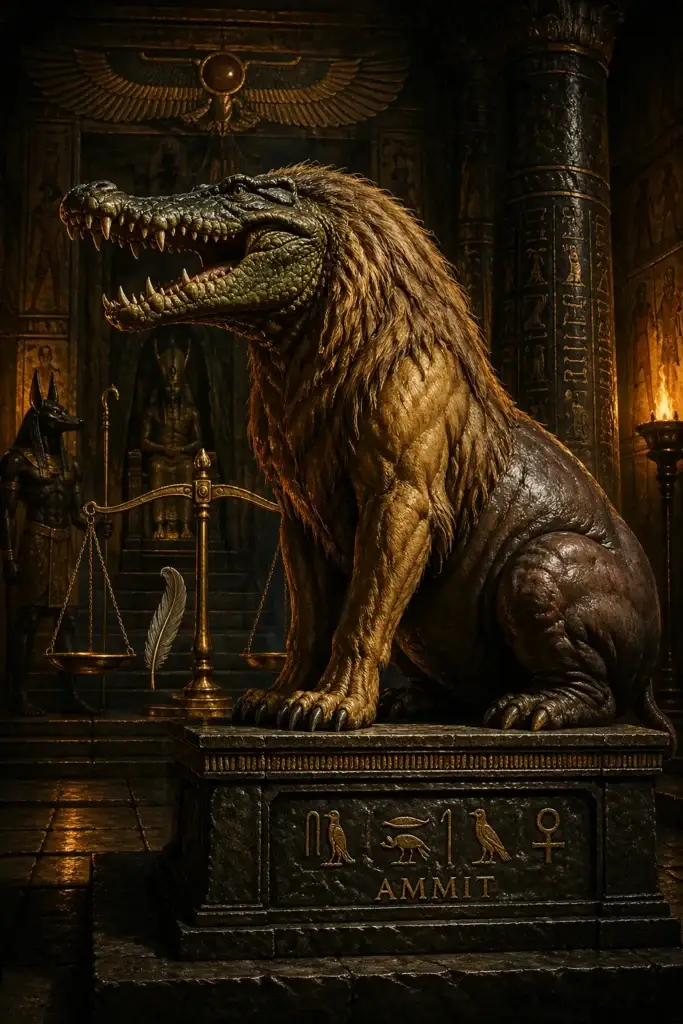
He remains interesting above all as an example of the Egyptian ability to capture the instinctual and the dangerous in a figure of its own, without suppressing it, and at the same time to make it usable. Related dangerous and ambivalent beings are Ammit and Nehebkau.
Further links
Sources and literature
Further standard works in the literature index.
The protective practice described here is a religious-studies classification of historical traditions. iWell Guard ties into this cultural-historical line of wearable protective objects and represents a contemporary form of it. More about the iWell Guard →