The Scarab: Egyptian Amulet of Protection and Rebirth
By Ralf Ittermann · last reviewed on
The scarab is an Egyptian protective amulet that was also placed in the grave as an amulet of rebirth, in order to guarantee renewal.
The scarab, the image of the dung beetle, was one of the most common amulets of ancient Egypt. It stood for the rising sun, for self-generation, and for rebirth, and it accompanied people in life as in death.
Classification
The scarab is the pictorial rendering of a beetle, the so-called dung beetle. In ancient Egypt this beetle became one of the most important religious symbols.
It appears as an amulet, as a seal, and as a pictorial sign. Over millennia it belonged to the natural furnishings of Egyptian life. Hardly any other amulet form has survived in such numbers.
The meaning of the scarab revolves around the concepts of sun, renewal, and rebirth. The beetle was associated with the course of the sun and with the idea of an ever-new beginning.
From this its protective meaning was derived. A sign of renewal protected by securing the continuation of life. The scarab thus stood for a confident basic attitude.
In religious studies the scarab is a model example of how an everyday observation of nature can become a religious symbol. The Egyptians observed the behavior of the beetle closely. Out of what they saw, they developed a rich interpretation. The scarab shows how closely natural science and religion were connected in Egypt.
As an amulet, the scarab belongs among the apotropaia. It was worn by the living and placed with the dead. A special form, the heart scarab, had its own, very important task in the cult of the dead.
The scarab is thus a sign that encompassed the entire course of life and the afterlife. Its distribution across all epochs underscores its rank.
The Beetle and the God Khepri
The scarab was closely connected with a god, with Khepri. Khepri was a manifestation of the sun god, namely the sun in the morning, just as it rises.
His name can be linked to the concept of coming into being and of becoming. Khepri was thus the god of the beginning. He embodied the moment in which the sun newly appears in the sky.
The connection of beetle and sun god rested on an observation. The dung beetle rolls a ball of dung before it. The Egyptians saw in this ball an image of the solar disk.
Just as the beetle moved its ball across the ground, so the god moved the sun across the sky. Out of this similarity a deep religious interpretation arose.
Khepri was frequently depicted with a scarab as a head, or shown entirely as a beetle. In this form he appears in the temples and in the books of the afterlife.
The beetle was thus not merely an animal, but the visible sign of a god. Whoever looked upon a scarab saw at the same time an image of the rising sun.
From this connection the high significance of the scarab is explained. It was bound to the course of the sun, and the course of the sun was for the Egyptians the great model of every renewal.
Each morning the sun rose anew, and each morning it overcame the night. The scarab carried this reliable hope within itself. It was the sign that every ending is followed by a new beginning.
The Image of Self-Generation
A further observation reinforced the meaning of the beetle. The dung beetle lays its eggs inside a ball of dung. From this ball the young beetles later crawl forth.
The Egyptians, who did not know the process in all its details, saw in it a wonder. It seemed as if the beetle arose out of itself.
This supposed self-generation made the scarab an emblem of great depth. It embodied life that emerges out of itself, without visible origin. This was precisely what the Egyptians also ascribed to the creator god. The god who brought the world into existence was himself uncreated. The beetle became the image of this mystery.
For this reason the scarab was linked with the idea of rebirth. If new beetles emerged from the seemingly lifeless ball, then new life from death was also conceivable. The scarab thus stood for the transition from ending to new beginning. It was a sign of hope beyond death.
This interpretation explains why the scarab became so important in the cult of the dead. It was not a sign of passing away, but one of becoming.
Whoever encountered it was reminded of the possibility of a new beginning. This message fit precisely with the Egyptian conceptions of continued existence. The scarab made the hope for rebirth vivid and tangible.
Form and Material
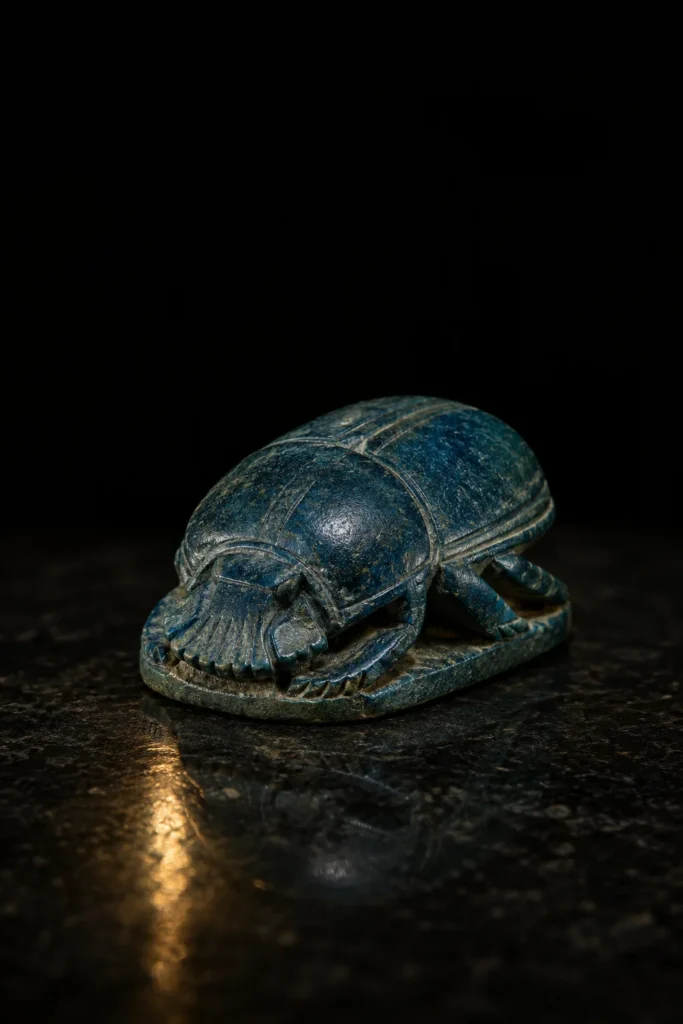
The scarab as an amulet renders the beetle in a stylized form. The upper side shows the arched body with head, thorax, and wing covers. These parts are set off from one another by clear lines. The underside is mostly flat. It was precisely this flat underside that was important for many uses.
The most common material for scarabs was steatite, a soft stone that was easy to carve. After working it, the stone was covered with a glaze that gave it a hard, shiny surface.
In addition, scarabs were made of faience, of precious stones, and of gold. The range extended from the simple mass-produced piece to the precious work of the goldsmith.
The sizes of scarabs vary greatly. There are tiny pieces of a few millimeters and large examples of considerable dimensions. Small scarabs served as pendants and as seals. Large scarabs were made for special occasions and bore longer inscriptions. Both forms conveyed the same basic meaning.
Production in molds permitted manufacture in great numbers. As a result, the scarab was affordable and accessible to many people. It was not a rare luxury object, but an everyday companion. The enormous quantity of surviving pieces confirms this. The scarab is among the most frequently found objects from ancient Egypt of any kind.
The Scarab as a Seal
The flat underside of the scarab had a practical function. It was provided with signs, patterns, or inscriptions. When this surface was pressed into soft clay, it left an impression. The scarab was thus at the same time a seal. Protective sign and utilitarian object coincided in a single object.
As a seal, the scarab fulfilled important tasks. It marked property, closed containers, and authenticated documents. The underside could bear a name, a title, or a short formula. Often these were names of kings or sayings that asked for good fortune and protection. Thus every impression was at the same time a protective sign.
Many scarabs were set in rings or threaded onto a wire so that they could be turned. In this way the underside could be used for sealing and afterward concealed again. The amulet was thus constantly at hand and at the same time worn. The scarab combined personal protection with daily use.
This double function is instructive. It shows that the protective was not separated from the world of daily life in Egypt.
An object could serve everyday life and carry religious meaning at the same time. The scarab was tool and amulet in one. It was precisely this close connection that made it such a widespread object.
The Heart Scarab
A special form of the scarab was the heart scarab. It is a larger piece that played its own, very important role in the cult of the dead. The heart scarab was placed on the chest of the mummy, at the position of the heart. It was thereby directly connected with the most important organ.
The heart was regarded by the Egyptians as the seat of the mind, of the conscience, and of character.
In the judgment of the dead, the heart of the deceased was placed on a scale and weighed against the feather of truth. On this judgment the fate of the dead depended. The heart had to be light, free of grave guilt.
The heart scarab bore an inscription that came from the Egyptian Book of the Dead. In this saying the heart is addressed and asked not to testify against the deceased in the judgment.
The scarab was meant to prevent the heart from incriminating the dead. It was thus a protection at a decisive point on the path through the afterlife.
The heart scarab shows the protective function of the beetle in a particularly pointed form. It warded off no external danger, but secured the deceased in the moment of judgment.
Form and task were here closely connected. The scarab, the sign of renewal, was meant to keep the way into a new life open for the dead.
Protection for the Living and the Dead
The scarab accompanied people in every situation of life. The living wore it as a pendant, as a seal ring, and as a component of jewelry.
It was meant to bring good fortune, to secure life, and to ward off misfortune. Its connection with the rising sun made it a sign of daily renewal. Whoever wore it placed himself under this reliable model.
In death the scarab accompanied the deceased further. Besides the heart scarab, numerous smaller scarabs were laid into the mummy wrappings and distributed in the coffins.
They were meant to secure rebirth for the dead. The burial chamber was thus filled with signs of renewal. The scarab carried the hope for a continued life with it into the grave.
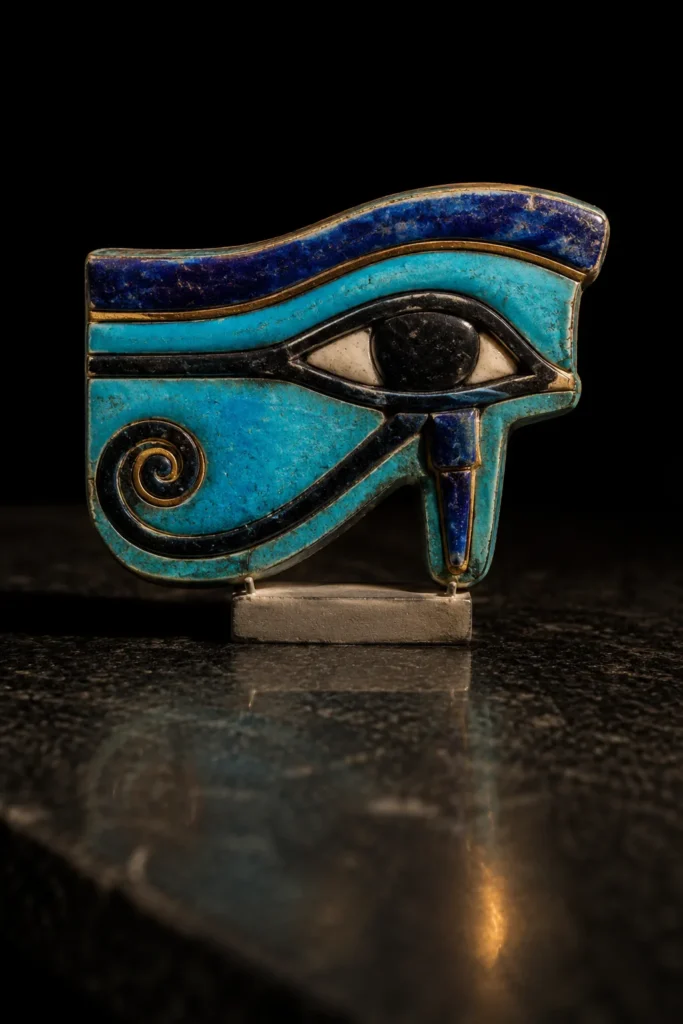
In this twofold use the scarab resembles the ankh and the wedjat. They too served the living and the dead. Egyptian protective practice did not strictly separate these two domains. What secured life was also meant to secure the transition into the afterlife. The scarab is a clear example of this continuous conception.
The protection that the scarab offered was thus comprehensive. It was not directed against a single enemy, but supported life as a whole. Its promise was renewal. As long as the sun rose anew each morning, the hope for a new beginning also remained. The scarab kept this hope visible and tangible.
Spread Beyond Egypt
The scarab did not remain confined to the Nile valley. Through trade and through the exchange of cultures, it reached the entire Mediterranean region. In the Levant, on Cyprus, and in the Aegean world, scarabs have been found in great numbers. The Egyptian sign was thus known far beyond its homeland.
The Phoenicians in particular took up the scarab. They produced their own scarabs and spread them further along their trade routes. By this means the form reached as far as the western Mediterranean. The scarab thus became a protective sign that many peoples knew and used.
In the course of this migration the meaning in part changed. The exact Egyptian understanding was not known everywhere.
The scarab could be understood as a general sign of good fortune and protection, detached from Khepri and from the course of the sun. The form was preserved, the interpretation adapted itself. This is a frequent occurrence with migrating protective signs.
The wide distribution of the scarab shows its appeal. A sign that promised renewal and protection was comprehensible across cultural boundaries. The scarab thus belongs among the most successful amulet forms of the ancient world. Its history extends far beyond Egypt.
Reception Today
The scarab is to this day a well-known sign. It is immediately associated with ancient Egypt and appears in countless representations that refer to this culture. Its clear form and its rich meaning have kept it alive across the millennia. It belongs among the established images that represent Egypt in the world.
As a piece of jewelry, the scarab remains widespread. It is worn as a pendant, as a ring, and as a brooch.
For many people it stands generally for good fortune, for protection, or for a connection to the world of the pharaohs. The exact ancient Egyptian interpretation mostly recedes into the background. The basic notion of protection and a good beginning, however, remains.
In museums the scarab is richly represented. The great Egyptian collections preserve entire series of scarabs, from the tiny seal to the large heart scarab. They attest to the enormous distribution of this amulet form. Whoever views such a collection recognizes how natural a part of Egyptian life the scarab was.
The scarab is thus a protective sign of great permanence. Out of the observation of an inconspicuous beetle, the Egyptians developed an emblem for sun, self-generation, and rebirth. This emblem accompanied them across millennia. To this day the scarab has held its place among the best-known signs of protection and good fortune in the world.
Literature (Selection)
Related key terms: scarab Khepri dung beetle heart scarab rebirth apotropaion seal Book of the Dead ancient Egypt.
iWell Guard and Protective Traditions
iWell Guard stands within the cultural-historical line of portable protective objects, to which the scarab also belongs. A modern companion for people who live with protective symbols: made in Germany, 41 layers of solid gold, platinum, and silver, with a 30-day right of return.
Personal experiences may vary. Not a medical device. No healing promise.