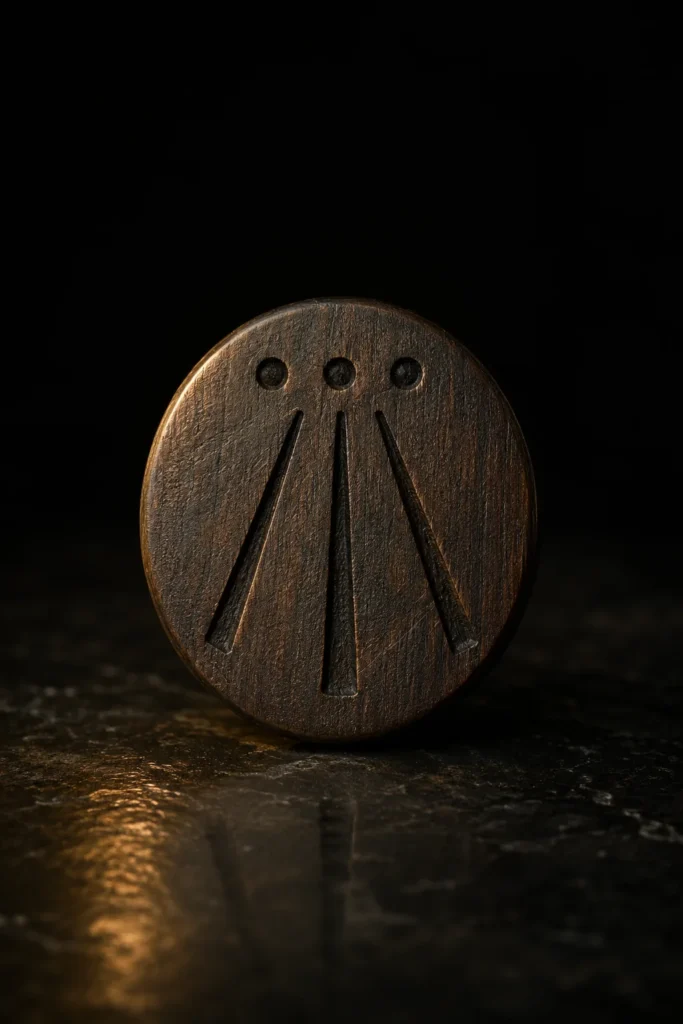
The Awen is a sign of three rays, often with three dots above them. It stands for poetic inspiration. The word is old, the symbol itself first arose in the 18th century.
The Awen is a sign from the Celtic tradition, more precisely from the Welsh tradition. It consists of three rays or lines that diverge downwards, and usually of three dots above them.
The word Awen comes from Welsh. It denotes poetic inspiration, the creative impulse, as it were the breath or the wind from which poetry and insight arise.
The Awen is therefore first and foremost a sign of inspiration and of creative power. It is not a defensive protective amulet in the narrower sense, but a sign of meaning.
In present-day use, however, the Awen also carries a protective and blessing meaning. In the modern Druidic movements it is a sign of spiritual connectedness that is also worn as a sign of protection and blessing.
In classifying the Awen, a precise distinction is important. The word Awen is old and reaches back into the medieval Welsh tradition. The symbol of three rays, by contrast, is much younger.
This distinction between the old word and the young symbol runs through the entire account. It is especially important because the Awen is often presented sweepingly as an old Celtic sign.
The term Awen is old. It is attested in medieval Welsh literature, where it denotes poetic inspiration.
The Welsh tradition knew the figure of the Bard, the poet and singer. Poetry was regarded not as a mere craft, but as a gift that flowed to the poet. This inflowing gift is the Awen.
The Awen was thus understood as a power that comes from outside or from above. The poet received it; he did not produce it from himself alone. It was, as it were, a breath that filled him.
In the Welsh tales the Awen is connected with particular figures. Well known is the story of a cauldron from which inspiration is gained, and of a poet who is thereby made a seer and singer.
The word Awen thus belongs to a genuine, old tradition. Welsh culture knew the term and the conception of the inflowing poetic inspiration.
What the old tradition does not know, however, is a particular drawn symbol for the Awen. The word is old, the sign of three rays is not.
The drawn Awen symbol consists of three rays. They diverge from top to bottom, and above them usually stand three dots. Often the whole is enclosed by one or more circles.
This symbol is not old. It arose in the late 18th century. Its creator was the Welshman Edward Williams, who became known under the name Iolo Morganwg.
Iolo Morganwg was a poet and collector who was passionately devoted to the Welsh heritage. He founded an assembly of Welsh poets and developed a symbolic world of its own for this movement.
For this modern Druidic movement Iolo Morganwg created the Awen symbol of the three rays. It was a new creation, even though it drew on old terms and conceptions.
Iolo Morganwg passed off as old much that he had himself created or elaborated. Scholarship later clarified this. The Awen symbol belongs to these creations of the 18th century.
A clear distinction is therefore to be drawn. The word Awen is medieval and genuine. The drawn symbol of three rays is a creation of the late 18th century. Both belong together, but they are of different ages.
To understand the Awen symbol, it is worth looking at the time of its origin. The late 18th century was a period in which interest in the ancient cultures of the British Isles grew strongly.
In Wales a movement arose that sought to cultivate and revive the Welsh heritage, the Welsh language and Welsh poetry. Iolo Morganwg was one of the driving figures of this movement.
He founded a solemn assembly of poets that drew on old conceptions of Bards and Druids. For this assembly he created customs, rituals and signs.
The Awen symbol belongs to this creation. From the outset it was a sign of the modern Druidic movement, not a handed-down old symbol.
This movement was no mere fraud. It was borne by genuine enthusiasm for the Welsh heritage, and it contributed much to the cultivation of Welsh culture. Some of its customs continue to this day.
Yet it was a movement of the modern age that wished both to revive the old and to create something new. The Awen symbol is a product of this movement, and it is honest to name it as such.
The Awen symbol of three rays is connected with an interpretation that expounds its components. This interpretation belongs to the modern Druidic tradition.
The three rays are interpreted in various ways. One widespread interpretation understands them as three rays of light or as three aspects of divine working.
The three dots above the rays are likewise interpreted, for example as points from which the light issues, or as emblems of fundamental forces. The enclosing circles too carry a meaning.
Overall the Awen symbol stands for inspiration, for the creative impulse and for the harmonious interplay of forces. It is a sign of spiritual creative power.
These interpretations are thoughtful and meaningful for the adherents of the Druidic movement. They belong to the living present of the sign.
It is important to know, however, that these interpretations are part of the modern Druidic tradition. They are not old, handed-down knowledge, but belong to the symbolic world that has been elaborated since the 18th century.
The Awen is first and foremost a sign of inspiration, not a defensive protective amulet. In present-day use, however, it also carries a protective and blessing meaning.
In the modern Druidic movements the Awen is used as a central sign of belief and recognition. Whoever wears it professes adherence to this spiritual tradition.
In this context the Awen gains a relation to protection. It places its wearer under the sign of inspiration and spiritual connectedness and is regarded as a sign of blessing and of good power.
The Awen thus belongs less among the defensive apotropaia than among the signs of blessing. It does not ward off through terror and does not catch a glance, but places one under a good, creative power.
In this respect the Awen resembles other signs of blessing that do not ward off but consecrate and place one under a good omen. Its protection is the connection with the inspiring power.
For a precise account it is important to classify the Awen correctly. It is a modern sign of inspiration and of spiritual blessing that has also acquired a protective meaning in the Druidic movement.
The Awen symbol is closely connected with the modern Druidic movement. This movement invokes the ancient Druids, the priests and scholars of the Celtic world.
Little is known with certainty about the historical Druids. They left no writings of their own. Knowledge of them rests on a few reports from outside, above all from ancient literature.
The modern Druidic movement arose only in the modern age, from the 18th century onwards. It is not an unbroken continuation of the ancient Druids, but a modern creation that invokes this ancient figure.
Within this movement there are various currents. Some understand themselves as a cultural movement for the cultivation of the Celtic heritage, others as a religious or spiritual community.
In all these currents the Awen is a unifying sign. It is, as it were, the emblem of the modern Druidic movement, similar to the cross for Christianity.
The Awen is thus a good example of a sign that was created by a modern movement and holds a central place within that movement. It is young, but firmly anchored within its tradition.
With the Awen, the distinction between old word and young sign is the decisive point. Both belong together, yet they are of different ages, and this should be stated clearly.
The word Awen is old. It is attested in medieval Welsh literature, where it denotes poetic inspiration. The conception of the inflowing creative gift is genuine and handed down.
The drawn symbol of three rays, by contrast, is young. It arose in the late 18th century as a creation of Iolo Morganwg for the modern Druidic movement.
This distinction is no minor point. In today’s image the Awen symbol is often presented as an age-old Celtic or Druidic sign. This presentation is not tenable in fact.
What is correct, rather, is this: an old word and an old conception were joined in the 18th century with a newly created symbol. The symbol draws on what is old, but is itself a new creation.
An honest account of the Awen names both. It honours the old word and the old conception of inspiration, and it classifies the symbol clearly as a creation of the modern age. In this way the Awen is neither artificially aged nor diminished in its meaning.

The Awen symbol is widespread today. It appears as a jewellery pendant, as a tattoo and as a motif in design. It is especially popular in connection with Celtic culture and with spirituality.
In the modern Druidic movement the Awen has its firm place as a central sign. There it stands for inspiration, for spiritual connectedness and for adherence to this tradition.
Beyond the Druidic movement the Awen is worn as a general sign of inspiration, of creativity and of a nature-connected spirituality. In this use its precise origin is often not known.
As with many signs, the factual classification is important with the Awen too. The word is old, the sign is young. Whoever presents the Awen should know and name this difference.
This classification does not diminish the Awen. It remains a striking sign with a beautiful, clear form and a moving meaning, that of creative inspiration.
The Awen is thus an instructive example. It shows how a modern movement can draw on an old word and from it create a new, living sign that is widely worn today.
Related key terms: Awen inspiration Iolo Morganwg Druids Wales three rays Bard Gorsedd.
iWell Guard stands in the cultural-historical line of wearable protective objects to which the Awen also belongs. A modern companion for people who live with protective symbols: made in Germany, 41 layers of solid gold, platinum and silver, with a 30-day right of return.
Personal experiences may vary. Not a medical device. No healing promise.