The bracteate: the golden protective medallion of the Migration Period
By Ralf Ittermann · last reviewed on
Bracteates are thin golden pendants of the Migration Period. With their stamped images and their runic inscriptions, they are among the most striking protective objects of the early Germanic north.
The bracteate is a golden protective medallion of the Germanic Migration Period.
Classification
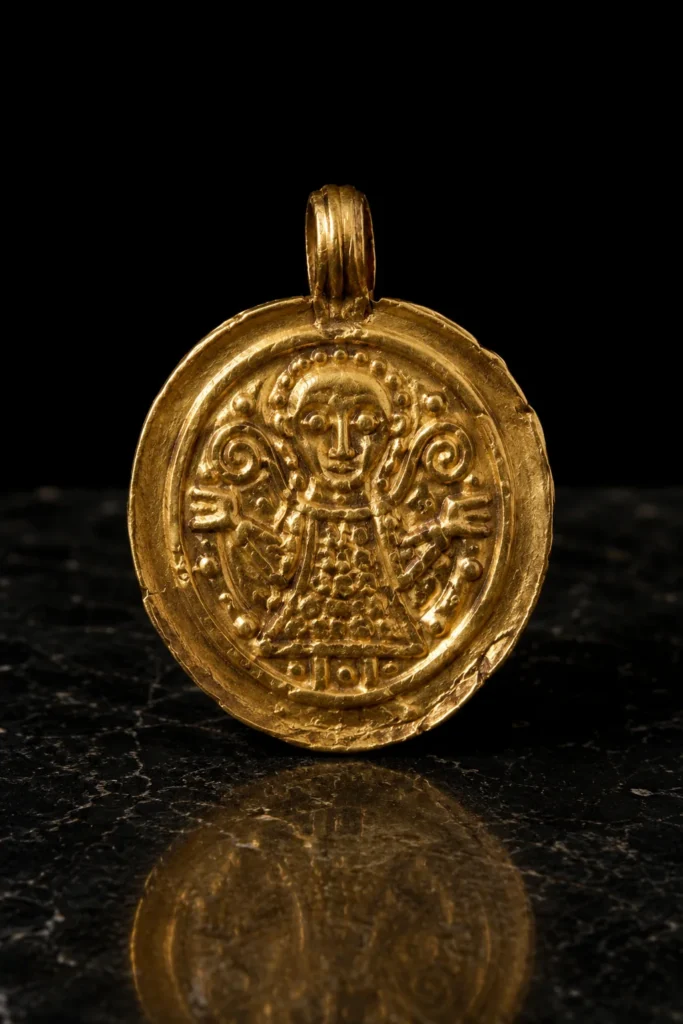
The bracteate is a thin pendant of gold, stamped on one side only. Such bracteates were widespread during the Migration Period, that is, in the centuries around the end of antiquity, above all in the Germanic north of Europe.
Bracteates were worn as jewellery on the body. They hung from a cord or chain and rested on the wearer’s chest. They thus belong to the worn objects.
Beyond their role as jewellery, bracteates are understood as protective objects. Their images and their runic inscriptions suggest that a protective and healing effect was attributed to them.
Unlike some protective signs whose age is disputed, bracteates can be dated precisely. They are genuine finds from a particular era and are therefore a well-attested testimony.
In scholarship, bracteates are an important and intensively studied field. A large number of pieces survives and has been recorded and interpreted in extensive works.
The bracteate is thus a well-documented protective object of the early Germanic north. It unites the goldsmith’s art, the pictorial art, and the runic script of its time in a single, worn object.
Form and manufacture
The bracteate is a thin, round disc of gold. Its hallmark is the one-sided stamping. Only the front bears an image; the back remains smooth or shows only the impression of the front.
The bracteate was made by pressing or stamping a thin sheet of gold over a cut die. This produced the raised image on the front.
Around the edge, the bracteate was often given an elaborately designed border. This border zone could consist of several zones of patterns and ornamentation.
For wearing, a loop was attached to the bracteate. The cord or chain ran through this loop. The bracteate was thus designed as a pendant from the outset.
The material was gold, a precious substance. Bracteates were therefore not cheap mass-produced goods but valuable pieces. They were worn by people who could afford such jewellery.
The bracteates are thus products of a highly developed goldsmith’s art. Their fine stamping and their elaborate borders attest to the great skill of the craftsmen of the Migration Period.
Model and a pictorial world of its own
The bracteates arose from a model that came from the Roman world. The late Roman emperors had golden medallions struck, which were given as tokens of distinction and connection.
Such imperial medallions reached the Germanic north. There they were perceived as precious and meaningful, and were imitated.
Yet the Germanic goldsmiths did not simply copy the model. They transformed it. The imperial medallion bearing the image of the ruler became the one-sided bracteate with a pictorial world of its own.
This pictorial world of its own broke away from the Roman model. The imperial image was reinterpreted and placed in new contexts. Image types arose that corresponded to the Germanic world of ideas.
The bracteate is thus a good example of a creative adoption. A foreign model was taken up, yet it was not copied but transformed into something of its own.
In this transformation the independence of Germanic art of the Migration Period becomes apparent. It took up impulses and shaped from them a pictorial language of its own, unmistakable in character.
The images on the bracteates
The images on the bracteates are varied, and their interpretation is among the most important tasks of scholarship. A human head frequently appears, alongside which animals and further pictorial elements occur.
A widespread image type shows a head above a four-legged animal, often accompanied by a bird. This image type is in scholarship frequently associated with the god Odin.
The interpretation rests on the Norse tradition. Odin is connected with horses, with birds, and with the healing art. A scene with a head, a horse, and a bird can therefore be related to Odin and his healing activity.
This interpretation links the bracteates to a well-known tradition. There is an old Germanic charm that tells of the healing of an injured horse through divine intervention. Some bracteate images can be connected with this idea of healing.
Such interpretations, however, are not certain in every respect. The bracteates show images without explanatory text. Much must be inferred from the tradition and from comparison.
What is certain is that the images on the bracteates were meaningful. They were not mere ornament but carried a sense that had to do with the gods, with healing, and with protection.
Runic inscriptions on bracteates
Many bracteates bear, alongside the image, a runic inscription as well. These inscriptions are of great importance for understanding the bracteates.
A portion of these runic inscriptions is readily legible and intelligible. Names are given, such as the name of the maker or of the owner. Such inscriptions link the bracteate to a particular person.
Other inscriptions are shorter and harder to interpret. A short sequence of runes is widespread, appearing on several bracteates and also on other objects. It is associated with the realm of protection and defence.
Some inscriptions seem like formulas whose exact meaning cannot be determined. It is possible that a protective power was attributed to them precisely as a formula, independent of their literal sense.
The runic inscriptions link the bracteate to the world of protective runes. On the page about protective runes, the protective use of runes is described in more detail.
Image and runic inscription form a unity on the bracteate. Both contributed to the meaning of the pendant. The bracteate was thus a protective object that united the power of the image and the power of the written word.
Protection and healing
The bracteates are understood as protective objects. Their images, their runes, and their worn form suggest that a protective and healing effect was attributed to them.
The connection of several image types with the god Odin and with the idea of healing suggests that the bracteates were associated especially with the realm of healing. They were meant to keep their wearer healthy or to further his recovery.
In addition, the general idea of protection comes into consideration. A worn golden pendant with divine images and protective runes was meant to preserve its wearer from misfortune.
The bracteates were thus not merely precious jewellery. They were jewellery and protective object at once. The high value of the gold and the protective meaning did not exclude one another.
This combination of jewellery and protection is common in worn objects. The Mesopotamian cylinder seal too was tool and amulet at once. The bracteate is jewellery and protective object at once.
The bracteate thus shows that the Germanic world of the Migration Period knew a rich practice of protection. This practice united the goldsmith’s art, the pictorial world of the gods, and the runic script into a worn protective object.
Find contexts and distribution
Bracteates have been found in large numbers. Their find sites are distributed across Scandinavia and the Germanic-settled north of Europe. Bracteates have also come to light in further regions.
Bracteates were frequently discovered in hoard finds. A hoard is an assemblage of valuable objects deposited in the ground. Bracteates often belong to such buried treasures.
Why the hoards were deposited is not clear in every case. Some were buried in uncertain times for safekeeping; others may have been deposited as an offering to the gods.
Bracteates have also been found in graves. In the grave, the golden pendant accompanied the deceased. This shows that the bracteate retained its significance even beyond death.
The Migration Period, in which the bracteates arose, was a time of great movements and upheavals. The wide distribution of the bracteates and their image types reflects the connections of this turbulent era.
The find contexts make the bracteates a valuable source. Together with their images and inscriptions, they offer insight into the culture, the religion, and the protective ideas of the early Germanic north.
The bracteates in scholarship
The bracteates are among the most thoroughly researched groups of objects of early Germanic history. A large number of pieces has been recorded and described in extensive scholarly works.
This thorough documentation makes it possible to order the bracteates. Scholarship distinguishes various image types and can classify the pieces in time and space.
The interpretation of the bracteate images is a lively field of research in its own right. The precise meaning of individual images and inscriptions is debated, and not every question has been conclusively resolved.
These debates are not a shortcoming but an expression of care. The bracteates show images without explanatory text, and so their interpretation must proceed with deliberation and with the comparison of many pieces.
What can be regarded as certain is the basic definition. The bracteates are worn golden pendants of the Migration Period; they bear meaningful images and often runic inscriptions, and a protective meaning was attributed to them.
The bracteates are thus an example of a well-researched, securely dated protective object. Unlike some signs whose age is disputed, the dating of the bracteates is firmly established.
Present-day reception
Today the bracteates are known above all to those familiar with early Germanic history. In scholarship they are an important field; among the wider public they are less familiar than, for example, Thor’s hammer.
Bracteates can be seen in the collections of several museums, especially in Scandinavia. Their fine goldwork and their enigmatic images make them striking exhibits.
For the study of Germanic religion and art, the bracteates are of great value. They are among the most important pictorial sources for the time before the Norse mythology was set down in writing.
The bracteates show that the Germanic north possessed a rich culture of protection and imagery long before the Viking Age. They are a testimony from an early, often little-known era.
As jewellery, reproductions of bracteates are occasionally worn, mostly by people with a particular interest in early Germanic history.
The bracteate thus remains an impressive example of an early Germanic protective object. It unites precious gold, the pictorial world of the gods, and the runic script, and is among the best-attested protective pendants of the old north.
References (selection)
Related key terms: bracteate gold bracteate Migration Period Odin runic inscription hoard find gold pendant Germanic.
iWell Guard and protective traditions
iWell Guard stands within the cultural-historical line of wearable protective objects to which the bracteate also belongs. A modern companion for people who live with protective symbols: made in Germany, 41 layers of solid gold, platinum, and silver, with a 30-day right of return.
Personal experiences may vary. Not a medical device. No healing promise.