The Thunder Sign: the Slavic Sign of Protection Against Lightning
By Ralf Ittermann · last reviewed on
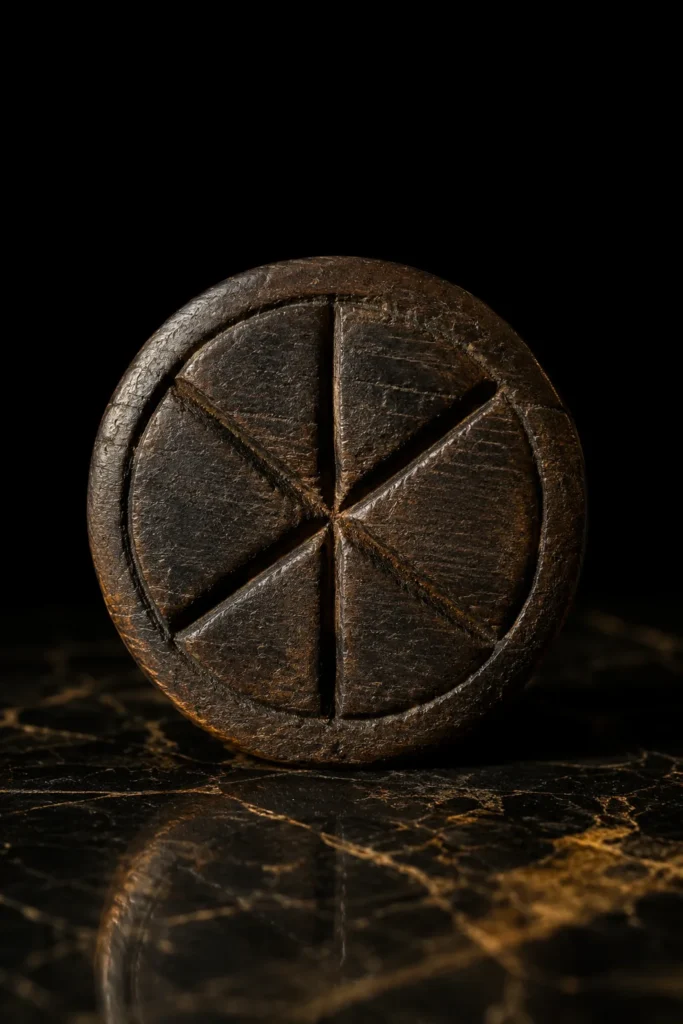
The thunder sign is a Slavic sign of protection, a six-spoked rosette within a circle. Affixed to houses and roof beams, it was meant to protect against lightning and harm, and it is associated with the thunder god Perun.
Classification
The thunder sign is a protective sign from the Slavic cultural sphere. It usually shows a six-spoked rosette, a wheel-like pattern enclosed by a circle.
In the Slavic languages, the sign is denoted by a term that refers to thunder. In German it is therefore rendered as Donnerzeichen or Donnermal, in English as the thunder sign or thunder mark.
The thunder sign was affixed to houses, above all to the roof beams, the gables, and the door frames. From there it was meant to keep the house safe from harm.
Its task is narrowly defined. The thunder sign is meant above all to protect against lightning, against the strike of a thunderstorm that could destroy a house and set it ablaze.
The sign is associated with the Slavic thunder god Perun. Perun was the lord of the storm, and the thunder sign is regarded as his mark.
In religious studies and in folklore studies, the thunder sign is a good example of a protective sign that responds to a concrete natural danger, namely lightning. As with many Slavic signs, a distinction must be drawn here between ancient root and modern interpretation.
Form: the six-spoked rosette
The thunder sign has a clear, simple form. It is a circular sign in whose interior six spokes or rays radiate from a central point.
The spokes are often shaped so that the sign resembles a six-petalled flower or a six-part rosette. For this reason it is also called the six-leaf or the six-star.
This pattern can be produced with a simple tool. With a compass one can strike a circle and, using the same radius, mark in the six arcs. This yields the regular six-part rosette.
This very ease of making it is important. The thunder sign could be carved cleanly and regularly into the wood by anyone who possessed a compass or a similar aid.
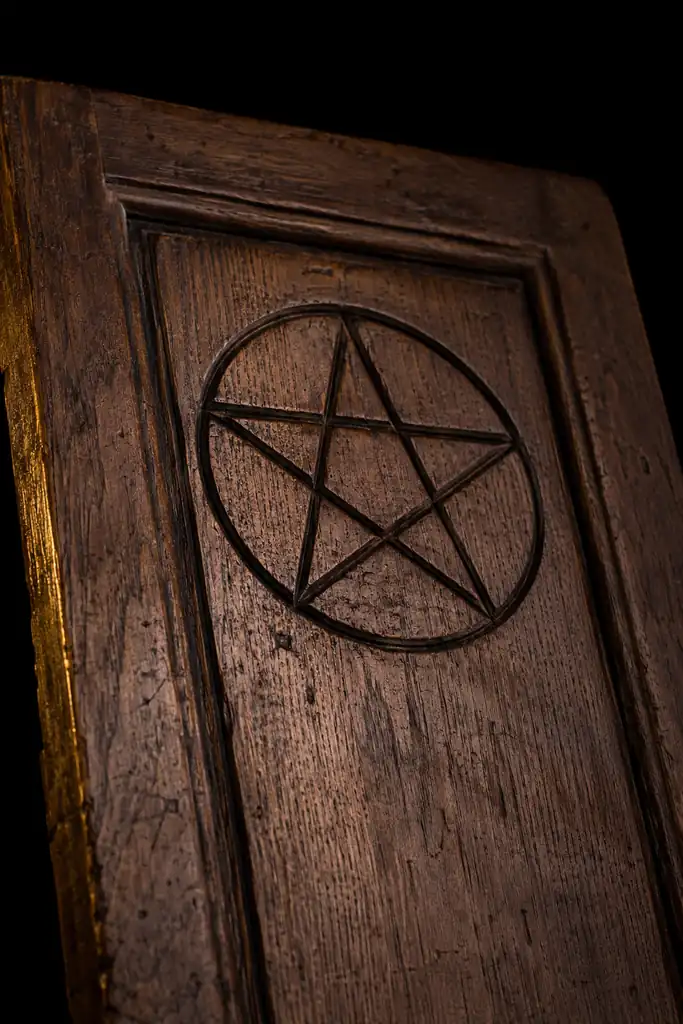
The sign was usually carved or scratched into wood, for Slavic houses were frequently timber structures. It could also be painted on.
The six-spoked rosette is thus a simple, clear, and easily produced sign. The thunder sign can be recognized by this regular form.
Perun, the thunder god
The thunder sign is associated with Perun, the thunder god of the Slavic religion. Perun was one of the most significant figures of the pre-Christian Slavic pantheon.
Perun was the lord of the storm, of thunder, and of lightning. He is associated with the sky, with the oak, and with the power of the forces of nature. As a storm god he was a mighty figure, feared and at the same time revered.
Perun belongs to a large group of thunder and storm gods known to many cultures. The Germanic Thor, the Baltic Perkunas, and other figures are kindred to him.
Lightning was the weapon and the visible work of the thunder god. When a storm passed over the land, then according to Slavic belief Perun was at work.
From this arises the connection of the thunder sign with Perun. The sign that is meant to protect against lightning is the sign of the god who commands lightning.
Whoever affixed the thunder sign to the house thereby placed the house under the protection of the thunder god. It was, as it were, a request to Perun to keep his own storm away from this house.
Protection against lightning
The most important task of the thunder sign was protection against lightning. This danger was very real for Slavic villages.
Slavic houses were frequently built of wood and roofed with straw or shingles. A lightning strike could quickly set such a house on fire. The blaze could spread to the entire village.
Against this danger there was no reliable defense in today’s sense. Protection through a sign, through the invocation of the thunder god, was one of the answers that Slavic folk religion offered.
The thunder sign was therefore affixed to the places regarded as at risk. Its most frequent location was the gable and the topmost roof beam, that is, the highest point of the house, which lightning would strike first.
The idea behind this was that the sign of the thunder god would turn lightning away from the house so marked. Perun was not to direct his storm against a house that bore his own sign.
The thunder sign thus belongs to the protective signs that respond to a concrete, named danger. It is not a general sign of defense, but a targeted protection against lightning.
The sign on the house
The thunder sign was a sign of the house. It was not worn on the body but fixed firmly to the building.
Its place was the prominent parts of the house. The gable in particular, the triangular field beneath the roof, frequently bore a thunder sign. The roof beams and the door frames were also marked with the sign.
These locations were deliberately chosen. The gable is the highest part of the house, the part most strongly turned toward the sky. The door is the threshold at which harm might enter.
The thunder sign thus secured the house at its most important points. It belonged to the house’s fittings, often from the time of its construction.
The thunder sign was frequently not the only protective sign on the house. It could be combined with other carved signs, with patterns, and with further protective elements.
The thunder sign thus belongs to the large group of threshold and house-protection signs. Like the Bagua mirror in China or the horseshoe in Europe, it secured the house at its boundaries and at its prominent places.
The six-part rosette in Europe
The six-spoked rosette pattern is not confined to the Slavic sphere. It is a very widely distributed sign that occurs in many parts of Europe.
The rosette of six arcs struck with a compass is one of the simplest regular figures. It arises almost of its own accord as soon as someone works with a compass.
For this reason the six-part rosette pattern is found in the folk art of many peoples. It appears on furniture, on houses, on implements, and in ornamentation throughout Europe.
In many places a protective meaning was ascribed to this pattern. As the so-called six-leaf or as an apotropaic scratched sign, it was meant to ward off harm. It thus belongs to the family of simple, widely distributed protective patterns.
The Slavic thunder sign is one particular form of this widespread pattern. In the Slavic sphere the six-part rosette was associated with thunder and with Perun.
This classification is important. The thunder sign is not an entirely independent, exclusively Slavic sign. It is the Slavic interpretation of a pattern that was known throughout Europe as a simple protective sign.
Ancient root and modern interpretation
With the thunder sign, as with other Slavic signs, a distinction must be drawn between the ancient root and the modern interpretation.
The ancient root is well attested. Six-part rosettes on houses, especially on gables and beams, can be documented in the Slavic sphere over a long period. The notion that such signs protect against lightning is also anchored in folk belief.
Likewise, the thunder god Perun is a genuine figure of the pre-Christian Slavic religion. The connection of storm, lightning, and a thunder god belongs to the secure body of Slavic belief.
What must be treated with caution, by contrast, is the closed, elaborate interpretation that often accompanies the thunder sign today. The precise connection of the six-part rosette with Perun is not attested in all its particulars by ancient sources.
As with the Kolovrat, modern Slavic movements have taken up the old folk pattern and worked it into a clearly named, fully interpreted sign. Part of today’s interpretation belongs to this modern elaboration.
An honest account holds to both. The six-part protective rosette on the house is a genuine, ancient folk custom. The closed interpretation as a Perun sign combines ancient roots with modern shaping.
Protection through the sign of the god
The thunder sign follows a particular notion of protection. It does not ward off through a frightening image, and it is not a sacred written character. It protects by bearing the sign of the responsible god.
This notion rests on a simple consideration. Lightning is the work of the thunder god. Whoever affixes the sign of this god to his house places the house under his protection.
The thunder sign is thus, as it were, a message to the god. It indicates that this house is turned toward the thunder god and seeks his protection. The god is therefore to keep his storm away from it.
This notion, of using the sign of a power in order to place oneself under its protection, is widely distributed. The Christian cross too protects according to this pattern, by pointing to Christ.
The thunder sign combines this notion with the six-part rosette. The simple, easily produced pattern becomes the sign of the thunder god and thereby the means of placing one’s house under his protection.
The thunder sign is thus a good example of a protective sign that rests on the connection with a deity. Its protection is the turning toward the lord of the storm.
Reception today
The thunder sign is today known above all in the Slavic sphere. Ancient six-part rosettes can still be seen on surviving timber houses and in folk art, and they are valued as part of the cultural heritage.
In the Slavic Neopagan movements the thunder sign, much like the Kolovrat, has found a firm place. There it is used as the sign of Perun and as a protective sign.
Beyond these movements, the thunder sign is taken up as ornament and as a motif. In this use it stands generally for the Slavic heritage and for protection.
As with other Slavic signs, factual classification is important with the thunder sign as well. The ancient protective rosette on the house is a genuine folk custom; the closed interpretation as a Perun sign combines the ancient and the modern.
The thunder sign thus remains a striking example of a house-protection sign. It shows how a simple pattern drawn with a compass could become a protective sign against a concrete natural danger.
In it are joined the fear of lightning, the veneration of the thunder god, and an easily produced sign. The thunder sign is the Slavic answer to a danger that was ever present above the houses of the village.
References (selection)
Related key terms: thunder sign Perun six-leaf rosette lightning house protection gable Slavic.
iWell Guard and protective traditions
iWell Guard stands in the cultural-historical line of portable protective objects to which the thunder sign also belongs. A modern companion for people who live with protective symbols: made in Germany, 41 layers of solid gold, platinum, and silver, with a 30-day right of return.
Personal experiences may vary. Not a medical device. No healing promise.