The Medicine Wheel, known in English as the medicine wheel, refers to two related but distinct things: on the one hand prehistoric stone circles on the Great Plains of North America, and on the other a teaching image that has spread more recently and links the four cardinal directions with colours, animals and stages of life.
The term medicine renders the English word medicine and means spiritual force, not the art of healing. From the perspective of religious studies it is important to keep the archaeological evidence and the modern interpretation cleanly apart. This text describes both levels from an outside perspective and avoids committing to any particular spiritual reading.
The Medicine Wheel is a Four-Directions stone circle symbol that is widely attested across many Indigenous cultures of North America.
The term Medicine Wheel is used in two clearly different senses, which regularly leads to confusion when one engages with the subject. The first sense refers to concrete archaeological structures, namely stone circles and stone settings distributed across the northern Great Plains.
The second sense refers to an abstract teaching image, that is, a circle divided into four fields that links the cardinal directions with colours, animals, seasons and life stages. In its form common today this teaching image is of more recent date and is treated separately further below.
Here too the word medicine renders the English medicine and means spiritual power or sacred significance. The German translation Medizinrad has become established, but it can create the false impression of a remedy. What is meant is a religiously or cosmologically significant object or image.
The stone Medicine Wheels are concentrated in the US states of Wyoming, Montana and South Dakota as well as in the Canadian provinces of Alberta and Saskatchewan. They were built and used by various peoples over a long period of time.
In religious studies the Medicine Wheel belongs to the broader context of protective symbols and cosmological images of order. Unlike a portable amulet, however, it is a fixed structure or a conceptual scheme, not an object carried on the body.
Important for a factual account is the insight that little reliable knowledge exists about the meaning of the prehistoric stone circles. Much of what is said about the Medicine Wheel today belongs to modern interpretation and not to the archaeologically documented evidence.
The oldest known stone Medicine Wheels are several thousand years old. The Majorville Medicine Wheel in Alberta, for instance, was according to archaeological dating used and altered repeatedly over a period of around five thousand years. This long span of use makes a clear attribution difficult.
In total, several dozen such structures are documented on the northern Great Plains. They differ considerably in size, layout and state of preservation. Some consist only of a cairn with spokes, others of several nested circles.
Probably the best-known example is the Bighorn Medicine Wheel in the Bighorn Mountains in Wyoming. It lies at an elevation of around three thousand metres and consists of a central cairn, a surrounding circle and several spokes. Its construction is estimated at about seven hundred years old.
Which peoples built the individual structures often cannot be determined precisely. Since the stones were added to and rearranged over centuries, many wheels are the work of several generations and possibly several peoples. The Crow, Cheyenne and others associate individual structures with their tradition.
With European settlement the stone circles at first fell into oblivion or were overlooked as mere heaps of stones. Only in the late nineteenth and the twentieth century did archaeologists turn to them systematically. Some structures were damaged in the process, others placed under protection.
The modern teaching image of the Medicine Wheel divided into four fields, by contrast, only arose in the twentieth century. It spread above all from the 1970s onward through educational and spiritual literature. Its history is therefore to be kept separate from the history of the stone circles.
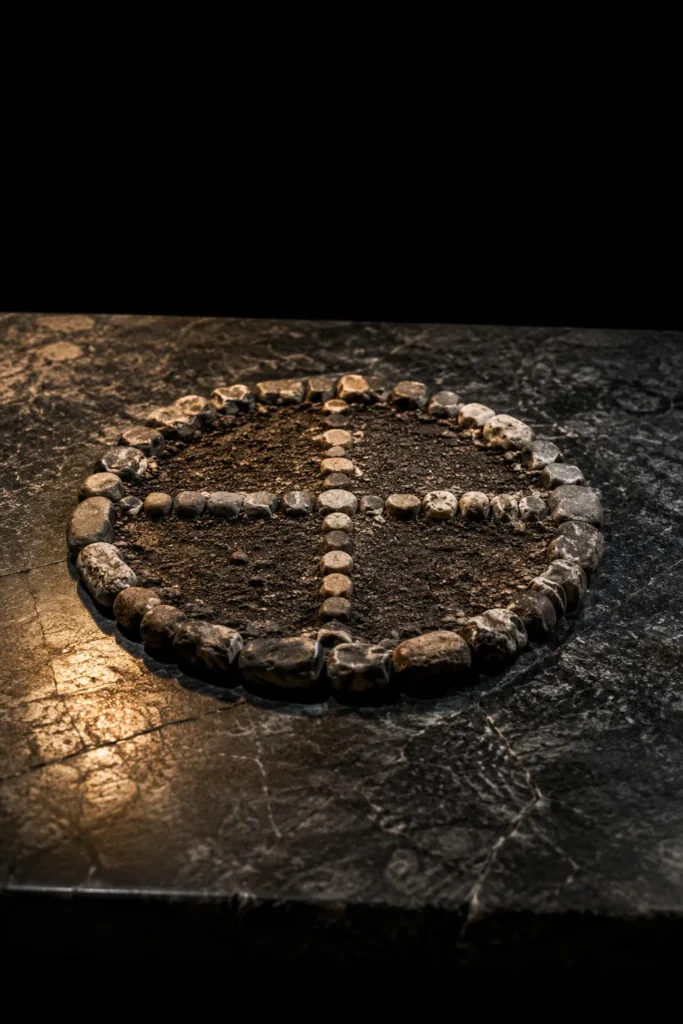
The stone Medicine Wheels consist of unworked field stones laid together into circles, spokes and cairns. A typical wheel has a central cairn, one or more concentric rings and lines that run outward from the centre like the spokes of a wheel.
The diameters vary greatly. Smaller structures measure a few metres, larger ones such as the Bighorn Medicine Wheel about twenty-five metres. Some wheels have additional small cairns at the end of individual spokes, so-called cairns.
Since only unworked stones were used, precise dating of the structures is difficult. Archaeologists date them through associated finds, through weathering and through their position in the terrain. The long span of use of many structures further complicates clear statements.
The alignment of some spokes is striking. In several wheels, including the Bighorn Medicine Wheel, individual cairns point toward the point of sunrise at the summer solstice or toward the rising of bright stars. Whether this alignment was intentional is disputed in research.
The modern teaching image of the Medicine Wheel, by contrast, is not built from stones but presented as a drawing, panel or ground image laid out on the floor. It divides a circle by a cross into four fields, which are assigned to the four cardinal directions.
The colours of these four fields, often yellow, red, black and white, are not uniformly fixed. Different authors and communities use different assignments. There is no universally valid colour order for the modern Medicine Wheel.

There is no reliable knowledge about the religious meaning of the prehistoric stone circles. Since no written sources exist and the oral tradition is only partly preserved, interpretations remain largely conjecture. Functions named include use as a gathering place, as a memorial site or as a place for observing the sky.
Some Indigenous communities connect particular stone circles with their own traditions and regard them as sacred places. The Bighorn Medicine Wheel, for instance, is honoured by several peoples as a site of prayer and vision quest. This meaning is part of living religious practice.
The modern teaching image of the Medicine Wheel rests on the widespread notion of the four cardinal directions as ordering axes of the world. This notion is attested in many cultures of North America, but in the modern Medicine Wheel it is gathered into a closed scheme.
In this scheme the four directions are assigned colours, animals, seasons, life stages and moral qualities. The circle here stands for wholeness and the eternal cycle. Which concrete assignments apply depends on the respective author or the respective community.
In religious studies the modern Medicine Wheel can be described as an image of order and instruction, comparable to other circular schemes that represent the relationship between people and the world. It serves to convey values and to help the individual locate themselves.
Important is the distinction between old and new meaning. The closed four-field scheme is not what the builders of the prehistoric stone circles had in mind. It is a modern synthesis that takes up older notions and reorders them.
How the prehistoric stone circles were used can only be partly reconstructed. Finds in their vicinity and their position in the terrain suggest that they were places of gathering, of remembrance or of prayer. A uniform use across all structures is unlikely.
Today several stone circles are visited by Indigenous communities as sacred places. At the Bighorn Medicine Wheel, prayers, the laying down of offerings and vision quests take place. Such practices are part of living religion and are subject to their own rules of respect.
The modern teaching image of the Medicine Wheel is used above all in instruction. Teachers, counsellors and spiritual teachers use it to illustrate values, life stages and personality types. It serves as a didactic aid, not as a fixed sanctuary.
In some communities the four-field scheme is used in counselling, education and health promotion. There it helps to discuss themes such as balance, responsibility and community. This use is independent of the archaeological level.
The bearers of the stone circle tradition are the peoples whose ancestors built the structures and who honour them today as sacred places. The bearers of the modern teaching image, by contrast, are very diverse groups, from Indigenous educators to providers on the market of spiritual offerings.
Anyone who visits a stone circle should follow the rules of the respective protected area and of the communities of origin. Moving stones, entering sacred areas and removing offerings count as intrusions that are to be refrained from.
The stone Medicine Wheels differ greatly among themselves. Some consist only of a circle with a central cairn, others have numerous spokes or several rings laid one inside another. This diversity argues against tracing all structures back to a single model.
Related to the Medicine Wheels are the numerous stone circles interpreted as remains of camp sites, so-called tipi rings. A tipi ring arose when the edges of a tent were weighted down with stones. Such rings are to be distinguished from ritual Medicine Wheels.
Outside North America too there are prehistoric stone circles and stone settings, for example in Europe. A comparison can illuminate general questions about the meaning of circular structures, but it must not lead to an equation of the very different traditions.
The modern four-field scheme of the Medicine Wheel is related to other direction and circle schemes. Notions of the four cardinal directions with assigned colours are found in many cultures. The modern Medicine Wheel gathers such notions into a closed image.
Within popular nature spirituality the Medicine Wheel is often named together with other objects, for example with the dreamcatcher. In religious studies these are different things that were merged into an overall picture only in modern reception.
Anyone who wishes to place the Medicine Wheel in the wider context of protective and ordering symbols will find further examples in the protective symbols section. The Medicine Wheel shows here how an ancient structure and a modern teaching image can come together under one name.
Whether the prehistoric stone circles were understood as protective objects in the narrower sense cannot be said with certainty. It is possible that they were regarded as sacred places where people sought assistance. A clear protective function cannot be derived from the archaeological evidence alone.
In the modern teaching image the Medicine Wheel is often connected with notions of balance and being whole. The circle there stands for an ordered, unharmed world in which the individual finds their place. In this sense the Medicine Wheel can count as an image of wholeness.
In modern use protection is understood rather as inner orientation. The scheme is meant to help order one’s own life, recognise strengths and weaknesses and take on responsibility. This function is an interpretation, not a measurable effect.
This text makes no statements about actual protective or healing effects. It describes only what meaning various groups attribute to the Medicine Wheel. Promises of healing and assurances of effect are expressly excluded.
For Indigenous communities that honour individual stone circles as sacred places, the protection lies in the place itself and in the relationship to spiritual forces cultivated there. This meaning is part of living religion and cannot be reduced to an abstract scheme.
In religious studies it can be noted that the Medicine Wheel, in both meanings, is less an object of defence against danger than an image of order. Protection appears here above all as the consequence of a right relationship to the world, not as a mechanical defence.
The archaeological study of the Medicine Wheels began in the late nineteenth century and became more systematic in the twentieth century. Researchers surveyed the structures, dug in their vicinity and tried to date them. Early interpretations were often shaped by the assumptions of their time.
In the 1970s the thesis caused a stir that some wheels had been astronomical observation instruments. This interpretation was widely discussed but remained disputed among specialists. Today it is regarded as possible for some structures and as unproven for others.
One ethical problem lies in the handling of the stone circles as sacred places. Tourism, the moving of stones and improper excavations have damaged structures. Several wheels are under protection today, and visiting them is regulated.
The modern teaching image of the Medicine Wheel raises its own questions of cultural appropriation. It was shaped and marketed by Indigenous as well as non-Indigenous authors. Whether its commercial use honours or exploits Indigenous traditions is judged differently.
Critical attention is due to sweeping accounts that present the modern four-field scheme as ancient knowledge common to all Indigenous peoples. Such an account blurs the diversity of the cultures and the more recent origin of the scheme.
A serious account therefore separates the archaeological evidence, the living religious practice of individual communities, and the modern, market-shaped reception. Only this separation makes it possible to do justice to the subject without creating false certainty.
The prehistoric stone circles are today partly archaeological monuments, partly living sacred places. Protection authorities and Indigenous communities work together in several places to preserve the structures and to make their visiting sustainable.
The modern teaching image of the Medicine Wheel is widespread. It is found in education, in counselling, in health promotion and in popular nature spirituality. Its popularity rests on its vividness and its easy adaptability.
In some Indigenous communities the four-field scheme is deliberately used in education and social work. There it serves as a culturally anchored aid for speaking about values and life stages. This use proceeds from the communities themselves.
On the market of spiritual offerings the Medicine Wheel is marketed in seminars, books and courses. In religious studies this is a reception form of its own that takes up older notions but follows the rules of a global market. It is to be distinguished from the Indigenous tradition.
In popular culture the Medicine Wheel often appears as a symbol of Native American wisdom. Such depictions are often simplified and mix the archaeological and the modern level. A closer look, however, reveals two different objects under one name.
For interested readers an alert handling of the term is advisable. Anyone reading about the Medicine Wheel should check whether an archaeological stone circle or a modern teaching image is meant. Further symbols of this kind are presented in the protective symbols section.
Related key terms: Medicine Wheel medicine wheel stone circle four cardinal directions Bighorn Majorville Plains Indians archaeology cosmology sacred place Crow Cheyenne.
iWell Guard stands in the cultural-historical line of portable protective objects, to which the Medicine Wheel also belongs. A modern companion for people who live with protective symbols: crafted in Germany, 41 layers of solid gold, platinum and silver, with a 30-day return policy.
Personal experiences may vary. Not a medical device. No promise of healing.