The Hagstone: Holed Protective Stone and Hen God of Folk Magic
By Ralf Ittermann · last reviewed on
The hagstone is a stone that has acquired a continuous hole through natural weathering. In European folk magic such a stone was regarded as a protective object. It is also known by names such as hen god, druid stone, or, in the English-speaking world, hag stone.
In folkloric terms the hagstone belongs to the group of protective stones to which a warding power was attributed. This article presents the origin, custom and interpretation of the holed stone.
The hagstone is a naturally holed protective stone, also called hen god in popular speech.
Classification
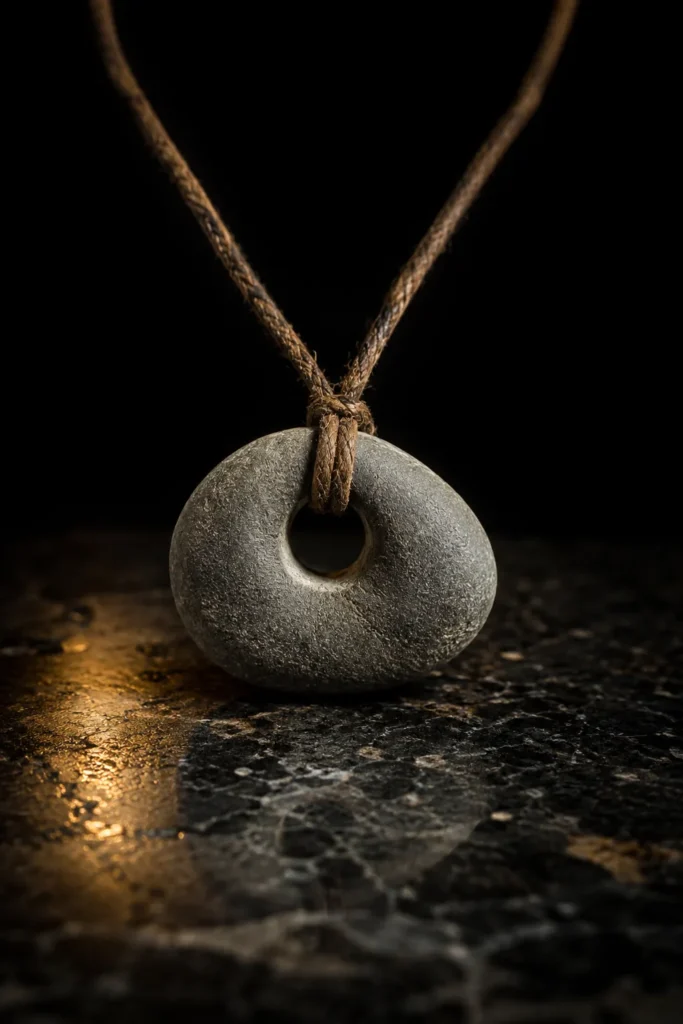
The hagstone is a natural stone with a continuous hole that has formed through weathering, water erosion or through boring organisms. The decisive point is that the hole was not made by human hands. It was precisely this natural origin that made the stone valuable in popular belief.
The stone bears various names across the German-speaking regions. Common forms are Hagstein, Hühnergott, Drudenstein, Schratenstein and Glücksstein. In the English-speaking world it is called hag stone, adder stone or holey stone. The variety of names reflects the wide spread of the custom.
The name element Hag points to old terms for a witch or a female malevolent spirit. The hagstone was accordingly the stone against the hag, that is, a means of warding off witchcraft and nocturnal haunting.
In folkloric terms the hagstone belongs to the protective symbols and protective objects of folk magic. It stands alongside other natural objects to which a protective power was attributed, such as certain woods and plants.
Unlike crafted amulets, the hagstone is a found object. According to belief, its power rested on the fact that nature itself had shaped it. In this it differs fundamentally from the manufactured amulet and talisman.
It must be emphasized that the protective effect of the hagstone describes a historical belief. The stone is a folkloric testimony, not an effective protective device in the scientific sense.
Origin and History
The belief in the protective power of holed stones is old and widespread across large parts of Europe. Even ancient authors report stones with special properties, even though not every account can be clearly related to the hagstone.
The Roman naturalist Pliny the Elder describes a stone that, according to belief, was supposed to have been formed by a snake and to confer protection. This so-called serpent stone is regarded as a forerunner of the later conceptions of the holed protective stone.
In medieval and early modern Europe the hagstone was a firm part of rural folk magic. Folkloric collections of the nineteenth century document the custom in Germany, England, Scandinavia and the Slavic regions.
The hagstone was especially common in coastal regions and along rivers, since water erosion frequently created holed stones there. Fishermen and boatmen valued it particularly, which gave rise to its own regional customs.
With the decline of the belief in witches in the eighteenth and nineteenth centuries, the hagstone lost its serious warding function. It increasingly became a lucky stone, to which friendly but non-binding qualities were attributed.
The history of the hagstone is thus a history of long continuity. The custom can be traced over many centuries, yet it changed its character from a serious warding means to a friendly bringer of luck.
The medieval stone books, the so-called lapidaries, also record holed and unusually shaped stones and attribute warding properties to them. These texts combined ancient knowledge with Christian interpretation and helped the belief in protective stones to reach beyond learned tradition into rural practice.
Form, Material and Manufacture
The hagstone is not a manufactured but a found object. It usually consists of flint, sandstone or other rock prone to weathering. Its form varies from stone to stone, since nature shapes it irregularly.
The decisive feature is the continuous hole. It forms through various natural processes. In the sea and in rivers, drifting material gradually rubs a hole into softer stones. On land, frost weathering can take effect.
A further cause is boring organisms. Certain mussels and worms bore channels into soft rock, which remain as holes after the surrounding material has disintegrated. Such biogenically holed stones are common on coasts.
The size of hagstones ranges from small specimens that can be worn on a cord to heavy stones that were hung in a fixed place. For wearing on the body, small, light stones were preferred.
There was no manufacture in the narrower sense. A person could only find the stone, select it and, if appropriate, fit it with a cord. A hole bored by human hands devalued the stone according to popular belief.
Some traditions attribute special significance to the finding. A hagstone found by chance was considered more valuable than one deliberately sought, and a gifted stone again different from one found oneself.
For hanging, the stone was fastened to a cord, a leather strap or a plaited strand. Where the stone hung over a door or in the stable, care was taken that it could swing freely.
A firmly wedged stone was in some places considered less effective, since its mobility belonged to the power attributed to it.
Folkloric Background and Beliefs
The hagstone rests on the notion that the natural hole confers a special quality. The hole was regarded as an opening through which one could look and thus perceive another, hidden reality.
A widespread belief held that through the hole of a hagstone one could recognize witches, elves and hidden beings. What remained hidden to the naked eye was made visible by the stone. This notion gave the stone a revealing function.
At the same time the holed stone was regarded as a means of warding. It was believed that harmful powers could not pass through a natural hole or would be kept off by it. The hagstone thus formed a symbolic barrier.
Especially against the alp, an oppressive night spirit, the hagstone was considered a remedy. Hung over the bed or in the stable, it was meant to prevent the alp from oppressing humans or animals in their sleep. From this comes the name druid stone.
The natural formation of the hole was central to the belief. Only what nature had created without human involvement was considered powerful. Here a high regard for the unmade and the found, widespread in folk magic, becomes apparent.
The hagstone thus combined several notions. It was a viewing aid for the hidden, a means of warding off harmful beings and a bringer of luck all at once. This bundling of meanings is typical of folk-magical objects.
The hagstone played its own role in beliefs concerning divination and lost property. In some regions it was said that the view through the hole allowed one to recognize a thief or a hidden cache.
The stone thereby combined the warding function with a revealing one, without the two notions being clearly separated from each other.
Use and Custom
The hagstone was employed in various ways. A common form was hanging it in the house, especially over doors, windows and beds. There it was meant to prevent the intrusion of harmful powers.
In rural areas the protection of livestock played a major role. Hagstones were hung in the stable to preserve horses and cattle from the alp and from illness. The name hen god points to a comparable use in the henhouse.
Smaller hagstones were worn on the body, on a cord around the neck or on a keyring. In this way they were meant to accompany and protect the person even outside the house.
On the coasts of Northern and Eastern Europe the hagstone was a boatmen’s custom. Fishermen fastened it to the boat or the net to ensure a good voyage and a good catch. This maritime use is well documented.
Giving a hagstone as a gift was in many places considered an especially good gesture. A gifted stone was meant to bring luck and protection to the recipient. This gift-giving custom has survived into the present.
A ritual consecration was not required for the hagstone. According to belief, it worked of its own accord. Its use was thus low-threshold and accessible to anyone who found a suitable stone.
In the custom of horse-keeping the hagstone was especially firmly anchored. A sweaty or exhausted horse was in many places taken as a sign that the alp had ridden it during the night.
The holed stone hung over the stall was meant to prevent this. This connection of hagstone and horse stable is attested equally in the folkloric collections of Northern Germany and of England.
Regional Variants and Related Objects
The hagstone appears under numerous regional names. In Northern Germany and on the Baltic the name hen god is widespread, which became especially popular as a beach find on the German North Sea and Baltic coasts. There it denotes the holed beach stone as a bringer of luck.
In Southern Germany and the Alpine region the stone is often called druid stone, after the Drude, a female night spirit. This name variant emphasizes the warding function against the nightmare pressure.
In the English-speaking world the hag stone is known, alongside adder stone and holey stone. The name adder stone points to the old belief that holed stones had been created by snakes.
In Scandinavia and the Slavic countries holed protective stones are likewise attested. Despite different names, custom and interpretation resemble one another strikingly across the language boundaries.
The hagstone is related to other natural protective objects, such as the thunderbolt, a fossilized find that was regarded as protection against lightning. Here too the natural form, perceived as unusual, gave the object its significance.
Within the protective symbols the hagstone belongs to the group of found natural objects. These differ from crafted amulets in that not the human being but nature is regarded as the originator.
On the coasts of Brittany and Normandy the holed stone is likewise attested as a protective and lucky object of fishermen. Despite the linguistic separation, the customs along the entire Atlantic coast resemble one another strikingly, which scholarship interprets as an indication of an old, widely shared circle of notions.
Significance as a Means of Protection
The protective significance of the hagstone rests on several interconnected notions. At its core stood the idea that the natural hole formed a barrier against harmful powers.
A central role was played by the warding off of the nightmare pressure. The hagstone was considered an effective means against the oppressive night spirit that tormented sleepers. Over the bed or in the stable it was meant to ensure a quiet night for human and animal.
A second meaning was protection against witchcraft. Since one could recognize hidden beings through the hole, the stone was also meant to have an unmasking effect. Anyone who could recognize a witch was, according to belief, less at her mercy.
Added to this was the function as a general bringer of luck. The hagstone was meant not only to ward off misfortune but also to attract favorable fortune. This friendly side emerged ever more strongly over the course of time.
For people the value of the hagstone lay in its availability. Unlike an expensive amulet, it could be found oneself on the beach or riverbank. Protection was thus bound not to money but to a lucky find.
It remains to be noted that this protective significance reflects historical beliefs. A real warding off of illness or misfortune is not connected with the hagstone. Its value lies in its cultural-historical statement about past thought.
Compared with a purchased amulet, the hagstone cost nothing but the effort of searching. This social low threshold explains its wide spread precisely among poorer rural classes, to whom expensive means of protection remained closed.
Source Situation and History of Research
The source situation regarding the hagstone is broad but scattered. It reaches from ancient natural-history writings through medieval texts to the folkloric collections of the nineteenth and twentieth centuries.
An important ancient source is the Natural History of Pliny the Elder, who describes the stone produced by a snake and its attributed power. This account was taken up many times in the Middle Ages.
For the German-speaking world the Concise Dictionary of German Superstition offers detailed entries on the holed stone, the druid stone and the warding off of the nightmare pressure. It places the hagstone in the context of protective magic.
The folklorists of the nineteenth century assembled a dense body of material on customs through surveys and collections. Their records are today the most important basis for knowledge of regional folk customs.
A methodological difficulty lies in distinguishing the sources. Not every ancient report about a special stone certainly means the naturally holed hagstone. Here scholarship must distinguish carefully.
The history of research shows that the hagstone, as a widespread but inconspicuous object, long received little attention. Only folkloric collecting activity has made its firm place in European folk magic visible.
A peculiarity of the source situation is the strong reliance on oral tradition. Since the hagstone was rarely the subject of written records, the survey protocols of the folklorists are often the only evidence for regional customs. This dependence on late records counsels caution in statements about the older history of the custom.
Reception Today
The hagstone enjoys lasting popularity in the present. Above all under the name hen god, the holed beach stone is regarded as a popular bringer of luck and a prized beach find.
On many coasts the search for hen gods is a widespread leisure pleasure. Found stones are collected, threaded or given as gifts. This practice keeps the old custom alive in a defused form.
In modern esotericism the hagstone is offered as a protective stone and advertised with various properties. These attributions tie in with the old notions but are to be distinguished from the historical tradition.
In handicraft and jewelry the holed stone is gladly worked. Its natural, irregular form is considered attractive, and the hole makes it easier to thread into pendants and necklaces.
Anyone interested in the historical background will find reliable information in folkloric accounts and in the overview of the protective symbols. Esoteric guidebooks often reproduce the historical context only in abbreviated form.
The reception today thus shows a friendly transformation. From the serious means of warding off alp and witchcraft has come a harmless, congenial bringer of luck and a popular collector’s object.
Literature (Selection)
Related key terms: hen god, druid stone, protective stone, adder stone, holed stone, nightmare pressure, lucky stone, flint, serpent stone, folk magic, beach stone.
iWell Guard and Protective Traditions
iWell Guard stands in the cultural-historical line of portable protective objects, to which the hagstone also belongs. A modern companion for people who live with protective symbols: made in Germany, 41 layers of solid gold, platinum and silver, with a 30-day right of return.
Personal experiences may vary. Not a medical device. No healing promise.