Nazar Boncuğu: The Blue Glass Eye Against the Evil Eye
By Ralf Ittermann · last reviewed on
The Nazar Boncuğu, the blue glass eye, is one of the best-known amulets of the Mediterranean and the Near East. It is meant to catch the evil eye and render it harmless, and it is still encountered today on doors, in vehicles and as jewellery.
Classification
The Nazar Boncuğu is an object made of blue glass that is found above all in the eastern Mediterranean, in Turkey and in the Near East. The name combines the word Nazar, derived from Arabic and meaning gaze or looking, with the Turkish word Boncuk for bead. Literally, then, it is the gaze bead.
The object is closely tied to the belief in the evil eye. While that page deals with the idea of the evil eye itself, the focus here is on the protective object set against it. The Nazar Boncuğu is the material answer to a form of looking perceived as dangerous.
In religious studies the blue glass eye counts among the apotropaia. It is a good example of how an idea spread across wide regions becomes tangible in a single, instantly recognisable object. Hardly any other protective object is so ubiquitous across the Mediterranean.
The Nazar Boncuğu is among the most widespread protective objects of all. In Turkey it is everywhere, and as travel and trade goods it has long reached the whole world.
This distribution makes it a good example of how a local craft and an old protective notion can together become an internationally known object. Hardly any other amulet combines such a clearly defined form with such wide distribution.
The Belief in the Evil Eye
The idea of the evil eye is very old and found across many cultures. It holds that a gaze can cause harm, often without conscious intent on the part of the one looking.
The evil eye is frequently linked with envy. Whoever regards something beautiful, healthy or successful with ill will can, according to this idea, do it harm.
Those considered especially at risk were those perceived as vulnerable or as enviable, that is small children, pregnant women and brides, but also livestock and harvests. It was precisely for these areas that protection through the Nazar Boncuğu was used.
The evil eye is not solely a matter of malicious intent. An admiring gaze too could become dangerous. This explains why protection did not target particular enemies, but was placed generally wherever something was especially precious or at risk.
The belief in the evil eye is very old. Mesopotamian and ancient Egyptian texts already know the harmful power of looking, and in Greece and Rome the idea was firmly anchored under its own terms. The Romans spoke of fascinatio.
This long history explains the wide distribution of the means of protection. The blue glass eye is a particularly successful answer, attested since antiquity, to a concern that has accompanied the Mediterranean for thousands of years.
Form: The Blue Glass Eye
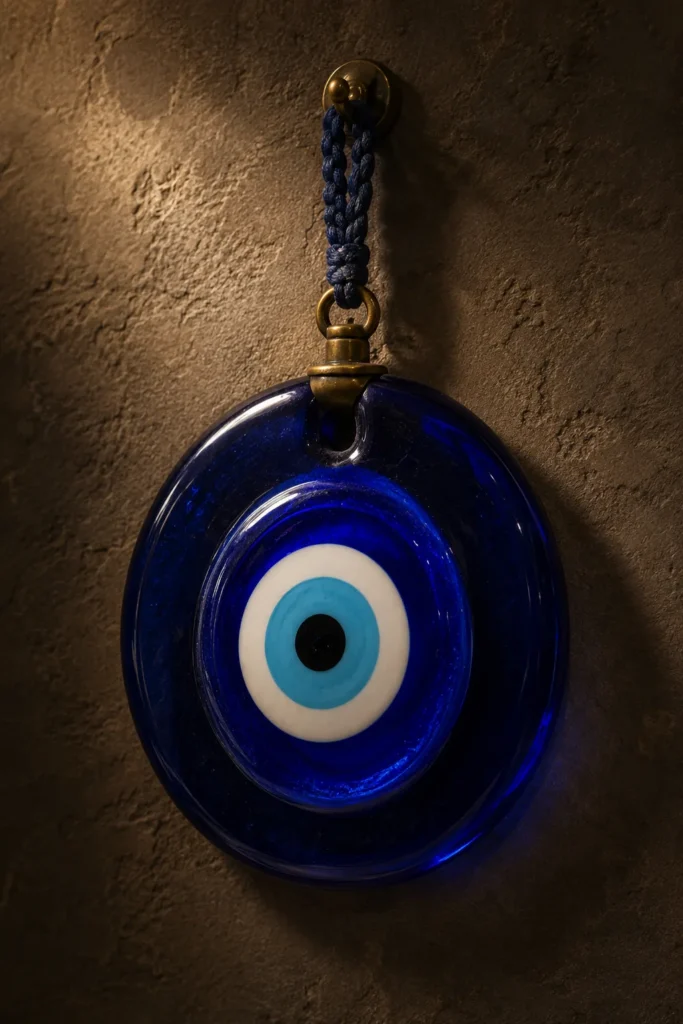
The Nazar Boncuğu has an unmistakable form. It is a flat, round disc or bead of glass with concentric rings. From the outside inward there usually follow a dark cobalt blue, a lighter blue, a white ring and a dark dot in the centre. This structure produces the image of a stylised eye.
The form is deliberately chosen. The protective object itself reproduces an eye and thereby sets a gaze of its own against the dangerous gaze. The eye of the amulet looks back, as it were, and catches the harmful attention before it reaches its target.
Sizes range from small beads for jewellery and bracelets to large discs that serve as wall decoration. Despite the differing dimensions the basic image always remains the same, so that the Nazar Boncuğu is instantly recognisable in any form.
Within the basic form there are numerous variants. Small beads are strung into necklaces and bracelets, larger discs serve as pendants for walls and doors. The eye is often combined with other protective signs, such as a small hand or a pomegranate.
Despite this variety, the concentric eye pattern remains the unmistakable core. It ensures that the object remains instantly recognisable as a Nazar Boncuğu in any size and any combination.
Production in Anatolian Glassblowing
The Nazar Boncuğu is traditionally made by hand. In Turkey there are places whose glassblowers have specialised in producing the protective eyes. The glassmakers work at wood-fired furnaces in which the glass is brought to high temperatures.
The concentric rings are created by layering molten glass of different colours one over another. The glassblower sets drop upon drop until the characteristic eye pattern is complete. This work demands experience, for the colour layers must mesh cleanly so that the eye remains clearly legible.
The craft tradition of glass beads is cultivated in Turkey as cultural heritage. It combines an old knowledge of glassworking with a protective notion that is still alive. Industrially produced pieces exist as well, yet the handmade beads are regarded as the proper form of the object.
In Turkey individual places have devoted themselves entirely to this craft. In villages near İzmir, among them a place that takes its byname from the protective eye itself, glass masters work at traditional wood-fired furnaces.
Their art is passed on from generation to generation. The work at the open fire is demanding and requires great skill. That this craft persists despite industrial competition shows the cultural standing the Nazar Boncuğu holds in Turkey.
Why the Colour Blue
The blue colour is no accident. In the eastern Mediterranean and the Near East blue eyes are rare, and it was precisely the rare, light gaze to which a special power was traditionally attributed. The blue glass eye takes up this notion and turns it to protection.
Beyond this, blue is regarded as a protective colour in many cultures of the region. It is associated with water and sky and connected with the warding off of misfortune. Blue colour on doors, window frames and objects is widespread as a means of protection across the entire Mediterranean.
In the Nazar Boncuğu both lines come together. The colour points to the light gaze perceived as powerful and at the same time stands within the general tradition of the protective colour blue. The object thus bundles two notions into a single, memorable image.
The protective power of the colour blue can be observed across the whole Mediterranean. Doors, shutters and house corners painted blue are meant to keep misfortune away, and an averting effect was also attributed to the bright blue of old glazes.
Ancient Egypt already knew a strong blue as the colour of life. The Nazar Boncuğu stands within this long line. Its colour is not ornament but part of the protective notion, to which the object owes part of its effect.
Use in Everyday Life
The Nazar Boncuğu is encountered in everyday life in many places. It hangs on front doors and in house entrances, it is fixed in vehicles, and it is found at workplaces and in shops. Everywhere it marks a threshold or a place that is to be protected.
The protection of children is especially important. The blue eye is pinned to the clothing of newborns and small children or worn as a bracelet. Brides, animals and new houses are also provided with the Nazar Boncuğu, for they are considered especially at risk.
A widespread notion holds that the glass eye shatters when it has caught a strong evil eye. The crack is then taken as a sign that the object has fulfilled its task. The broken piece is replaced, and the protection begins anew.
The Nazar Boncuğu is also a frequent gift. At the birth of a child, at a wedding or when moving into a new house it is presented, expressing a wish for protection and well-being.
For newborns it is often combined with gold, for instance as a small pendant on a bracelet. In this combination of protective intent and gift it becomes clear that the object not only wards off but also makes social relationships and care visible.
The Working Principle: The Caught Gaze
The Nazar Boncuğu works on a clear principle. It sets an eye of its own against the dangerous gaze and draws the harmful attention to itself. Instead of striking the protected child or the protected place, the evil eye is directed onto the conspicuous blue eye.
The object thus functions as a diversion and a catching point. Its bright colour and clear form are no ornament but part of the effect. The eye is meant to enter the field of vision and bind attention before it can do harm.
This principle of the catching counter-image links the Nazar Boncuğu with other protective objects of the Mediterranean, such as the Hamsa. It too often bears an eye and follows the idea of setting a gaze against the harmful gaze.
In this the Nazar Boncuğu differs from protective objects that work through deterrence. A frightening image such as the Gorgoneion is meant to push the attacker back. The blue eye, by contrast, works through attraction.
It draws the gaze to itself and catches it, rather than warding it off. Both ways belong to the world of apotropaia, yet they follow opposite movements. Understanding this difference helps to order the large family of protective objects according to their mode of action.
Nazar in Religion and Region
The belief in the evil eye is known and acknowledged in Islam. Islamic tradition knows the harmful gaze and recommends protection through prayer and invocation of God. The Nazar Boncuğu stands alongside this religious practice as a folk means of protection.
The evil eye, however, is not confined to one religion. The idea is widespread throughout the Mediterranean, in Christian as well as Jewish and Islamic settings. The blue glass eye is accordingly used by people of different religious affiliations.
This breadth makes the Nazar Boncuğu a connecting object. It belongs to no single faith community alone, but to an entire region. Here lies an important difference from protective signs that are closely bound to a particular religion.
Islamic tradition expressly acknowledges the reality of the evil eye. At the same time there is an ongoing discussion among scholars about which means of protection are appropriate.
Some emphasise prayer and the invocation of God and are reserved toward worn amulets, others permit them. Judaism knows similar considerations. The Nazar Boncuğu thus moves in a field between folk practice and religious teaching, a tension that accompanies many protective objects.
Reception Today and Worldwide Distribution
The Nazar Boncuğu has found worldwide distribution in recent decades. As a pendant, bracelet and wall decoration it is worn and sold in many countries today, often without precise knowledge of its origin. The blue eye has become an internationally known motif.
In fashion and design the eye motif appears in many forms, and it has even entered the pictorial signs of digital communication. In the process the meaning shifts. From a protective object with a clear function it becomes in part a decorative sign.
In the Mediterranean itself, by contrast, the original meaning remains alive. There the Nazar Boncuğu remains an object that makes the belief in the evil eye and the wish for protection visible in everyday life. It is thus an example of a protective tradition that continues unbroken.
In Turkey the making of the glass beads is today cultivated and supported as cultural heritage. At the same time the blue eye has become an informal emblem that many travellers associate with the country.
In international fashion the eye motif appears on jewellery and clothing, often detached from its original meaning. This double existence, as a seriously taken protective object and as a fashionable sign, is typical of many traditional amulets that have passed into global visual language.
Literature (Selection)
Related key terms: Nazar Boncuğu evil eye blue glass eye apotropaion Turkey glass bead Mediterranean envy.
iWell Guard and Protective Traditions
iWell Guard stands in the cultural-historical line of wearable protective objects to which the Nazar Boncuğu also belongs. A modern companion for people who live with protective symbols: made in Germany, 41 layers of solid gold, platinum and silver, with a 30-day right of return.
Personal experiences may vary. Not a medical device. No promise of healing.