The Seal of Solomon: the sign over the spirits
By Ralf Ittermann · last reviewed on
The Seal of Solomon is a protective sign that goes back to a legend. With a signet ring, so it tells, King Solomon commanded the spirits. The sign travelled through the Jewish, the Islamic and the magical tradition.
Classification
The Seal of Solomon is a protective sign whose origin lies in a legend. It is connected with King Solomon, a figure of the Hebrew Bible to whom extraordinary wisdom and power are attributed.
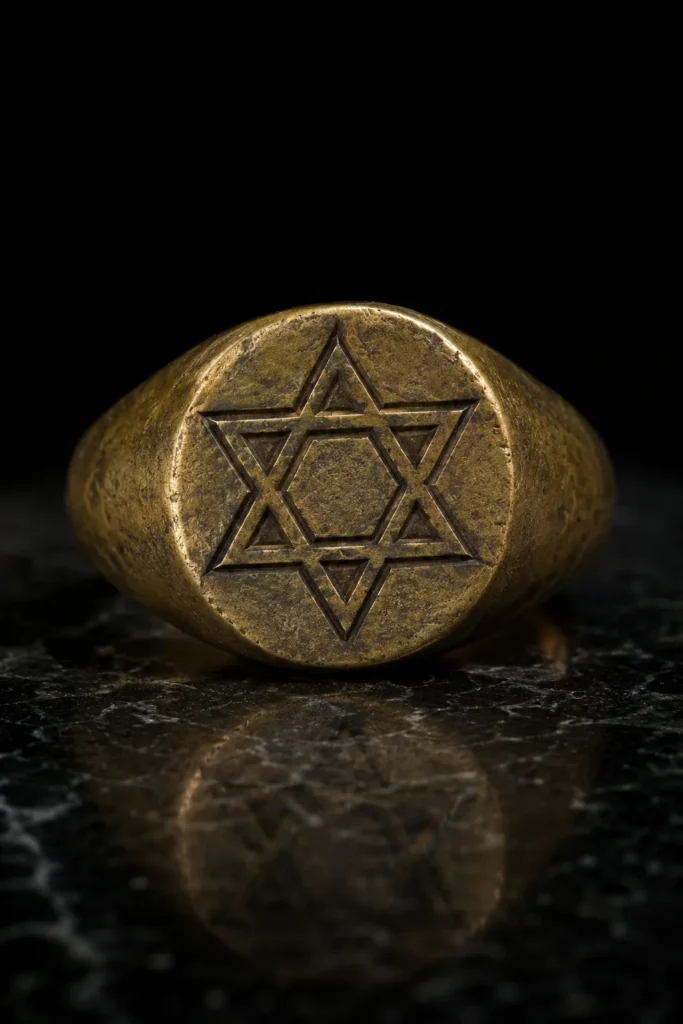
According to the legend, Solomon possessed a signet ring. With this ring, the Seal of Solomon, he commanded the spirits and demons and forced them into his service.
The Seal of Solomon is thus a sign of power over the spirits. It is meant to bind, control and keep away harmful powers. Therein lies its meaning as a protective sign.
The sign is not confined to a single culture. It has its origin in the Jewish tradition and from there travelled into the Islamic tradition and into Western magic.
In religious studies, the Seal of Solomon is a good example of a sign that travelled across the boundaries of several religions. Its history connects the Jewish, the Islamic and the Christian-influenced magical tradition.
The Seal of Solomon also shows that a protective sign can be bound up with a narrative. Its power derives from the legend of Solomon and his power over the spirits.
King Solomon
The Seal of Solomon is connected with King Solomon. Solomon is an important figure of the Hebrew Bible, a king of ancient Israel.
The Bible portrays Solomon as a king of extraordinary wisdom. This wisdom is his outstanding trait, and numerous narratives revolve around it.
Solomon is also regarded as the builder of the Temple in Jerusalem. The construction of this Temple is one of the great works attributed to him.
Beyond the biblical account, a rich tradition of legend grew up around Solomon. In these legends his wisdom is expanded into a knowledge that also encompasses the language of the animals and the world of the spirits.
In this legendary tradition Solomon becomes a ruler who possesses power over the spirits and demons. He exercises this power with the help of his signet ring.
The Seal of Solomon thus belongs to this expanded, legendary figure of the king. It is the sign of his power over the invisible forces, a power that the legend, not the Bible, ascribes to him.
The Legend of the Signet Ring
At the centre stands the legend of Solomon’s signet ring. This legend explains where the seal derived its power over the spirits.
According to the narrative, Solomon received the ring from God or through divine mediation. The ring was therefore no ordinary piece of jewellery, but an object of divine origin.
With this ring Solomon could command the spirits and demons. He could summon them, question them and force them to serve him.
A widespread narrative reports that Solomon employed the spirits with the help of the ring in the building of the Temple. The invisible forces had to take part in the great work.
The ring bore a seal, and this seal was what was truly effective. With the seal Solomon sealed and bound the spirits. From the seal of the ring the sign takes its name.
A detailed form of this legend is found in an old writing called the Testament of Solomon. There it is described how Solomon questions and binds the demons one by one with the ring.
Form of the Sign
With the form of the Seal of Solomon caution is required, for the sign is not unambiguously fixed. The term has been used for various figures.
The Seal of Solomon is often depicted as a hexagram, a six-pointed star made of two interlocking triangles. In this form it coincides with the figure also known as the Star of David.
Just as often, however, the Seal of Solomon was understood as a pentagram, a five-pointed star. In numerous sources, especially in the magical tradition, the term denotes the five-pointed star.
This inconsistency is characteristic. The Seal of Solomon is less a particular figure than a name that has been linked with various powerful geometric signs.
What these signs have in common, the hexagram as well as the pentagram, is that they were held to be powerful. Both are self-contained, regular star figures to which a binding power was ascribed.
For an accurate account it is important to name this inconsistency. The Seal of Solomon has no single fixed form. It is a name under which various powerful star signs were grouped together.
Power over the Spirits
The meaning of the Seal of Solomon revolves around power over the spirits. The sign is meant to bind, control and keep away harmful powers.
This idea is a distinctive one among the conceptions of protection. The Seal of Solomon does not ward off the spirits through a frightening image and does not catch a gaze. It binds the spirits and subjects them.
The notion behind it is that of a rightful rule. Just as Solomon rightfully commanded the spirits with the ring, the seal is meant to hold the spirits in check and to command them.
This conception of binding and controlling the spirits became especially important in the magical tradition. There the Seal of Solomon was regarded as a means to summon and to compel spirits.
At the same time the Seal of Solomon served as protection. A sign that confers power over the spirits can keep away and ward off harmful spirits.
The Seal of Solomon thus belongs to the protective signs that work through binding. It binds the invisible forces, and in this binding lies the protection it grants.
The Seal of Solomon in Islam
The Seal of Solomon did not remain confined to the Jewish tradition. It travelled from there into the Islamic tradition.
In Islam, Solomon is known under the name Sulaiman. He is regarded as a prophet, and the Islamic tradition too ascribes to him power over the spirits.
According to Islamic belief, Sulaiman commanded the jinn, the spirit beings that exist alongside humans. Here too the signet ring is the means of this rule.
The Seal of Solomon, in Islam often called the Seal of Sulaiman, thus became an important sign in the Islamic world as well. It appears on amulets and in the magical tradition.
On the page about Islam the world of the jinn is presented in more detail. The Seal of Sulaiman is among the signs with which Islamic popular piety sought protection from the jinn.
The Seal of Solomon thus shows how closely the Jewish and the Islamic tradition are connected in some respects. The same figure, the same ring, the same power over the spirits are encountered in both traditions.
The Seal in Western Magic
A third line carries the Seal of Solomon into the Western magical tradition. There too it plays an important role.
In medieval and early modern magic, handbooks arose that taught the summoning and controlling of spirits. These handbooks are called grimoires.
Several of these handbooks invoke Solomon and his seal. They bear his name in the title and place themselves in the tradition of his power over the spirits.
In these handbooks the Seal of Solomon appears as a sign with which the magician banishes and compels the spirits. It belongs to the most important signs of this tradition.
This magical use stands outside the Jewish and the Islamic religion. It is a distinct, Western line that invokes the legend of Solomon.
The Seal of Solomon thus has a threefold history of reception. It belongs to the Jewish tradition, to the Islamic tradition and to Western magic. Few protective signs have so widely branched a history.
Seal of Solomon and Star of David
The Seal of Solomon and the Star of David are frequently confused, for both are associated with the hexagram. Their relationship deserves a close consideration.
The hexagram, the six-pointed star, is an old and widespread figure. For a long time it was not a distinctly Jewish sign, but was used in many contexts.
In magical and amuletic use the hexagram was called the Seal of Solomon. In this meaning it was a sign of power over the spirits.
Only later, above all in the 19th century, did the hexagram become the Star of David, the general sign of Judaism. On the page about the Star of David this process is presented in more detail.
The hexagram thus has two names and two meanings that exist side by side. As the Seal of Solomon it is a sign of mastery over the spirits, as the Star of David a sign of Judaism.
For an accurate account this distinction is important. The Seal of Solomon and the Star of David can be the same figure, yet they carry different names, different histories and different meanings.
Reception Today
Today the Seal of Solomon is known above all as a historical and a legendary sign. Its rich history across three traditions makes it a much-discussed subject.
In the study of the Jewish, the Islamic and the Western magical tradition, the Seal of Solomon is an important theme. Through it one can trace how a sign travels across cultural boundaries.
As a worn sign, the Seal of Solomon is encountered in various forms, sometimes as a hexagram, sometimes as a pentagram. In this use its precise meaning has often faded.
In esoteric and magically interested contexts the Seal of Solomon is still known. There it is understood, in the sense of the old tradition, as a sign of power over the spirits.
A factual account names the Seal of Solomon for what it is, a legendary protective sign that rests on the narrative of Solomon’s power over the spirits and that has travelled through three great traditions.
The Seal of Solomon is thus a striking example of a travelling protective sign. In it are joined the legend of the wise king, the conception of the binding of the spirits and a history of reception that reaches across the boundaries of the religions.
References (selection)
Related key terms: Seal of Solomon Solomon Sulaiman signet ring spirits jinn hexagram grimoire.
iWell Guard and Protective Traditions
iWell Guard stands in the cultural-historical line of portable protective objects, to which the Seal of Solomon also belongs. A modern companion for people who live with protective symbols: made in Germany, 41 layers of real gold, platinum and silver, with a 30-day return right.
Personal experiences may vary. Not a medical device. No healing promise.