Milagros: small votive metal plaques of Latin American folk piety
By Ralf Ittermann · last reviewed on
Milagros are small, often figurative metal plaques used as votive offerings in the Catholic-shaped folk piety of Latin America and the Iberian world. The Spanish term milagro means miracle.
With a milagro, a person brings a petition or a word of thanks before a saintly figure, frequently in the shape of a body part, an animal or an object that symbolizes the concern.
From the perspective of religious studies, milagros belong to the long history of votive practice, in which a concern is carried before the sacred in a visible object. This text describes the origin, form and meaning of milagros from an outside perspective and without any claims of efficacy.
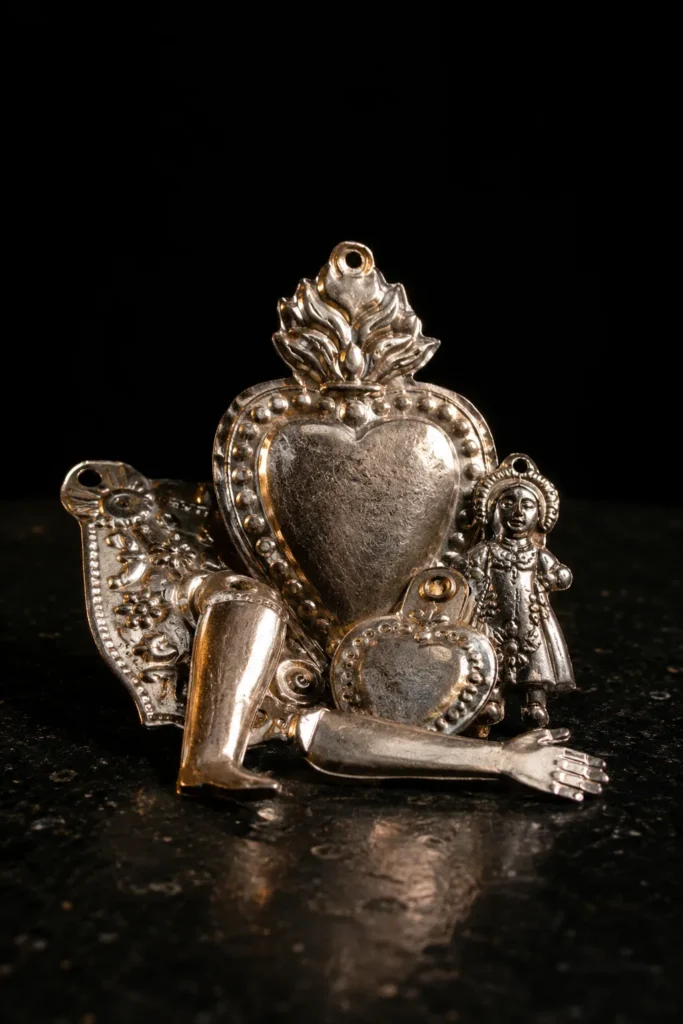
Milagros are small votive plaques offered in Latin America for protection and healing.
Classification of the Milagros
Milagros are small pendants or plaques, usually made of metal, used as votive offerings in folk piety. The Spanish word milagro means miracle and points to the petition for help or the thanks for help received that is bound up with the object.
Most milagros are figuratively designed. They depict body parts such as arms, legs, eyes or hearts, and also animals, houses, vehicles or whole human figures. The figure names the concern, for example the petition for the healing of a particular body part.
Milagros are widespread above all in Mexico, in other countries of Latin America, and in Spain, Portugal and parts of the Mediterranean region. The practice is shaped by Catholicism but in places merges with indigenous and folk-religious ideas.
Milagros are attached to figures of saints, to crosses or to images, laid down at places of pilgrimage or worn on the body. In every case they connect a particular person with their concern and a sacred figure.
In religious studies, milagros belong to the wider context of protective symbols and votive offerings. They are an example of how piety expresses itself in small, everyday objects.
Important for a factual account is that milagros occur both as religious votive offerings and as jewelry and collector’s items. Both uses exist side by side and should be distinguished in any description.
The votive metal plaques, called milagros or ex-votos in Latin America, are usually stamped from thinly rolled tin, silver or brass and attached in stylized form to figures of saints in order to make a hoped-for or already realized healing visible.
Origin and History
The practice of presenting votive offerings in the shape of body parts or objects is very old. Already in antiquity, people in the Mediterranean region laid down such offerings at sanctuaries to ask for healing or to give thanks. This tradition reaches far back into pre-Christian times.
With Christianity, votive practice was carried over into the veneration of saints and of the Mother of God. In Spain and Portugal a rich tradition of small votive offerings developed from this, laid down at images of grace and in pilgrimage churches.
With colonization this tradition reached Latin America. There it merged with indigenous ideas of gift and petition. In Mexico, Peru and other countries an independent and richly varied milagro culture thus arose.
The making of milagros became a craft of its own over time. Silversmiths and later workshops produced milagros in large numbers, so that they became affordable for broad sections of the population.
In the 19th and 20th centuries milagros remained a fixed component of folk piety. At the same time collectors and the art trade began to take an interest in them. Thus new, secular contexts arose alongside the religious use.
Distinct regional centers formed in the process. In Mexico the workshops around pilgrimage sites such as San Juan de los Lagos are particularly well known, while in Peru there are connections to the silver work of the Andean cities.
Researchers in folklore studies have since the early 20th century begun to distinguish these local traditions rather than to assume a single, uniform milagro culture.
Today milagros are used both traditionally as votive offerings and as jewelry, decoration and collector’s items. This diversity is the result of a long history in which an ancient votive practice passed through many transformations.
Form, Material and Manufacture
Milagros are as a rule small, often only a few centimeters in size. They are flat or slightly relief-like in design and frequently have a small loop by which they can be fastened or hung.
The material is usually metal. Tin, brass, silver-plated metal and, in high-quality pieces, silver or gold are common. Simple milagros are stamped from thin sheet metal, more elaborate ones made by hand.
The motifs include body parts, animals, plants, houses, vehicles, tools and human figures. A leg stands for the petition for the healing of a leg, a heart for concerns of the soul or of love, an animal for the welfare of livestock.
Milagros are made by stamping, casting or chasing the metal. In traditional workshops craftspeople work with molds and simple tools. Industrially produced milagros are made in larger quantities.
The choice of a milagro depends on the concern. Whoever asks for the healing of the eyes chooses a milagro in the shape of eyes. This correspondence of figure and concern is the guiding principle of milagro practice.
Alongside the figurative milagros there are simple plaques without any pictorial representation. Painted or inscribed votive tablets, the so-called retablos, also belong to the wider context, but are to be distinguished from the small metal milagros.
Religious and Mythological Background
Milagro practice rests on the Catholic idea of intercession. Saints and especially the Mother of God are regarded as mediators who carry the concerns of the faithful before God. A milagro is directed to such a mediating figure.
At its core stands the principle of petition and thanks. A person brings a concern forward with the milagro, for example the petition for healing, for protection on a journey or for the welfare of the family. If the petition is fulfilled, a further milagro can be presented in thanks.
The figurative design makes the concern visible. The affected body part or area of life is set, as it were, before the eyes of the saintly figure. The object translates an inner worry into an outward sign.
In Latin America older indigenous ideas of gift and counter-gift frequently combine with this Catholic foundation. Milagro practice is therefore often part of a folk-religious piety that unites ecclesiastical and indigenous elements.
In religious studies, milagros can be compared with other votive offerings, for example with the yarn objects of the Wixárika described in the article on the Eye of God. In both cases a concern is brought before a sacred power in an object.
The idea of intercession also explains why milagros are frequently assigned to particular saints. Travelers turn to the patron saints of the roads, the sick to saints to whom folk piety attributes a closeness to a particular affliction.
The choice of the figure invoked is thus just as meaningful as the form of the milagro itself.
The religious meaning of milagros therefore lies less in the object itself than in the act of presenting it. The milagro is the visible sign of a relationship between a person, their concern and a venerated figure.
Ritual Use and Bearers
The most common use of a milagro consists in fastening it to a figure of a saint, an image of grace or a cross. At much-visited places of pilgrimage, figures of saints are sometimes densely hung with milagros.
The presentation may be accompanied by a prayer, a candle or a vow. Some of the faithful connect the milagro with a pilgrimage, others present it in the local parish church. The procedure follows regional customs.
Milagros are also worn on the body, for example on a chain, or kept at the household altar. In this form they accompany a person over a longer period and recall the concern or the thanks.
The bearers of the practice are believers of all social classes. Milagro piety is not bound to priests but is part of the lived religion of families and individuals. It can be carried out without ecclesiastical mediation.
Figures of saints in private homes are in many cases themselves adorned with milagros. In this way a place arises at the household altar where the petitions and thanks of the family are visibly gathered.
The act of presentation is in most cases plain. A person fastens the milagro, speaks a prayer or lights a candle. It is precisely this simplicity that has contributed to the wide spread of the practice, for it requires neither special knowledge nor the presence of a member of the clergy.
Beyond their religious use, milagros are employed in handicraft and jewelry. They adorn boxes, frames and items of clothing. In this use the decorative value comes to the fore.
Regional Variants and Related Forms
In Mexico milagros are especially widespread and are made in numerous workshops. There they are a self-evident part of folk piety and of handicraft. There are also distinct milagro traditions in Peru, Brazil and other countries of Latin America.
In Spain and Portugal the tradition of small votive offerings is likewise alive. Here it is frequently designated by its own terms. The forms and materials can differ from the Latin American milagros.
Related to the milagros are the painted votive tablets, the retablos or ex-votos. They show in image and writing a help received and give thanks for it. While the milagro briefly symbolizes the concern, the votive tablet recounts a whole event.
In antiquity and in the European Middle Ages there were also votive offerings in the shape of body parts. The milagros thus stand within a long, widely branching history of religious gifts that connects many cultures.
In religious studies, milagros can be compared with other small objects of piety, for example with pendants and medals. The article on amulet and talisman explains the conceptual differences.
Within the field of protective symbols, milagros occupy a special position, because they serve less to ward off danger than to petition and to give thanks. They show that the piety of protection can take many forms.
Meaning as a Protective Object
In folk piety, milagros are also understood as protective objects, for example when they ask for preservation on a journey, for the protection of a child or for the safety of the house. The protection is thereby hoped for from the saintly figure invoked.
In this conception the protection rests not on the metal of the milagro but on the intercession that is sought with it. The object is the sign of a petition, not a self-acting thing. This distinction is important for understanding.
In religious studies, the protective meaning of milagros can be described as part of a coping with uncertainty. Illness, travel and the welfare of the family are bound up with worry, and the milagro offers an ordered action by which to express this worry.
This text makes no statements about actual protective or healing effects. Described is only what meaning believers ascribe to the object. Promises of healing and claims of efficacy are expressly excluded.
If a milagro is presented in thanks, its meaning shifts from petition to testimony. It then bears witness to an event experienced as help. In this form it is less a protective object than a visible token of thanks.
It remains to be noted that milagros derive their protective meaning from the religious context of the veneration of saints. Outside this context, for example as jewelry, usually only a remembering allusion to the protective meaning remains.
History of Research, Ethical Questions and Cultural Appropriation
Milagros have long been an object of folklore studies and of religious studies. Researchers examined them as examples of votive practice and the veneration of saints. Art history too took an interest in their forms and their craftsmanship.
In the 20th century milagros were increasingly discovered by collectors and by the art trade. They found their way into museums, into private collections and into decorative use. Thus new contexts arose alongside the religious use.
This development raises questions. When a religious object becomes pure decoration, its original meaning can recede into the background. At the same time the situation is less acute than with strictly secret objects, since milagros have always been publicly used offerings.
The making of milagros is an economic basis for many craft businesses in Latin America. The sale to believers and to tourists alike secures income. The market can therefore also preserve the craft.
Ethically required is a precise account that distinguishes religious and decorative use and names the origin of the milagros. Whoever uses milagros as jewelry should be aware of their religious origin.
A serious account refrains from promoting milagros as magical tools. It describes them as what they are in their culture of origin: small votive offerings of a living folk piety.
Reception Today
In Latin America and in the Iberian world, milagros remain part of lived folk piety. At places of pilgrimage and at household altars they are still presented as petitionary and thanksgiving offerings. The tradition is alive.
At the same time milagros have become popular collector’s and decorative objects. In handicraft, interior decoration and jewelry they are valued for their form and their variety. This use is widespread beyond Latin America.
In esotericism and gift culture, milagros are sometimes offered as objects of luck or protection. In religious studies this is a modern form of reception that takes over the label of the protective object without continuing the Catholic votive practice.
Artists take up milagros in collages, jewelry and installations. In this artistic use the objects become building blocks of new works that play with the religious meaning or quote it.
Museums show milagros as testimonies of folk piety. Such exhibitions can foster an understanding of votive practice, provided they place the religious meaning in a factual context and do not merely show the form.
In scholarly literature, milagros have been treated since the works of 20th-century folklore studies. Studies from Mexico and the United States have described them both as a religious source and as an object of material culture. This double perspective shapes to this day how exhibitions and collections classify the small metal objects.
For interested readers a thoughtful approach is advisable. Whoever acquires a milagro can inform themselves about its religious origin. The section protective symbols presents further votive and protective objects.
Literature (Selection)
Related key terms: Milagros votive offering ex-voto folk piety Latin America Mexico veneration of saints pilgrimage metal plaque petitionary offering thanksgiving offering Catholic piety.
iWell Guard and Protective Traditions
iWell Guard stands in the cultural-historical line of portable protective objects to which the milagros also belong. A modern companion for people who live with protective symbols: made in Germany, 41 layers of solid gold, platinum and silver, with a 30-day right of return.
Personal experiences may vary. Not a medical device. No promise of healing.