Rudraksha: the Sacred Beads from the Tear of Shiva
By Ralf Ittermann · last reviewed on
Rudraksha are the seed beads of a tree that are regarded as sacred in Hinduism. Their name means eye of Rudra, and they are closely associated with the god Shiva. Worn and used in prayer, they accompany many believers throughout their lives.
Classification
Rudraksha are beads obtained from the seeds of a particular tree. In Hinduism, they are regarded as sacred. They are worn as jewelry, strung into prayer chains, and used in prayer.
The name Rudraksha combines two word elements from Sanskrit. The first refers to Rudra, a name of the god Shiva. The second means eye. Taken literally, the name designates the eye of Rudra; legend interprets it as a tear.
From this name arises the close connection of the rudraksha with Shiva, one of the great gods of Hinduism. This connection is the core of their religious significance.
The rudraksha belong to the protective and auspicious objects that are worn. They are said to protect the wearer, to help focus the mind, and to accompany the wearer on their religious path.
In religious studies, the rudraksha are a good example of a protective object that comes directly from nature. They are not a crafted sign, but the seeds of a plant to which a sacred meaning has grown.
Care is required when presenting the rudraksha. Alongside their religious significance, there are popular beliefs about their effects that must be distinguished from the established tradition. This too will be addressed in what follows.
The Tear of Rudra
The connection of the rudraksha with Shiva is told in a legend. This legend explains why the beads are called the tear of Rudra.
According to the narrative, the god Shiva sank for a long time into deep absorption and meditation. This absorption was dedicated to the wellbeing of the world and its beings. When Shiva finally opened his eyes, tears fell from them.
From these tears, so the legend tells, the first rudraksha trees arose. The beads of the tree thus emerged, in a sense, from the tears of the god. Within them, a part of Shiva’s compassion and absorption is present.
This legend gives the rudraksha their particular dignity. They are not arbitrary seeds, but stand, according to the narrative, in direct connection with the god. Whoever wears a rudraksha carries, in a sense, a piece of this divine tear.
Like many origin legends, this narrative is not a historical account but an interpretive story. It illustrates clearly why the rudraksha are associated with Shiva and why they are accorded a sacred significance.
The legend thus binds the tree, the bead, and the god into a unity. From this connection grows the entire religious significance of the rudraksha. They are the beads of Shiva, and therein lies their rank.
The Rudraksha Tree and Its Seeds
Behind the legend stands a real tree. The rudraksha tree is a large, evergreen tree that grows mainly in certain regions of South and Southeast Asia, often at higher, humid elevations.
The fruits of the tree are small and bluish in color. Inside the fruit lies the hard seed kernel. This seed kernel is the actual rudraksha bead.
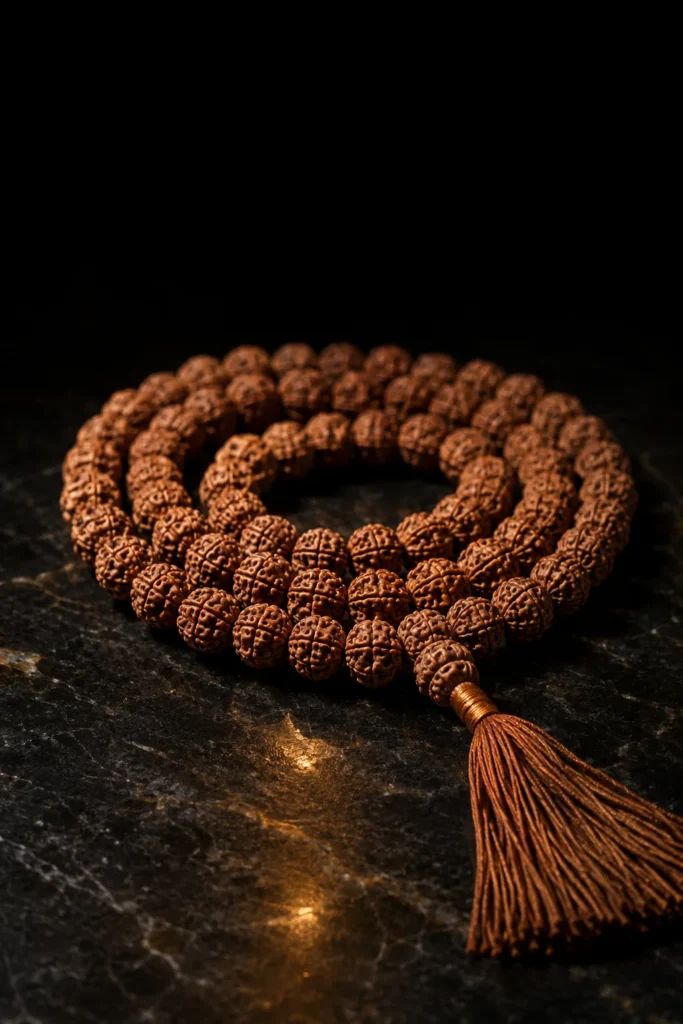
The surface of the seed kernel is not smooth but strongly furrowed and pitted. This natural furrowing is a characteristic feature of the rudraksha and plays an important role in its interpretation.
To obtain the bead, the fruit flesh is removed and the seed kernel is cleaned and dried. After this, the rudraksha is ready to be pierced and threaded onto a cord.
The rudraksha is thus a natural product. Unlike a cast or carved amulet, it is not manufactured but harvested. Its form is the form that nature has given it.
This natural origin itself contributes to its significance. The rudraksha is a gift of the tree, and according to the legend, a gift that traces back to the tears of the god. Nature and belief are closely united within it.
The Mukhis: the Faces of the Bead
An important characteristic of the rudraksha are the furrows on its surface. These furrows run from one end of the bead to the other and divide its surface into segments.
Each of these segments is called a face. The Sanskrit word for this is mukha, and so one speaks of the mukhis of a rudraksha. The number of mukhis varies from bead to bead.
The most common rudraksha has five mukhis. This five-faced bead is widespread and is regarded as the usual, generally usable form. It is worn by many believers.
Alongside this, there are rudraksha with other numbers of mukhis. Particularly rare and therefore especially prized is the one-faced rudraksha. It occurs only rarely and is considered extraordinarily significant.
In the tradition, each number of mukhis is attributed its own meaning and often an association with a specific deity. The number of faces thus determines the character of the individual bead.
The mukhis make the rudraksha a differentiated protective object. There is not one single rudraksha but many kinds, and those knowledgeable in the tradition choose the bead according to its mukhis and according to the particular need.
The Mala and Japa
Rudraksha are frequently strung into a chain. Such a prayer chain is called a mala. The rudraksha mala is one of the most important prayer instruments of Hinduism.
The complete mala traditionally consists of a fixed number of beads, usually one hundred and eight, plus one distinguished main bead. The number one hundred and eight holds a particular significance in the Indian religions.
The mala is used in japa, the repetitive invocation. In japa, a mantra or divine name is spoken again and again. With each repetition, the person praying lets one bead of the mala pass through their fingers.
In this way, the mala helps to count the repetitions and to keep the mind engaged in the practice. The beads give prayer a rhythm and an order. Japa thus becomes a calm, focused practice.
The rudraksha mala thus combines the protective object with religious practice. It is not merely a worn item but a tool of prayer. In it, jewelry, protection, and practice instrument converge.
Alongside the complete mala, rudraksha are also worn as individual beads or as bracelets. In each of these forms, the rudraksha accompanies the believer and keeps the connection to Shiva and to religious practice present.
Rudraksha and Shiva
The rudraksha is associated above all with the god Shiva. Shiva is one of the great gods of Hinduism. He is a multi-layered figure associated with absorption, asceticism, and the dissolution and renewal of the world.
In the pictorial tradition, Shiva himself is frequently depicted with rudraksha beads. He wears them around his neck, arms, and hair. The rudraksha thus belongs to the image of the god.
From this close association, the significance of the rudraksha for the worshippers of Shiva becomes clear. Whoever wears rudraksha follows the example of the god and places themselves visibly in his proximity.
Especially the ascetics and wandering monks who venerate Shiva wear rudraksha in large numbers. For them, the beads are a natural part of their equipment and a sign of their path.
The rudraksha is thus far more than a general token of good fortune. It is a sign of belonging to Shiva and his veneration. In it, the wearer connects with the god from whose tears it arose, according to the legend.
This bond with Shiva gives the rudraksha its firm place in Hinduism. It is not an arbitrary natural product but the bead of a specific god, worn by those who know themselves connected to this god.
Protection and Mental Composure
Several effects are attributed to the rudraksha. One of them is protection. The bead is said to guard its wearer from harmful influences and from misfortune.
A second effect, closely connected to the first, concerns mental composure. The rudraksha is said to help the wearer remain calm and collected. When used as a prayer chain, it directly supports the practice of the mind.
These two effects belong together. According to the understanding of the tradition, a mentally composed, calm person is less vulnerable. Protection and inner composure interlock.
In this, the rudraksha differs from purely defensive protective objects. It does not ward off through a frightening image, and it does not intercept a harmful gaze like an eye amulet. Its protection is bound up with religious practice and with inner attitude.
The rudraksha accompanies the wearer on their spiritual path. It is a reminder of Shiva, it serves prayer, and it is meant to keep the wearer in a state of calm and composure. Its protection is thus a spiritual protection.
In this combination of protection and spiritual practice, the rudraksha resembles the prayer chains of other religions. There too, the chain is at once jewelry, protection, and a tool of inner composure.
Popular Belief and Its Limits
Alongside the religious significance of the rudraksha, there is a rich layer of popular beliefs. These beliefs attribute further effects to the beads, for example regarding health and physical wellbeing.
Such beliefs are widespread and belong to the living world of popular religion. Within it, the rudraksha are often attributed an immediately healing or physically effective power.
Care is required, however, when presenting such beliefs. These are articles of faith, not established knowledge. A medical effect of the rudraksha has not been demonstrated.
A factual presentation records this. The rudraksha is a religious protective and practice object. It is not a remedy, and no medical effects should be attributed to it.
This distinction is important. The religious and spiritual significance of the rudraksha can be presented without ascribing physical healing effects to it. The two must be clearly separated.
The rudraksha thus retains its full significance as the sacred bead of Shiva, as a prayer instrument, and as a companion on the spiritual path. This significance is rich enough and requires no unsubstantiated claims of effect.
Contemporary Reception
The rudraksha remains alive in Hinduism to this day. It belongs to the equipment of many believers, particularly worshippers of Shiva, and is widely used as a prayer chain and worn bead.
Beyond Hinduism, the rudraksha has also become known in other countries through the global spread of yoga and meditation. It is used as jewelry and as a meditation aid.
With this spread comes, as with many sacred objects, a shift in meaning. Outside its religious context, the rudraksha is often understood simply as a sign of calm or as ornamentation.
With the increased demand, trade in rudraksha has also grown. The question of authenticity has arisen, since especially the rare beads are sought after and valuable.
Within Hinduism itself, however, the rudraksha remains what it has always been: a sacred bead connected with Shiva. There it is part of religious practice and a sign of faith.
The rudraksha is thus a compelling example of a protective object from nature. From the seed of a tree that arose, according to legend, from the tears of a god, a companion has emerged that unites protection, prayer, and spiritual composure in a single bead.
Selected Bibliography
Related key terms: Rudraksha Shiva Rudra Mala Japa Mukhi prayer bead seed Hinduism.
iWell Guard and Protective Traditions
iWell Guard stands in the cultural-historical lineage of wearable protective objects, to which the rudraksha bead also belongs. A modern companion for people who live with protective symbols: crafted in Germany, 41 layers of genuine gold, platinum, and silver, with a 30-day right of return.
Personal experiences may vary. Not a medical product. No healing claims.