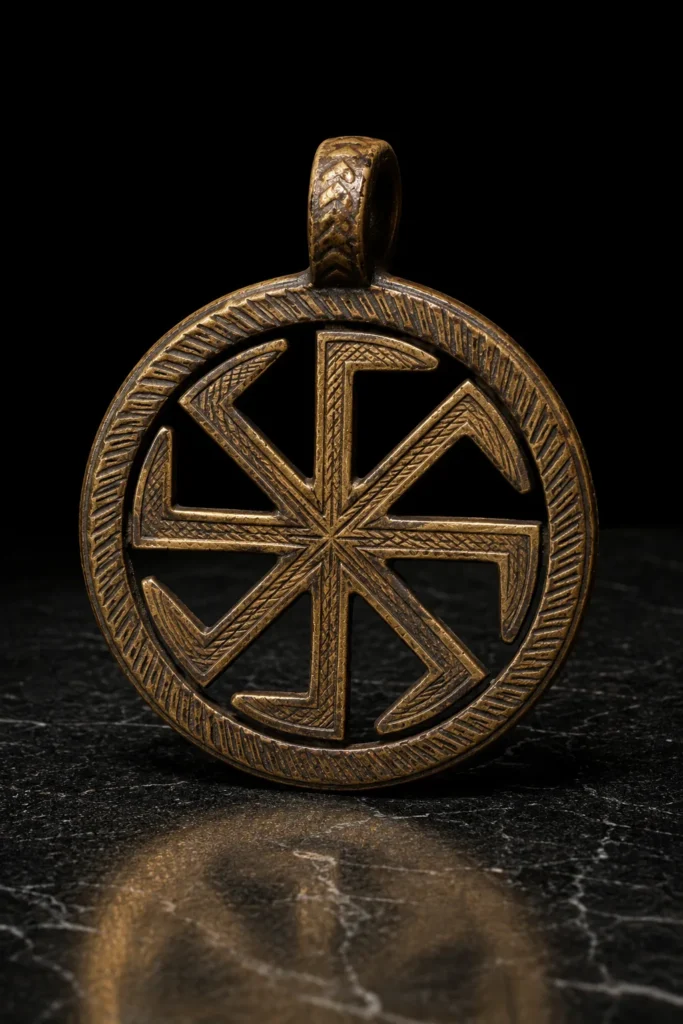
The kolovrat is a Slavic sun wheel, a circular sign made of curved spokes. It stands for the sun and its course. Its present, fixed form is, however, more recent than is often assumed.
The kolovrat is a sun wheel symbol from the Slavic cultural sphere. It shows a circular, rotating wheel. From a center point, several curved spokes or rays radiate outward.
The name Kolowrat combines two word elements that refer to the wheel and to rotation. Taken literally, the sign therefore denotes a turning wheel. This rotational motion is essential to its meaning.
The kolovrat is understood as a sun sign. It stands for the sun, for its circling in the sky, and for the course of the year. Its protective meaning derives from this connection with the sun and with light.
In scholarship, the kolovrat is treated with care. Sun and wheel signs are ancient in the Slavic world, yet the kolovrat in its present, fixed form is a comparatively recent phenomenon. This distinction is part of an accurate account.
The kolovrat is therefore an instructive case. It shows how a sign can draw on old visual ideas while still belonging, in its elaborated form, to the modern era. An honest account separates the old roots from the modern elaboration.
As a protective sign, the kolovrat belongs to the family of sun and light symbols. It is attributed the power to ward off darkness and misfortune through the force of light. This places it within a widely distributed family of protective signs.
The kolovrat belongs to the broad group of sun wheels. A sun wheel is a circular sign representing the sun and its movement. Such signs are known across many cultures.
The reason lies in the observation of the sky. The sun appears as a round disk, and it moves across the sky in a steady, recurring course. The wheel is a natural image for this circular motion.
The sun wheel thus combines two ideas. It shows the sun as a disk, and at the same time shows it as something that turns and returns. The kolovrat, with its curved spokes, emphasizes precisely this rotational movement.
The sun was of the greatest importance to people of earlier times. It brought light, warmth, and the flourishing of the fields. Its reliable course structured the day and the year. A sign of the sun was therefore a sign for life itself.
This significance explains the high standing of sun wheels. They stood for a benevolent, life-giving power. Whoever used a sun sign aligned themselves with the light and with the reliable order of the heavens.
The kolovrat is the Slavic expression of this widespread idea. It takes its place in a long line of sun wheels that arose in various cultures, independently or in connection with one another.
The kolovrat has a clear, circular form. From a central point, several spokes radiate outward, curved toward the rim. This curve makes the wheel appear to be in motion.
The kolovrat most often has eight spokes, though other numbers occur as well. The curved arms can point to the right or to the left. The direction of the curve creates the impression of rotation in one direction or the other.
The curved form of the spokes is the distinctive feature of the kolovrat. A wheel with straight spokes appears to be at rest. A wheel with curved spokes appears to be turning. It is precisely this motion that the kolovrat is meant to express.
The rotation points to the course of the sun and to the cycle of the year. Just as the sun ceaselessly traces its path, the wheel turns. The kolovrat is thus an image of the unending, reliable movement of light.
The geometrically clear form makes the kolovrat easy to recognize. It can be drawn, carved, and embroidered with ease. This visual clarity has contributed to its spread as a worn and depicted sign.
When examining the kolovrat, however, attention is warranted. Rotating wheel signs resemble one another across many cultures. An accurate account takes care not to hastily equate the Slavic kolovrat with similar signs of other origins.
To place the kolovrat in context, it is worth looking at Slavic religion before Christianization. Less is known about this religion than about some others, because the Slavs left almost no written sources of their own.
Knowledge of pre-Christian Slavic religion rests on a small number of outside accounts, on archaeological finds, and on traces in language and folk custom. This source situation is limited and calls for cautious conclusions.
From what is known, the sun played a significant role in Slavic belief. Deities are associated with it to whom light, warmth, and flourishing were attributed. The sun was regarded as a benevolent, life-promoting power.
The course of the year with its festivals was also closely tied to the position of the sun. The turning points of the solar year, the longest and the shortest night, were important occasions. Slavic folk custom included festivals celebrated with fire and light.
Against this background, a sun sign in the Slavic world is readily understandable. The sun was a central, venerated power. A sign representing it connects with this venerated standing.
Precisely because the sources on Slavic religion are sparse, restraint is called for. Much must be inferred, and not everything said today about Slavic sun veneration can be substantiated from the old sources.

In the Slavic world there are old ornaments that are related to the kolovrat. Circular, radiating, and rotating patterns appear on various objects.
Such patterns are found on clay vessels, on jewelry, and on objects of daily life. Particularly rich is Slavic embroidery, in which geometric signs were passed down over long periods. Radiating and wheel-shaped patterns have been preserved within it.
These embroidery patterns were handed down across generations. Certain signs were attributed a protective meaning in this process. The embroidery on clothing and cloths served not only as decoration but could also be understood as protection.
It is therefore correct that in the Slavic world there exists an old tradition of radiating and wheel-shaped signs. Sun and wheel motifs are attested in Slavic folk art. The kolovrat connects with this tradition.
However, a distinction must be drawn between these old ornaments and the present-day kolovrat. The old patterns are varied and have not been reduced to a single, fixed form. The kolovrat, with its particular, standardized shape, is by contrast a clearly defined individual sign.
The old ornaments are thus the root from which the kolovrat becomes understandable. They are not, however, the kolovrat itself. This distinction is important for an accurate account.
For the kolovrat, the question of age is of particular importance. In the common image today, the sign is frequently regarded as an ancient, pre-Christian symbol of the Slavs. This view calls for careful examination.
It is correct that radiating sun and wheel motifs are old in the Slavic world. Such motifs can be documented in folk art and in archaeological finds. The general idea of a sun wheel thus has old roots.
The kolovrat as a specific, clearly defined sign with a fixed name and a set form is, however, a modern phenomenon. It was elaborated and standardized within the Slavic neopagan movements of the 20th and 21st centuries.
The present-day kolovrat is therefore a modern synthesis. It takes up old visual ideas but brings them into a new, unified form and provides them with a fixed name and an elaborated interpretation.
This observation does not diminish the sign. It only places it correctly. The kolovrat is a modern sign that connects with an old tradition. Both belong together and should be clearly named as such.
An honest account therefore avoids two errors. It does not claim that the kolovrat in its present form is ancient. And it does not deny that Slavic sun signs have old roots. Both sides belong to the truth about the kolovrat.
The present-day kolovrat is closely connected with Slavic neopagan movements. These movements, often grouped under the name Rodnovery, seek to revive the pre-Christian religion of the Slavs.
These movements arose in the 20th century and have since spread across several countries of the Slavic world. They draw on the few old sources, on folk custom, and on their own elaborations.
Within these movements, the kolovrat became a central sign. It serves as a recognition and faith sign, standing for the veneration of the sun and for the connection with the Slavic tradition.
The kolovrat is therefore primarily the sign of a modern religious movement that appeals to an ancient past. This classification is important for understanding the sign.
Like other signs used by neopagan movements, the kolovrat is not protected against appropriation. Cases have occurred in which the sign was used by groups whose concerns have nothing to do with sun veneration.
Anyone presenting the kolovrat should be aware of this tension. A factual account shows the sign in its proper context, as a Slavic sun sign, and classifies it in accordance with its modern origins.
The protective meaning of the kolovrat is grounded in the idea of the power of sunlight. The light of the sun drives out darkness. From this simple observation grew the thought that light can also drive out misfortune.
In a great many cultures, light is assigned to the good and darkness to the harmful. A sun sign therefore stands on the side of light and good. It wards off by setting the bright against the dark.
The kolovrat as a sun sign carries this meaning within it. Whoever uses it places themselves under the sign of light. The wheel of the sun is held to keep away darkness and the misfortune associated with it.
Added to this is the idea of reliable return. The sun rises anew each morning, and it returns reliably after the dark season. The turning wheel stands for this reliable order, which is itself a form of protection.
The kolovrat thus protects not through a forbidding image and not through a sacred written character. It protects through the connection with light and with the reliable order of the sun’s course.
In this mode of operation, the kolovrat resembles other sun signs from across the world. The sun wheel as a protective sign is a widely distributed idea, and the kolovrat is its Slavic form.
The kolovrat is today widespread primarily in the Slavic world, and also beyond it. It is worn as a jewelry pendant, used as an embroidery motif, and taken up in design.
In the Slavic neopagan movements, the kolovrat holds a firm place as a sign of faith and recognition. There it stands for sun veneration and for the connection with the pre-Christian Slavic tradition.
Beyond these movements, the kolovrat is understood by some as a general Slavic cultural sign and by others as a purely decorative motif. In this usage, the precise meaning often recedes into the background.
As already noted, the kolovrat is not protected against appropriation by groups with entirely different aims. This tension accompanies the sign and should be kept in mind when presenting it.
At its core, however, the kolovrat remains a sun sign. It stands for light, for the course of the sun, and for the reliable order of the year. This basic meaning is the same across all uses.
The kolovrat is thus a good example of a sign that combines old roots with a modern form. It shows how a clearly defined sign can be shaped in the present from transmitted sun motifs, connecting with a very old veneration of the sun.
Related key terms: Kolowrat sun wheel Slavic Rodnovery sun sign spokes folk art sun veneration.
iWell Guard stands in the cultural-historical line of wearable protective objects, which includes the kolovrat. A modern companion for people who live with protective symbols: made in Germany, 41 layers of genuine gold, platinum, and silver, with a 30-day right of return.
Individual experiences may vary. Not a medical device. No healing claims.