iWell Guard

The Troll Cross: The Iron Protective Amulet of the North

The troll cross is a protective amulet made of bent iron that is said to protect against trolls and misfortune in Scandinavia. The belief in the protective power of iron is old, while the troll cross itself is a more recent form.

The troll cross is the iron protective amulet of the far north.

Protective symbolGermanicProtective amulet
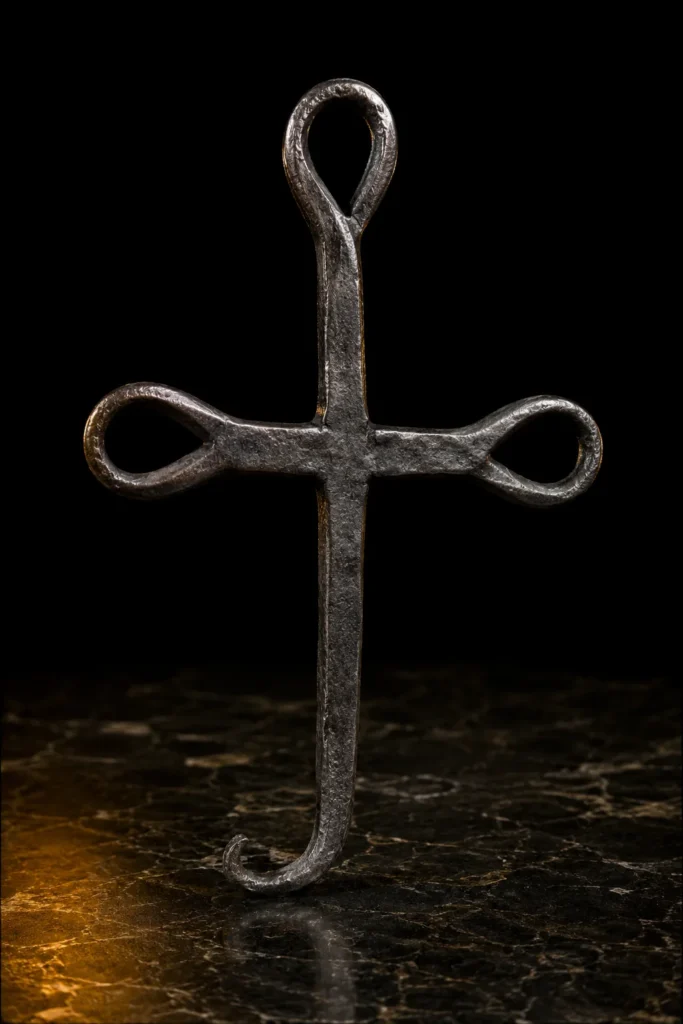
Troll cross - protective symbol, museum-style illustration

Classification

The troll cross is a protective amulet from the Scandinavian region and belongs to the Germanic-Nordic world. It consists of a bent piece of iron that forms an open, cross-like or loop-like shape.

Its task is warding off. The troll cross is said to protect its wearer from trolls and from other misfortune. In Scandinavian tradition, trolls are dangerous beings closely bound to nature.

The troll cross is worn as a pendant or fixed to doors and within the house. In both forms it is meant to keep misfortune away: on the body it protects the wearer, on the door it protects the house.

In classifying the troll cross, an important distinction must be made. The belief in the protective power of iron is old and well attested. The troll cross as a specific, named amulet, by contrast, is a more recent phenomenon.

This distinction runs through the entire account. It is necessary because the troll cross is often regarded today as ancient, whereas its documented history as a shaped amulet is shorter.

In the study of folk magic, the troll cross is a good example of how an old idea of protection, here the power of iron, can in more recent times be condensed into a specific, marketable amulet.

Iron as a Protective Metal

The core of the troll cross’s meaning lies in its material, in iron. For a long time, iron was regarded in Nordic and in European folk magic as a metal with protective, warding power.

Iron was credited with keeping harmful powers away. Trolls, spirits and other malevolent beings were thought to shun iron. Iron objects were therefore regarded as effective means of warding off harm.

This belief showed itself in many customs. Iron objects, nails, blades and tools were fixed at thresholds, on cradles and in stables in order to secure these places.

One reason for this notion may lie in the special standing of iron. Its extraction and its working in the fire of the forge were regarded as a skill with its own, almost mysterious significance.

Other protective objects also rest on this notion. The European horseshoe owes its protective meaning largely to its iron material. On the page about the horseshoe, this connection is presented in more detail.

The troll cross is made of iron, and thus it carries within it from the outset the protective meaning of this material. As a mere piece of iron it would already, in folk thinking, be a warding sign, even before its shape is added.

Trolls in Nordic Tradition

The troll cross is directed against trolls. To understand the amulet, it is worth taking a look at these beings of Nordic tradition.

In the Scandinavian world of legend, trolls are beings closely bound to nature. They are imagined in the mountains, in the forests and in the wilderness, far from the world of humans.

Trolls were regarded as dangerous. They could harm people, their livestock and their houses. The isolated Scandinavian farmsteads, surrounded by wilderness, felt especially exposed to such beings.

In the legends, trolls appear in many forms, often large and uncouth, sometimes cunning, always foreign and hostile to the world of humans. They embody uncanny, untamed nature.

Against such beings people sought protection. The belief that trolls shun iron made iron objects an obvious means of warding off harm.

The troll cross takes up this belief. It is an iron amulet that names, in its very name, the beings against which it is directed. It is the cross against the trolls.

Form of the Troll Cross

The troll cross has a distinctive form. It consists of a single piece of iron bent into an open shape.

The form recalls a cross or a loop. Often one end of the iron rod is bent into a ring or a curve, while the other end is shaped differently.

This form is occasionally associated with a runic sign. Some interpretations see in the curve of the troll cross the suggestion of a rune. This interpretation, however, is not certain.

The material is iron, usually in a form that a blacksmith can work and bend by hand. The troll cross therefore appears plain and handmade, not fine and elaborate.

The troll cross is worn as a pendant on a cord or chain. In this form it accompanies the wearer. Larger pieces are fixed to doors or within the house.

The plain, wrought-iron form is characteristic of the troll cross. It underlines the connection to iron and to the work of the blacksmith, on which the protective meaning of the amulet rests.

The Question of Age

With the troll cross, the question of age is important. In the image current today, the troll cross is often regarded as an ancient Nordic amulet. This notion calls for careful examination.

It is correct that the belief in the protective power of iron is old. Iron objects as a defence against trolls and misfortune are attested over a long period in Scandinavian and in European folk belief.

The troll cross as a specific, named amulet shaped in a fixed form, however, is a more recent phenomenon. It became known and widespread in more recent times.

The 20th century played an important role in this. The troll cross became widely known, among other things, through a female blacksmith from a Swedish province, who described and reproduced such a piece as a family heirloom.

Today’s troll cross is thus the result of a convergence. An old idea of protection, the power of iron against trolls, was condensed in more recent times into a specific, marketable amulet.

An honest account names both sides. The belief in protective iron is old. The troll cross as a shaped amulet, as it is offered today, is a young expression of this old belief.

The Blacksmith and Iron

The troll cross is closely connected with the figure of the blacksmith. The blacksmith mastered the fire and shaped the hard iron, and in folk belief his craft was regarded as an art with special power.

In the legends of many European peoples, the blacksmith is a significant figure. He is often credited with a closeness to mysterious knowledge and to supernatural powers.

This esteem for the blacksmith and his material is reflected in the troll cross. It is a piece of iron forged by hand, and its protective power is bound up with the art of the blacksmith.

Iron made by a blacksmith was regarded as especially effective. Worked in the fire of the forge, it was not merely metal, but a substance that had gained its own significance through the skill of the blacksmith.

The troll cross is therefore not a finely worked piece of jewellery, but a hand-forged amulet. Its plain form points directly to the forge and to the power of the iron worked there.

In this connection of blacksmith, iron and protection, the troll cross stands alongside the horseshoe. Both amulets rest on the protective power of iron and on the special standing of the blacksmith.

The Troll Cross and Related Protective Customs

The troll cross does not stand alone. It belongs to a whole group of protective customs that were directed in Scandinavia against trolls and misfortune.

Among these customs was the placing of iron objects at endangered spots. Iron above the door, on the cradle or in the stable was meant to keep the harmful beings away.

Certain plants, too, were regarded as protection against trolls. The rowan in particular, a tree to which a protective power was attributed in the north, belonged to these means of warding off harm.

Alongside these there were protective signs, protective sayings and customs observed on special days of the year. Nordic folk magic knew a rich repertoire for warding off trolls.

The troll cross fits into this repertoire. It condenses the widespread custom of protecting against trolls with iron into a single, portable amulet.

Anyone who wishes to understand the troll cross should therefore see it in the context of this whole protective practice. It is the handy, worn form of an idea of protection that was deeply rooted in Scandinavian folk belief.

Protection Through Iron

The protective effect of the troll cross rests, as shown, above all on iron. The troll cross protects not through a frightening image and not through a sacred sign of writing, but through its material.

This principle of effect, protection through a particular substance, is widespread in many cultures. It rests on the idea that the power dwells and works in the substance itself.

With the troll cross it is iron to which this power is attributed. According to folk notion, the bent piece of iron works against the trolls precisely because it is made of iron.

The form of the troll cross, by contrast, recedes. It makes the amulet recognizable and wearable, yet the actual protective power lies in the material, not in the shape.

In this the troll cross differs from signs such as the pentagram, whose effect depends on the form. With the troll cross the substance is decisive.

The troll cross is thus a clear example of a protective object that works through its material. It belongs to the substance amulets, and among these to the large group that rests on the protective power of iron.

Reception Today

Today the troll cross is known above all in Scandinavia and within the sphere of interest in Nordic culture. It is worn as a jewellery pendant and sold as a protective sign.

In this use the troll cross is often presented as an old Nordic amulet. As shown, this presentation is too simplified. The belief in protective iron is old, while the shaped troll cross is younger.

For some, the troll cross is a protective sign taken seriously, for others a piece of jewellery or a keepsake of Nordic culture. In this twofold use it resembles many other protective objects.

A factual account values the troll cross but classifies it correctly. It is the modern, condensed form of an old idea of protection, not an unchanged, handed-down Viking-age amulet.

This classification does not diminish the troll cross. It remains a striking protective amulet that makes the belief in the power of iron and in the warding off of trolls visible in a plain, hand-forged object.

The troll cross is thus a good example of how an old idea of protection lives on in the present. From the widespread custom of protecting against trolls with iron, a named, portable amulet has emerged.

References (selection)

  • Bengt af Klintberg: Svenska folksägner (Studies on Swedish legend tradition)
  • Reimund Kvideland, Henning Sehmsdorf: Scandinavian Folk Belief and Legend (1988)
  • Rudolf Simek: Lexikon der germanischen Mythologie (2006)
  • John Lindow: Swedish Legends and Folktales (1978)
  • Hilda Ellis Davidson: The Lost Beliefs of Northern Europe (1993)

Related key terms: troll cross Trollkors iron trolls protective amulet blacksmith Scandinavia folk magic.

iWell Guard and Protective Traditions

iWell Guard stands in the cultural-historical line of portable protective objects to which the troll cross also belongs. A modern companion for people who live with protective symbols: made in Germany, 41 layers of solid gold, platinum and silver, with a 30-day right of return.

Personal experiences may vary. Not a medical device. No healing promise.