The Ægishjálmur: the Icelandic sign of the Helm of Awe
By Ralf Ittermann · last reviewed on
The Ægishjálmur, the Helm of Awe, is a star-shaped magical sign from Icelandic tradition. It is said to grant its bearer protection and superiority and to instil fear in opponents.
Classification
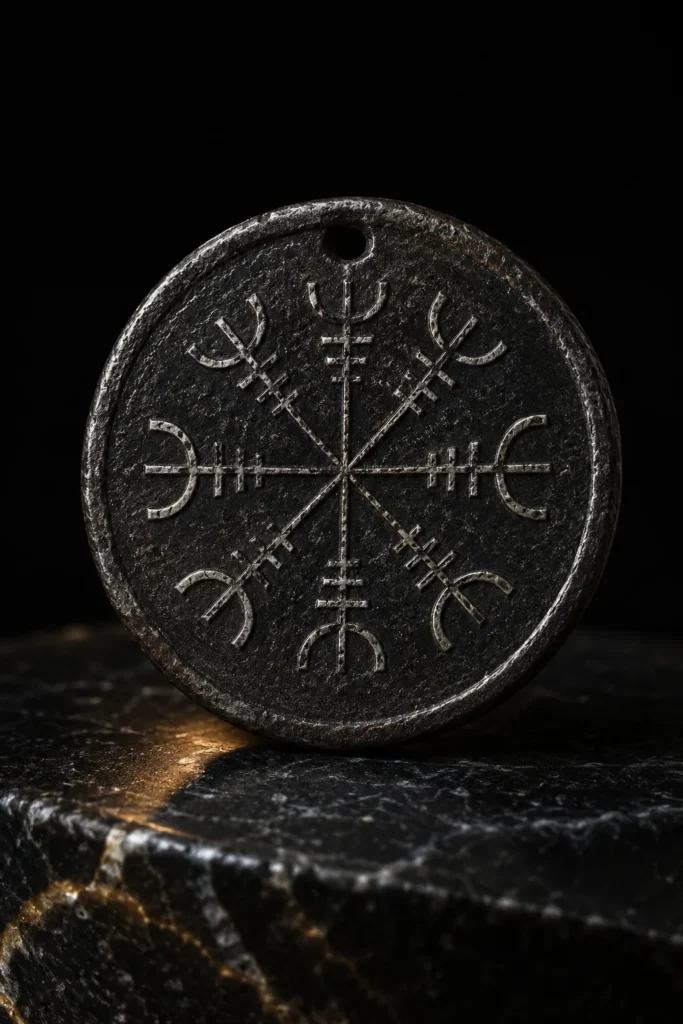
The Ægishjálmur is a magical sign from Icelandic tradition. It consists of several staff-like arms that radiate from a common centre and end in forked tips. The overall form is strictly star-shaped.
Its name is usually translated as Helm of Awe, occasionally also as Helm of Terror. The name already hints at the sign’s function, for it is connected with terror, protection and superiority.
The Ægishjálmur belongs to the Germanic-Norse world and stands close to the Vegvísir. Both are Icelandic magical signs, both are built in a star shape, and both are frequently named together today.
When classifying the Ægishjálmur, a careful distinction is important. The name and the concept are old and reach back into the Old Norse tradition. The drawn magical sign in its present form, by contrast, belongs to a later period.
This distinction between the old concept and the later sign runs through the whole account. It is necessary because the Ægishjálmur in its present image is often taken indiscriminately as Viking-age.
In the study of folk magic, the Ægishjálmur is a good example of how an old concept and a later pictorial sign can grow together. Both layers belong to a complete account.
The name in the old tradition
The term Ægishjálmur is old. It appears in Old Norse literature, that is, in the texts that transmit the myths and heroic legends of the North.
The Ægishjálmur is especially well known from the tale of the dragon Fafnir. In this heroic legend the dragon possesses the Helm of Awe, and it confers on him a fearsome, overwhelming power.
In this tradition the Ægishjálmur is not a drawn sign but a power or object that spreads terror. Whoever possesses it instils fear in his opponents and is superior to them.
The name is linked linguistically with the idea of terror and with the helmet. The helmet is a piece of protective armour, and the Ægishjálmur is, as it were, a helmet that not only protects but also radiates terror.
From the old tradition, then, come the concept and the idea, but not the drawn magical sign. The legend speaks of a power of terror; it shows no star-shaped sign.
This ancient root is important. It shows that the idea of the protective, terror-spreading helmet does indeed reach back into the Old Norse world. The pictorial sign, however, was only added later.
The Icelandic magical staves
The drawn sign of the Ægishjálmur belongs to the Icelandic magical staves. In the Icelandic language they are called galdrastafir. They are geometric signs made of staves, lines and branchings.
These magical staves belong to the Icelandic folk magic of the post-medieval period. They are transmitted in handwritten collections that recorded magical knowledge, and there they stand alongside incantations and instructions.
The galdrastafir are not a pure continuation of the Old Norse religion. Various influences flowed into them, including Christian ideas and learned magical knowledge from continental Europe.
Within this group the Ægishjálmur is one of the best-known signs. It stands beside the Vegvísir, the Icelandic signpost, with which it shares the star-shaped basic form.
Like the Vegvísir, the Ægishjálmur in this form is securely known only from the later manuscripts. Its demonstrable history as a drawn sign therefore does not begin in the Viking Age.
The Ægishjálmur is thus an Old Norse concept that received a drawn form in later Icelandic folk magic. The galdrastafir joined the old name to a new, visible form.
Form of the sign
The drawn sign of the Ægishjálmur is strictly constructed. From a centre several arms radiate, pointing evenly in all directions. Frequently there are eight arms.
Each arm is not simply a straight stroke. At its end and along its sides it bears small branchings and forked tips. These branchings are the most striking feature of the sign.
The forked ends recall tridents or splayed points. They give the Ægishjálmur a defensive, almost bristling expression. The sign appears as though it wards off in all directions.
The strict star shape with its common centre links the Ægishjálmur with the Vegvísir. Both are built from staff-like arms around a centre. The difference lies in the design of the arms and in the meaning.
The clear, geometric form has made the Ægishjálmur easily recognisable. It lends itself well to being drawn, engraved and tattooed. This design strength has contributed to its present spread.
Some recipes in the manuscripts specify applying the sign at a particular place, for example on the forehead. This takes up the helmet idea, for the helmet sits on the head.
Protection and superiority
The meaning of the Ægishjálmur centres on protection and superiority. The sign is meant to preserve its bearer and at the same time grant him a position of strength over others.
The Ægishjálmur is directed especially at situations of distress and confrontation. Whoever faces an opponent or a difficult situation is meant to gain firmness and superiority through the sign.
Part of the effect lies in the fear the sign is meant to spread. According to the idea, the Helm of Awe instils fear in the adversary. This fear weakens the opponent and strengthens the bearer.
In this way the Ægishjálmur combines protection with deterrence. It preserves its bearer by intimidating opponents. The sign works outward, against those who might become dangerous to the bearer.
On this point the Ægishjálmur differs from the Vegvísir. The Vegvísir preserves against going astray; the Ægishjálmur grants protection and superiority in distress. Each of the two signs has its own function.
The Ægishjálmur thus belongs to the protective signs that work not through a petition or a blessing, but through a radiance of strength and terror. Its protection is the superiority attained.
The question of age
With the Ægishjálmur the question of age is especially important, as it is with the Vegvísir. In its present image the sign is often taken indiscriminately as Viking-age. This idea calls for careful examination.
It is true that the term Ægishjálmur is old. It appears in Old Norse literature, and the idea of a protective, terror-spreading helmet reaches back into the Old Norse world.
The drawn magical sign in its present star-shaped form, however, is securely known only from the post-medieval Icelandic manuscripts. From the Viking Age there is no evidence for this sign.
The Ægishjálmur thus combines two layers. The name and the idea are old. The pictorial sign belongs to the later Icelandic folk magic.
This distinction is no minor point. It concerns the core of an honest treatment of the sign. It is not wrong to speak of the old concept, and it is not wrong to speak of the later sign. It would be wrong only to present both, without distinction, as Viking-age.
An honest account names both layers. The Ægishjálmur is an Old Norse concept that found a drawn form in later Icelandic folk magic. This form is striking, but it is not Viking-age.
Ægishjálmur and Vegvísir
The Ægishjálmur is today almost always named together with the Vegvísir. The two signs belong closely together and are the best known among the Icelandic magical staves.
Both signs share the star-shaped basic form. From a centre staff-like arms radiate. At first glance the two signs therefore appear related and similar.
In their meaning, however, they differ clearly. The Vegvísir preserves against going astray and secures the right path. The Ægishjálmur grants protection and superiority in distress.
Both belong to the same world of post-medieval Icelandic folk magic. Both are transmitted in the manuscripts, and for both the same distinction applies between the old concept and the later sign.
Whoever wishes to understand the Ægishjálmur should therefore view it within the context of the whole group of galdrastafir. It is not an isolated sign but part of a rich Icelandic tradition of practical protective magic.
Beyond the Ægishjálmur and the Vegvísir, the galdrastafir comprise many further signs for different concerns. The Helm of Awe is only the best known among the warding, strengthening signs of this group.
The working principle of deterrence
The Ægishjálmur can be considered within the larger context of protective signs. In part it follows the working principle of warding off through deterrence.
This principle rests on the idea that terror keeps others at a distance. Whoever radiates fear keeps opponents away. The Ægishjálmur is meant to spread precisely this fear.
The Ægishjálmur thus stands in line with other signs of terror. The Greek Gorgoneion wards off through the dreadful head of Medusa. The Pazuzu amulet wards off through the demon‘s head. The Ægishjálmur wards off through the terror-spreading power of the helmet.
Unlike the Gorgoneion and the Pazuzu amulet, however, the Ægishjálmur shows no face and no figure. It is an abstract, geometric sign. Its terror lies not in an image but in the power attributed to it.
In this the Ægishjálmur resembles rather the pentagram, which is likewise an abstract sign with a protective meaning. The Ægishjálmur combines geometric clarity with the idea of deterrence.
The Ægishjálmur is thus a case of its own among the signs of terror. It wards off through deterrence, yet it does so not with a fearsome face but with a strict, star-shaped magical sign.
Reception today
The Ægishjálmur is widespread today. It is among the most popular signs associated with the Norse world and is especially sought after as a tattoo.
The Ægishjálmur owes this popularity to its clear, striking form and its meaning. The idea of a sign that confers protection and superiority appeals to many people.
In modern pagan movements that invoke the Norse religion, the Ægishjálmur is used as a sign. There it stands in line with other signs of the North.
With its spread comes, as with the Vegvísir, a widespread false attribution. Very often the Ægishjálmur is presented as an old Viking sign. This presentation is not tenable on the facts.
An accurate account therefore makes it clear. The term Ægishjálmur is Old Norse; the drawn sign belongs to the later Icelandic folk magic. Both layers are genuine, but they belong to different periods.
The Ægishjálmur thus remains a doubly interesting sign. It is a genuine magical sign from Icelandic folk magic with a clear meaning, and it is an example of how old concepts and later pictorial signs flow together in the present-day image of history.
References (selection)
Related key terms: Ægishjálmur Helm of Awe galdrastafir magical staff Iceland Vegvísir folk magic Fafnir.
iWell Guard and protective traditions
iWell Guard stands in the cultural-historical line of portable protective objects, to which the Ægishjálmur also belongs. A modern companion for people who live with protective symbols: made in Germany, 41 layers of solid gold, platinum and silver, with a 30-day right of return.
Personal experiences may vary. Not a medical device. No healing promise.