iWell Guard

The Taʿwīz: the Islamic Amulet from the Word of God

The Taʿwīz is a widespread protective amulet of the Islamic world. It contains verses from the Qurʾan, the names of God, or prayers, and is intended to protect its wearer from harm. Its use is, however, assessed differently among scholars.

The Taʿwīz is an Islamic protective amulet, most commonly inscribed with Qurʾanic verses.

Protective SymbolIslamWritten Talisman
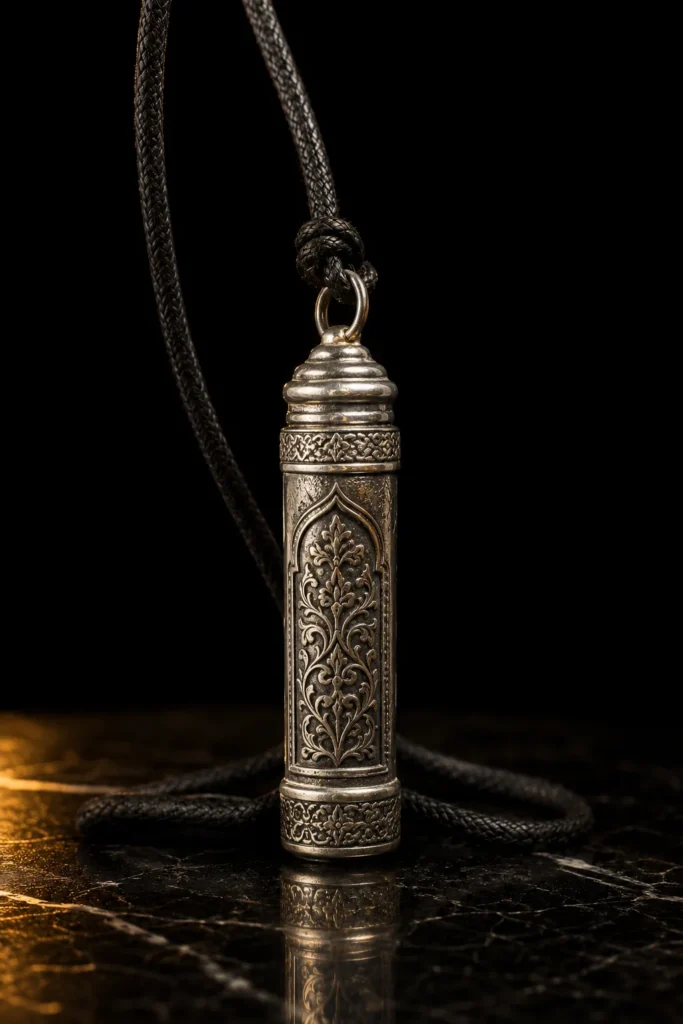
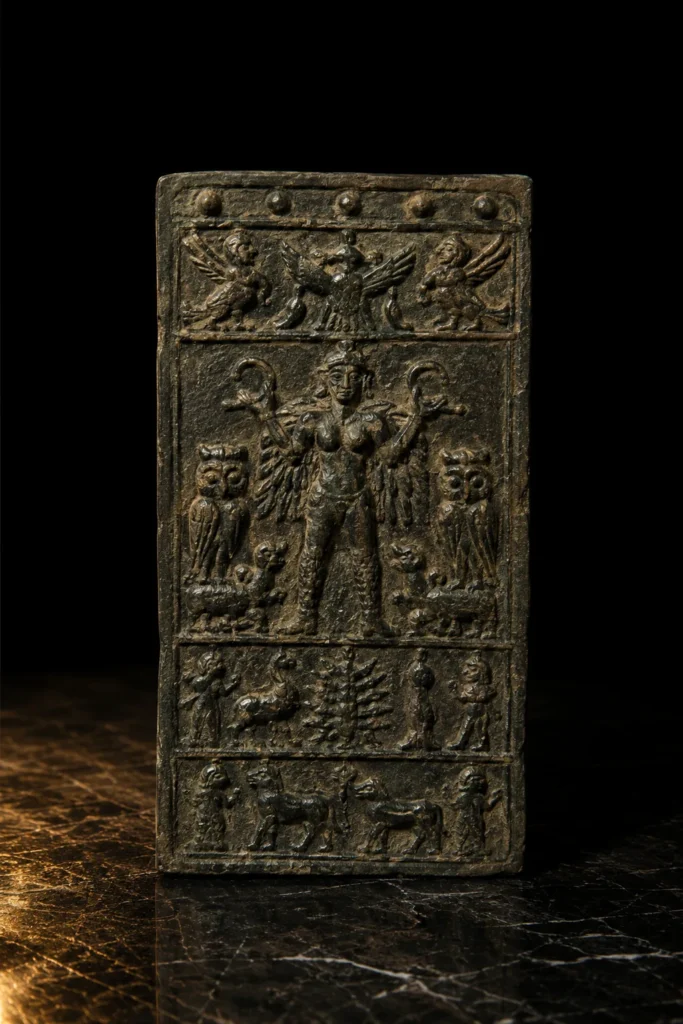
Tawiz - protective symbol, museum-style illustration

Classification

The Taʿwīz is a protective amulet from the world of Islam. In its most common form it consists of a small container or a folded piece of paper worn on the body.

What makes the Taʿwīz distinctive is its content. It typically contains words: verses from the Qurʾan, the names of God, or prayers. The Taʿwīz thus belongs to the group of written talismans, whose efficacy is bound to the written word.

The purpose of the Taʿwīz is to ward off harm. It is intended to protect its wearer from the evil eye, from harmful spirits, from illness, and from misfortune. In this way it is a protective object for everyday life.

In religious studies, the Taʿwīz is a prime example of a protective object whose use is contested within its own religion. It stands at the centre of an ongoing debate among Islamic scholars.

This debate is part of any complete account of the Taʿwīz. It shows that the handling of protective amulets need not be uniform even within a single religion, but can be the subject of serious scholarly discussion.

The Taʿwīz is thus not only a protective object but also an example of how a religion reflects on the proper relationship between faith, word, and material object. Both perspectives are presented below.

Name and Form

The word Taʿwīz comes from Arabic and is connected to the idea of seeking protection and refuge. It designates the amulet as an object through which a person seeks protection.

The Taʿwīz appears in various forms. It is often a small container made of metal, such as a cylindrical or rectangular capsule. Inside this container lies the inscribed paper.

Alternatively, the Taʿwīz also exists as a simple piece of paper folded several times and sewn into cloth or leather. In this form it is particularly plain. The container can be worn on a cord around the neck or on the upper arm.

The Taʿwīz is small, since it is designed to be worn on the body. It is meant to accompany a person unobtrusively through the day, and is therefore made small and easy to carry.

In some regions the Taʿwīz is not worn on the body but placed in the home or kept nearby. The basic form, however, remains the same: an inscribed piece of paper enclosed in a protective cover.

In this way the Taʿwīz follows the widespread pattern of the amulet capsule. The effective element, the inscribed word, is kept inside a container. Container and content belong together.

The Content: the Word of God

What is decisive about the Taʿwīz is its content. On the paper inside are written sacred words. According to the understanding underlying this practice, its protective power derives from them.

Most commonly the Taʿwīz contains verses from the Qurʾan, the holy scripture of Islam. Muslims regard the Qurʾan as the word of God. Carrying words from the Qurʾan on the body thus means having the word of God close at hand.

In addition to Qurʾanic verses, the names of God may also appear on the Taʿwīz. The Islamic tradition recognises a series of names expressing attributes of God. Prayers and invocations may also form the content.

Some Taʿwīz also contain numbers and symbols, for instance in the form of magic squares. These elements belong to an older learned tradition of interpreting signs and numbers.

The core of the Taʿwīz, however, is the word of God. It is precisely here that the theological debate begins, for the question is whether the protective effect is attributed to the word of God or to the object itself.

Those who understand the Taʿwīz in the sense of its advocates see in it nothing other than the word of God carried on the body. The protective power then comes not from the paper and not from the container, but from God and his word alone.

The Protective Surahs and the Throne Verse

Certain parts of the Qurʾan are considered particularly protective and are therefore frequently used for the Taʿwīz. Foremost among these are two short surahs at the end of the Qurʾan.

These two surahs are often called the protective surahs. In them the one praying seeks refuge with God from evil in its various forms. They are explicitly texts of seeking protection.

The Islamic tradition reports that the Prophet himself recited these surahs for protection. This gives them a special standing. They are the words with which a Muslim places himself under God’s protection in prayer.

Another frequently used text is the so-called Throne Verse. This is a single, particularly significant verse from the Qurʾan that proclaims the greatness and power of God.

In Islamic piety, this Throne Verse is attributed a strong protective meaning. It is recited and also written down, for instance on a Taʿwīz or on the walls of houses.

The use of precisely these texts reveals the underlying idea of the Taʿwīz. Its protection is meant to flow from the word of God, specifically from those words that in Islam are most closely connected with seeking protection and with the power of God.

Who Produces the Taʿwīz

A Taʿwīz is generally not made by just anyone. Its production is usually reserved for persons to whom a special religious competence is attributed.

Religious scholars or teachers frequently write the Taʿwīz. They are familiar with the sacred texts and the correct selection of verses for the particular need. Knowledge of the Taʿwīz belongs to their learning.

In some regions, particular healers or men with a reputation for piety also produce Taʿwīz. Ideas about who may write a Taʿwīz vary by region.

The production often follows fixed rules. The verses must be selected correctly and written carefully. Sometimes the writing is accompanied by prayers or a particular state of focused recollection.

Those who want a Taʿwīz approach such a person and state their concern. The scholar then selects the appropriate texts. The Taʿwīz is thus often tailored to a specific worry.

This dependence on qualified individuals shows that the Taʿwīz is not an arbitrary piece of paper. Its production requires knowledge, and this knowledge is part of the religious learning of those who write it.

Protection against the Evil Eye and Jinn

The Taʿwīz addresses various dangers. One of them is the evil eye. The belief in the harmful power of an envious glance is widespread in the Islamic world and is also recognised in the tradition.

Another danger against which the Taʿwīz is meant to protect are the jinn. In Islamic understanding, jinn are spirit beings that exist alongside humans. Some of them are considered harmful.

The Taʿwīz is intended to protect its wearer from the harmful effects of such forces. Beyond this, it is also worn against illness, misfortune, and general affliction.

The Taʿwīz is used particularly frequently for children. Children are considered especially vulnerable in many cultures, and so protective amulets are placed on them above all. The Taʿwīz follows this widespread pattern as well.

In this way the Taʿwīz covers a broad range of dangers. It is not limited to a single threat but is intended to safeguard the general well-being of its wearer.

In this orientation the Taʿwīz resembles other protective amulets from around the world. The evil eye, harmful spirits, and the protection of children are concerns that recur in very many protective traditions.

The Theological Debate

The use of the Taʿwīz is assessed differently among Islamic scholars. This debate is old and continues to the present day. It concerns a fundamental question.

At its centre stands the belief in the oneness and the sole power of God. This belief is the core of Islam. From it arises the question of whether wearing an amulet is compatible with this belief.

Some scholars reject amulets. They see the danger that a power may be attributed to the object itself. Whoever attributes to an amulet an independent effect, separate from God, violates in this view the belief in the sole power of God.

Another group of scholars assesses the Taʿwīz more leniently, provided it contains only words from the Qurʾan and the names of God. According to this view, the protection is then not attributed to the object but to the word of God that it carries.

The dividing line thus runs not simply between permitting and prohibiting, but along the question of what the protective effect is referred to. When it is referred to God and his word, many scholars judge the Taʿwīz differently than when it is attributed to the object itself.

This debate is instructive. It shows that Islam takes the question of the proper handling of protective objects seriously and distinguishes carefully between piety and a reliance on objects considered impermissible.

Related Written Talismans

The Taʿwīz belongs to the large family of written talismans. These are protective objects whose efficacy is bound to a written word or sign. Such talismans are widespread in many cultures.

Within the Islamic world the Taʿwīz is widely distributed, from North Africa across the Middle East to South and Southeast Asia. In each region it has its own names and its own forms.

Beyond the Islamic world there are related written talismans in other religions. The Jewish tradition knows inscribed protective amulets, and in Christian popular piety there were also worn protective texts.

In East Asia paper talismans are widespread: the Chinese Fu-talisman and the Korean Bujeok. These too are based on written signs, even though their religious background differs.

This wide distribution shows that the written talisman is a widespread basic pattern. The idea of carrying a sacred or powerful word on the body is found in many religions.

The Taʿwīz is the Islamic expression of this basic pattern. Its distinctive feature is that its content is the word of God, and that its use is carefully considered and debated within its own religion.

Contemporary Reception

The Taʿwīz remains widely used in the Islamic world to this day. In many regions it is part of established protective customs, particularly in connection with children, illness, and concern for well-being.

At the same time the Taʿwīz has remained the subject of ongoing debate. In some currents of Islam its use is emphatically rejected; in others it continues to be practised, under the conditions mentioned above.

In this way the Taʿwīz reveals a living tension. On one side stands an old, broadly rooted popular religious practice. On the other side stands the theological concern for pure belief in the sole power of God.

For a balanced account it is important to name both sides. The Taʿwīz is neither simply an accepted means of protection nor simply a forbidden object. It occupies a space that Islamic scholarship itself carefully explores.

The Taʿwīz is thus a protective object of a particular kind. It carries the word of God and is thereby closely connected to the core of the Islamic faith. And it is at the same time the subject of serious reflection on the boundary between piety and impermissible reliance on an object.

Its significance lies in this dual nature. The Taʿwīz shows that protective objects are not only worn but also reflected upon, and that a major religion takes the need for protection seriously while also seeking to direct it into considered forms.

Selected Bibliography

  • Tewfik Canaan: The Decipherment of Arabic Talismans (1937)
  • Emilie Savage-Smith (Hrsg.): Magic and Divination in Early Islam (2004)
  • Venetia Porter: Arabic and Persian Seals and Amulets in the British Museum (2011)
  • Constant Hamès (Hrsg.): Coran et talismans (2007)
  • Annemarie Schimmel: Die Religion des Islam (1990)

Related key terms: Taʿwīz Taweez written talisman Qurʾanic verse Throne Verse protective surahs jinn evil eye Islam.

iWell Guard and Protective Traditions

iWell Guard stands in the cultural-historical lineage of wearable protective objects, to which the Taʿwīz also belongs. A modern companion for people who live with protective symbols: made in Germany, 41 layers of solid gold, platinum, and silver, with a 30-day right of return.

Individual experiences may vary. Not a medical device. No claims of healing.