The Lamashtu Plaque: Mesopotamian Protective Tablet against the Demoness
By Ralf Ittermann · last reviewed on
The Lamashtu plaque is a Mesopotamian protective tablet. It depicts how the feared childbed demon Lamashtu is driven back into the underworld, and was intended to ward off harm above the bed of mothers and children.
Classification
The Lamashtu plaque is a protective object from the ancient Near East. It is a small tablet of bronze or stone covered with images and texts. It was widespread in Mesopotamia.
The plaque targets a specific being: the demoness Lamashtu. Lamashtu was considered the most dangerous threat to pregnant women, women in childbed, and newborn infants.
Unlike a worn amulet, the plaque was hung up or placed on display. Its position was the living space, above all near the bed where mother and child rested.
The Lamashtu plaque is closely linked to the Pazuzu amulet. On many plaques a Pazuzu head appears, because Pazuzu was the power set against Lamashtu. The page on the Pazuzu amulet describes this connection in more detail.
In the study of religion, the Lamashtu plaque is a fine example of a protective object that depicts an entire scene. It is not a single sign but an image portraying a process: the banishment of the demoness.
The plaque belongs to the best-researched protective objects of Mesopotamia. Numerous examples survive and can be connected with the transmitted incantation texts.
Lamashtu, the Childbed Demon
To understand the plaque, one must know the demoness Lamashtu. In Mesopotamian belief, Lamashtu was a terrible being that directed its attacks against mothers and children.
Lamashtu was conceived as the daughter of the sky god Anu. Unlike other demons, some texts hold that she acted on her own initiative rather than at the gods’ command. This made her especially dangerous.
Lamashtu was held responsible for the worst afflictions that could befall mother and child. She was regarded as the cause of miscarriages, childbed fever, and the early death of infants.
Lamashtu thus embodied a very real danger. Birth and earliest infancy were fraught with risk for both mother and child in the ancient world. Lamashtu was the demonic personification of this ever-present threat.
A more detailed account of the demoness appears on the page about Lamashtu in the beings lexicon. For the plaque, the most important point is that Lamashtu was the adversary against whom the entire object was directed.
The Lamashtu plaque is thus a protective object aimed at a named demoness. It is directed at a specific danger and is not a general apotropaic sign.
Form of the Plaque
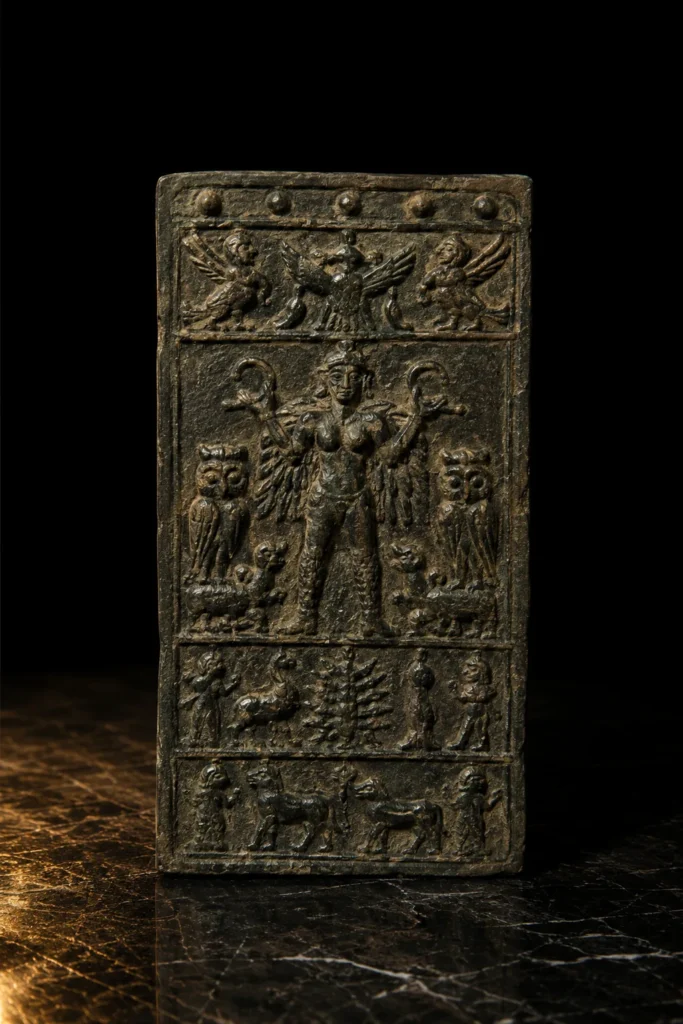
The Lamashtu plaque is usually a rectangular tablet. Its surface is divided into several superimposed pictorial bands, referred to in scholarship as registers.
These registers depict a complete scene. They show the demoness Lamashtu and the process of her banishment. The image thus tells a story across several sections.
Lamashtu herself is portrayed in a fearsome manner. She appears with the head of a predator or a bird, often kneeling and holding suckling animals. These pictorial elements identify her as the dangerous, unnatural being she was considered to be.
In the lower registers the underworld is frequently indicated: the destination to which Lamashtu is to be driven back. The plaque thus shows not only the demoness but also the goal of her banishment.
Projecting above the upper edge of the plaque there is frequently a head looking down onto the scene. It is the head of Pazuzu, who oversees the banishment of Lamashtu.
The plaque is also covered with texts. These texts are incantations against Lamashtu. Image and text together form the effective protective object.
The Scene of Banishment
The image on the Lamashtu plaque does not depict a static state but a process. It shows how the demoness Lamashtu is conjured and driven back into the underworld.
The pictorial registers show the means of this banishment. Offerings for Lamashtu are depicted: gifts intended to appease her and persuade her to withdraw. These include animals, food, and objects for her journey.
The underlying idea is that Lamashtu is provided with offerings and thereby induced to return to the underworld. She is, so to speak, provisioned for her journey and sent on her way.
Lamashtu is often depicted on a donkey or in a boat: the means of her return journey. She leaves the world of the living and returns to the place from which she came.
The image thus shows the desired outcome. It does not depict the threat but its resolution. The plaque makes present the moment at which the demoness yields.
This depiction of the desired outcome is the core of the protective function. By showing the banishment of Lamashtu, the plaque is intended to bring about that banishment. The image of victory is meant to effect the victory.
Pazuzu above the Edge
A striking feature of many Lamashtu plaques is the head projecting above the upper edge. It is the head of the demon Pazuzu, looking down from above onto the scene.
Pazuzu was himself a feared demon, lord of the evil wind demons. Yet precisely as a dangerous being he could be deployed against Lamashtu. Pazuzu was the counter-power that could withstand Lamashtu.
On the plaque, Pazuzu oversees the banishment. His head at the upper edge signals that he presides over the entire process. He is the power ensuring that Lamashtu actually yields.
This arrangement ties the plaque closely to the Pazuzu amulet. Both objects belong together and follow the same logic: a feared power is turned against one that is even more dangerous.
The Pazuzu head on the plaque is therefore not decorative but an essential element. It makes visible who enforces the banishment of Lamashtu.
In the combination of the Lamashtu plaque and Pazuzu, a coherent system of Mesopotamian protective practice becomes visible. The demoness, the counter-power, and the process of banishment are brought together in a single object.
The Operating Principle: Demon against Demon
The Lamashtu plaque follows the same operating principle as the Pazuzu amulet. The study of religion describes it as protection through an allied power of dread.
Rather than invoking only a benevolent deity, Mesopotamian protective practice harnessed the force of a feared being. Pazuzu, himself a demon, was directed against the demoness Lamashtu.
On the plaque this principle unfolds across an entire scene. The demoness is shown, her counter-power is shown, and the process of her banishment is depicted.
The incantation texts on the plaque support this process. They name Lamashtu by name, describe her banishment, and command her to return to the underworld.
Image and text thus work in the same direction. The image shows the banishment; the text pronounces it. Together they are intended to bring about the demoness’s actual retreat.
The Lamashtu plaque is therefore a particularly detailed example of Mesopotamian protective thinking. It does not merely display an averting sign but the entire process of averting.
Above the Bed of Mother and Child
The place of the Lamashtu plaque was the living space, specifically near the bed. There, where mother and child rested, the plaque was meant to ward off harm.
The plaque was attached to the wall or hung up. From there it watched over the room. Its scene of banishment was permanently present and was intended to keep Lamashtu at bay.
This placement near the bed is telling. It shows that the plaque was deployed precisely where the danger was greatest. Lamashtu threatened the woman in childbed and the infant, and it was at their bedside that the plaque stood.
Alongside the hung plaque, pregnant women and young children also frequently wore the Pazuzu-head amulet directly on the body. Protection that was hung up and protection that was worn complemented each other.
In this way Mesopotamian protective practice covered both levels. The plaque secured the space; the worn amulet accompanied the person. Together they formed a comprehensive protection.
The Lamashtu plaque is thus a protective object closely tied to a particular life situation. It belonged to the space of birth and early childhood: the time considered most fraught with danger.
The Lamashtu Incantations
The texts on the Lamashtu plaque belong to a larger body of material. In Mesopotamia there existed an entire collection of incantations against Lamashtu, which was transmitted and organised over a long period.
This collection of incantations describes the nature of Lamashtu, her dangerousness, and the means by which she could be warded off. It is an important source for knowledge about the demoness.
The texts on the plaques are excerpts or condensations of these incantations. They distil the knowledge of Lamashtu‘s banishment into a concise form fixed on the tablet.
The incantations followed fixed rules. They had to be spoken correctly and applied correctly. They were frequently linked to ritual actions, such as the making of figurines or the presentation of offerings.
The incantation was performed by a knowledgeable specialist, an incantation priest. He knew the texts and the actions that were supposed to bring about Lamashtu‘s banishment.
The plaque therefore does not stand alone. It is part of an elaborated protective practice that included texts, ritual actions, and skilled specialists. The object and the knowledge of its use belong together.
Reception Today
The Lamashtu plaque is today known primarily to specialists in the ancient Near East. It does not belong to the widely familiar signs, but within Assyriology it is a well-researched object.
The collections of several major museums contain Lamashtu plaques. They attest to how widespread this protective object was in Mesopotamia and how seriously the threat posed by Lamashtu was taken.
For the study of ancient Near Eastern religion, the plaques are of considerable value. Together with the incantation texts, they provide a precise insight into Mesopotamian protective practice.
The Lamashtu plaque shows that the protection of mother and child was a central concern in the ancient Near East. An entire protective practice of plaques, amulets, texts, and ritual actions was devoted to this concern.
The Lamashtu plaque is thus among the most remarkable protective objects of the ancient Near East. It is closely linked to the Pazuzu amulet and illustrates Mesopotamian protective thinking in particularly thorough form.
In it one can see how an ancient culture responded to the great dangers of life. The Lamashtu plaque is the image of a victory intended to bring that victory about: victory over the demoness who threatened mother and child.
Selected Bibliography
Related key terms: Lamashtu plaque Lamashtu Pazuzu childbed incantation apotropaion underworld Mesopotamia.
iWell Guard and Protective Traditions
iWell Guard stands in the cultural-historical lineage of wearable protective objects, which includes the Lamashtu plaque. A modern companion for people who live with protective symbols: crafted in Germany, 41 layers of genuine gold, platinum, and silver, with a 30-day right of return.
Individual experiences may vary. Not a medical device. No therapeutic claims.