The Slavic Lunula: the moon amulet of the Slavic world
By Ralf Ittermann · last reviewed on
The lunula is a crescent-moon-shaped amulet that was widespread in the Slavic world. Made of metal and worn on a chain or on a headdress, it was used above all by women and associated with the moon.
Classification
The lunula is a jewelry and protective pendant that was widespread in the Slavic world. Its name derives from a Latin word for the little moon.
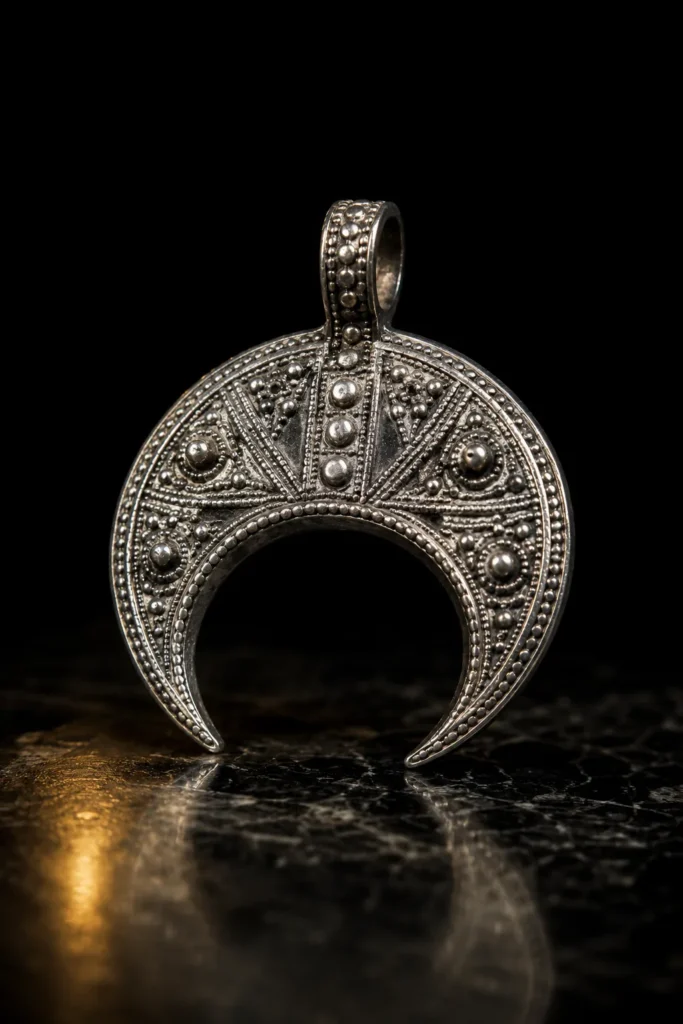
The amulet has the shape of a crescent moon. It is a curved pendant that tapers at both ends, and whose open side points either upward or downward depending on how it is worn.
Lunulae were made of metal, often of bronze or of silver. They were worn on a chain around the neck or on a headdress and belonged to the array of jewelry.
The lunula was worn above all by women. It belonged to women’s jewelry and is therefore associated with the world of women, with the moon and with fertility.
In archaeology and in religious studies, the Slavic lunula is a well-documented example of a moon amulet. It combines the functions of jewelry and of protection.
This page presents the Slavic lunula from the standpoint of protection. It describes the form, the archaeological record, the connection with the moon, the wearing by women and the interpretation of the sign.
Form and material
The lunula has a clearly outlined shape. It is a curved pendant in the form of a crescent moon, whose two tips taper toward each other.
At the upper point of the crescent there is usually a small loop. Through it the pendant was fastened to a chain. When worn, the two tips of the crescent then point downward.
The material of the lunula is metal. Bronze and silver were common. The metal combined the durability of the object with the gleam that was characteristic of jewelry.
The surface of the lunula was often decorated. One finds incised or applied patterns, geometric signs, rows of dots and braided bands. Some pieces are elaborately worked.
The size of the lunulae varies. There are small, plain pieces and larger, richly decorated ones. The basic form of the crescent moon, however, remains recognizable across all sizes.
The lunula is thus a clearly defined item of jewelry. Its form, the crescent moon, is its essential mark and at the same time the key to its meaning.
The archaeological record
The Slavic lunula is known above all through archaeological finds. Unlike with some other Slavic signs, the record here is comparatively rich.
Lunulae have been found in Slavic graves and settlements. They are among the more frequent jewelry finds of the Slavic Middle Ages and are spread across wide areas.
The finds come above all from women’s graves. This connection with the burials of women is one of the most important indications that the lunula was a piece of women’s jewelry.
The record also shows that the lunula was worn over a longer period. It was not a short-lived piece, but jewelry spread over generations.
The lunula is not exclusively Slavic, however. Crescent-moon-shaped pendants are known from other cultures as well. In the Slavic world, however, this motif found a particularly broad distribution.
The archaeological record thus makes the Slavic lunula a readily tangible object. Unlike with purely modern reconstructed signs, a broad evidentiary basis of finds is available here.
The lunula and the moon
The form of the lunula is the crescent moon. The amulet is thus directly connected with the moon, and this connection is the core of its meaning.
The moon was a significant celestial body in many cultures. Its regular waxing and waning, its change from the thin crescent to the full round and back, made it a sign of change and of return.
The moon was often connected with the world of women. The course of the moon and the female rhythm of life were set in relation to each other. From this it can be explained that the lunula was worn above all by women.
The moon was moreover regarded as connected with fertility. Its growing and waning light was related to the growing and ripening in nature.
About the precise notions that the Slavs associated with the moon, however, only little has been securely handed down. Much must be inferred from the record and from comparisons.
The lunula is thus a moon amulet. It bears the sign of the moon and with it the meanings that were ascribed to the moon: change, return, the world of women and fertility.
The lunula as women's jewelry
The Slavic lunula was above all a piece of women’s jewelry. This emerges from the archaeological record and from the connection with the moon.
Lunulae have been found predominantly in women’s graves. They belonged to the array of women’s jewelry and were also placed in the grave with the women.
The lunula was worn on the necklace or on the headdress. It was often part of a richer set of jewelry that comprised several pendants and chains.
The connection with women is explained by the moon. Since the moon was connected with the female world and with fertility, the moon amulet was jewelry that belonged especially to women.
The lunula accompanied various phases of a woman’s life. From girl to woman it could be worn, and it was connected with protection and with the blessing for the woman’s life.
The lunula is thus a good example of jewelry that was assigned to a particular group. As women’s jewelry it combined adornment, protection and the connection with the moon.
Jewelry and protection
The Slavic lunula unites two functions that belonged closely together in Slavic folk culture: jewelry and protection.
As jewelry the lunula adorned its wearer. The artfully worked crescent moon of gleaming metal was an object of beauty and a sign of status and of prosperity.
At the same time, according to widespread interpretation, the lunula was a means of protection. The moon sign was meant to preserve its wearer and to convey to her the blessing that was connected with the moon.
This combination of jewelry and protection was nothing unusual in Slavic folk culture. Like the protective embroidery presented as an obereg on a page of its own, jewelry too was often at the same time protection.
It is difficult, however, to weigh both functions precisely. The record shows the lunula as widespread jewelry. How strongly the idea of protection played a part in the individual case cannot always be said.
The lunula is thus an example of the close connection between jewelry and protection. It was a beautiful piece of jewelry, and it was a moon amulet. Both sides belonged together.
Caution in interpretation
With the Slavic lunula too a certain caution in interpretation is advisable, even though the record here is better than with many another Slavic sign.
Well documented is the lunula as an object. The archaeological record shows the amulet, its form, its material and its connection with the women’s graves. These facts are secure.
The connection of the crescent form with the moon is also obvious and well founded. The lunula is without doubt a moon sign.
More difficult is the question of which precise notions the Slavs associated with the moon and with the amulet. Since written testimonies are lacking, much must be inferred from comparisons.
Present-day accounts sometimes ascribe very precise meanings to the lunula, for instance the connection with a particular moon deity. Such precise attributions are often uncertain.
An honest account therefore distinguishes here too. The object and the connection with the moon are secure. The precise religious notions of the Slavs remain in many respects uncertain.
The lunula alongside other Slavic signs
The Slavic lunula stands alongside other Slavic signs and means of protection. It can be readily placed within this larger picture.
As a protective object the lunula belongs to the group of the oberegi, the Slavic means of protection. It is a particular, named member of this group.
While the lunula bears the sign of the moon, other Slavic signs are connected with the sun. The sun wheel, the Kolovrat, is one such sun sign.
Moon and sun thus form a pair of celestial signs. The lunula belongs to the side of the moon, the Kolovrat to the side of the sun.
Over the Slavic lunula, archaeology has an important advantage. Unlike signs such as the Hand of God, whose present-day form is modern reconstructed, the lunula is well documented through rich finds.
The lunula is thus a readily tangible Slavic amulet. It shows that, alongside signs of uncertain transmission, the Slavic world also knew clearly documented objects of protection and adornment.
Present-day reception
The Slavic lunula today is above all an archaeological and a religious-historical object, yet it has also found a more recent reception.
In the archaeological collections of the Slavic-speaking countries, lunulae are well represented. They are among the frequent and informative jewelry finds of the Slavic Middle Ages.
In the neo-Slavic movement and in craftwork the lunula is reproduced today. Pendants modeled on the old finds are made and worn as Slavic jewelry.
In this modern use the lunula stands comparatively well. Since it is a well-documented ancient object, its reproduction rests on a secure basis of finds.
Nevertheless caution in interpretation applies here too. The precise meanings ascribed to a present-day lunula are often modern interpretation and not documented from old sources.
The Slavic lunula is thus a striking example of a well-documented moon amulet. In it are combined the form of the crescent moon, the rich archaeological record, women’s jewelry and the wish for protection and blessing.
Literature (selection)
Related key terms: Slavic lunula moon amulet crescent moon women’s jewelry Slavic Middle Ages archaeological record bronze silver obereg moon.
iWell Guard and protective traditions
iWell Guard stands within the cultural-historical line of wearable protective objects to which the lunula also belongs. A modern companion for people who live with protective symbols: made in Germany, 41 layers of solid gold, platinum and silver, with a 30-day right of return.
Personal experiences may vary. Not a medical device. No promise of healing.