Fumitory – Incense Herb Against Negative Energies
By Ralf Ittermann · last reviewed on
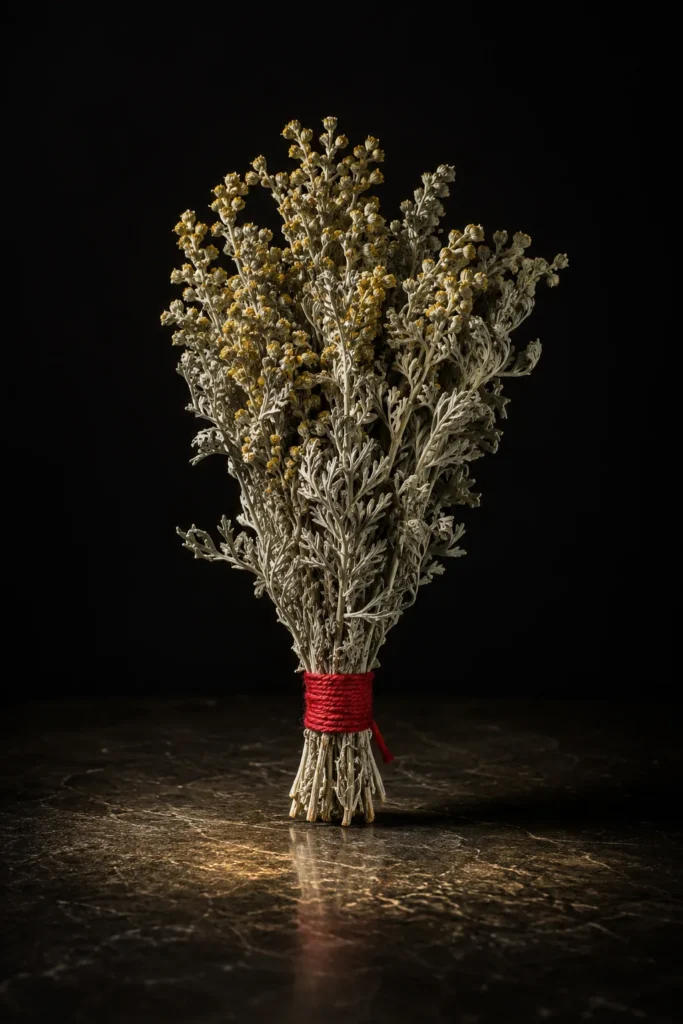
Fumitory is an unassuming, blue-green shimmering field herb with fine, divided leaves and small reddish-purple flowers. Its name points to two common interpretations found in incense tradition: the bluish, smoke-like shimmer of the plant, and the fine, barely visible smoke that the damp herb releases when burnt, rather than burning openly.
Unlike the strong, resinous smoke of juniper, fumitory is regarded in tradition as a mild incense herb for the regular cleansing of the house, credited with a power against evil spirits and what is today often described as negative energies.
Fumitory is used in folk belief as an incense herb against negative energies.

Quick Overview
Fumitory (Fumaria officinalis) is a widespread field herb that grows in fields, vineyards and along roadsides, and is not botanically related to actual smoke. The name Fumaria derives from the Latin fumus, meaning smoke.
In some regions the plant is also called field smoke or elf smoke, a reference to its role as a means either of establishing contact with an invisible world or of keeping it at bay, depending on the traditional interpretation.
Origin and Tradition
Fumitory was already known in medieval monastic medicine and appears as a medicinal plant in the writings of Hildegard of Bingen. From this knowledge, a second use developed in rural folk tradition: burning dried fumitory as incense to drive evil spirits and harmful influences from the house.
This practice was not tied to fixed church dates such as the Rauhnächte, but was applied as needed: in cases of discord in the house, after an illness, or as a regular cleansing in spring. In some areas fumitory bore the byname ‘elf smoke’, because it was said to make visible the boundary between the human world and a spirit world.
Operating Principle According to Tradition
As with other incense herbs, the principle of purifying smoke also applies to fumitory: what appears to people as a mild, barely perceptible cleansing was thought to have a repelling effect on harmful spirits and negative influences. The fine, slowly spreading smoke of the plant was considered especially suited to reaching every corner of a room.
Unlike the pungent smoke of juniper, which in tradition remained reserved for great, rare occasions, fumitory was regarded as an everyday herb for the ongoing cleanliness of the house.
Cross-Cultural Distribution
Fumitory is widespread as a field weed across large parts of Europe, but its incense tradition is most densely documented in southern Germany, Austria and Switzerland, where it forms part of a broader body of rural incense practices alongside juniper and mugwort.
The idea that rising smoke itself marks a boundary between worlds is found in similar form beyond the German-speaking world as well, placing fumitory within a Europe-wide tradition of incense burning as a protective act.
What It Is Used Against
In tradition, fumitory is regarded as a means against evil spirits in the house, as well as against what in modern language is called negative energies: an atmosphere felt to be oppressive after an argument, illness or bereavement.
Occasionally it is also credited with an effect against discord and quarrels within the household. It was often used not on its own but as part of larger incense mixtures together with juniper or mugwort, as also documented by the Protection Compass.
Application and Limits
Dried fumitory is burnt on glowing charcoal, and the smoke is carried through the rooms of the house one after another. As with juniper, the rule here too is to open the windows after burning so the smoke can leave the house.
One limitation of the practice is that fumitory is rarely described in tradition as a sole means of protection. It supplements other forms of home protection rather than replacing them.
Literature (selection)
Related key terms: fumitory incense evil spirits cleansing fumaria.
iWell Guard and Protective Traditions
Fumitory represents a quiet, everyday form of protection: not the great, rare act, but the regular tending of a boundary between one’s own space and what burdens it. This principle of continuous mindfulness also underlies the iWell Guard.
Where fumitory once had to be regularly relit, the pendant stands for a protection that is carried permanently. The idea of a recurring, conscious drawing of boundaries remains present in both forms.
Personal experiences may vary. Not a medical device. No promise of healing.