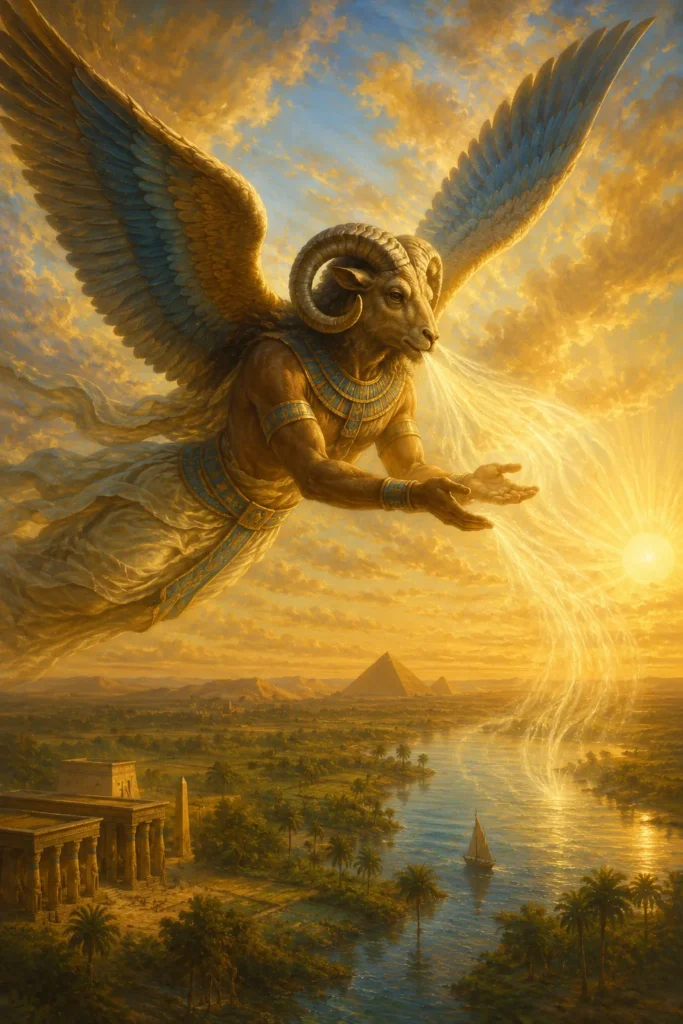
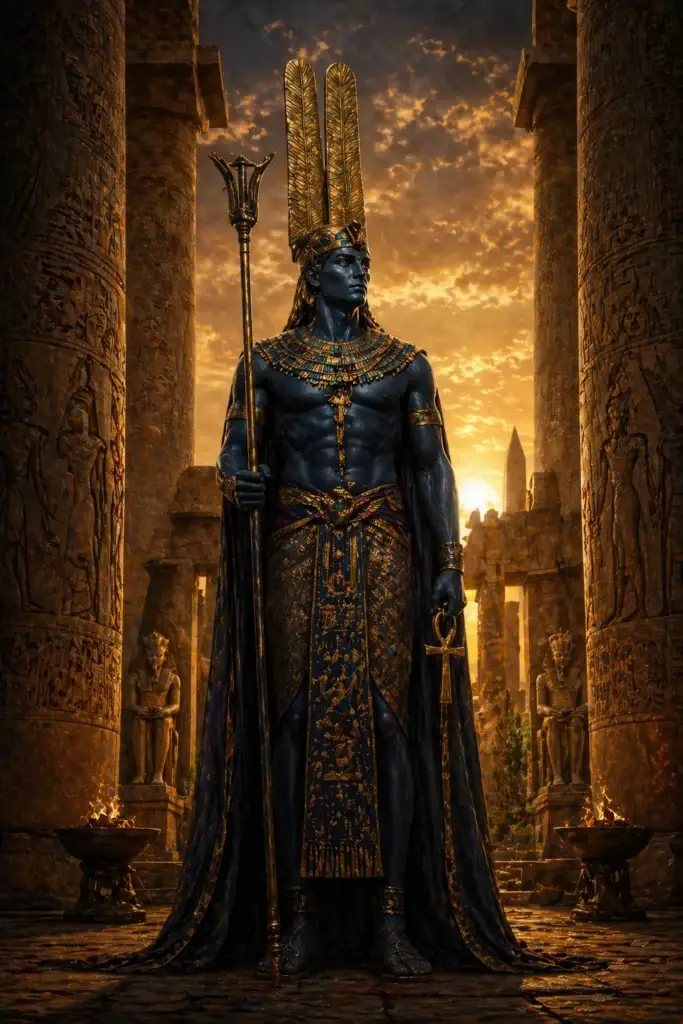
Nehebkau is a demon of the Egyptian tradition.
Demon in serpent form, uniter of the double souls, ambivalent guardian. Nehebkau is the “keeper of the Ka”, the magical double soul that accompanies every person.
As a serpent, vast and ancient, he exists on the threshold between being and nothingness. His power is both healing and danger at once. In the afterlife Nehebkau can become a friend, if one understands and respects his dark nature.
Nehebkau is an Egyptian demon of serpents and keeper of the Ka force.
Type: Egyptian principal deity, serpent goddess and feeder of the dead
Pantheon: Egypt (all dynasties)
Function: protection in the world of the dead, feeding of the deceased, protector of Ra against Apophis
Main attributes: serpent body with two heads or a humanoid upper body
Main cult sites: Heliopolis (Ra temple precinct), Edfu, Dendera
Significance: one of the oldest Egyptian gods
Nehebkau is attested from the Pyramid Texts (Spell 229 ff., ca. 24th century BCE), one of the oldest Egyptian gods with continuous veneration.
In the Middle Kingdom a protective figure in the Coffin Texts (Spell 84 ff.); in the New Kingdom central in the Book of the Dead (Spells 87, 91, 149). In Late Period temples (Edfu, Dendera) as an apotropaic wall sculpture.
Venerated throughout the Egyptian land, without a pronounced main cult site. Present in temples of Ra at Heliopolis, Edfu and Dendera as a protective figure. Frequently depicted on sarcophagi since the 18th Dynasty. Plaster statues with two serpent heads in private tombs. In Hellenistic and Roman Egypt increasingly syncretized with the serpent god Asclepius.
Central sources: Pyramid Texts (Spell 229 ff.), Coffin Texts (Spell 84 ff.), Book of the Dead (Spells 87, 91, 149, Nehebkau invocations), inscriptions at Edfu and Dendera. Secondary literature: Bonnet, Reallexikon der ägyptischen Religionsgeschichte; Wilkinson, The Complete Gods and Goddesses; Pinch, Egyptian Mythology.
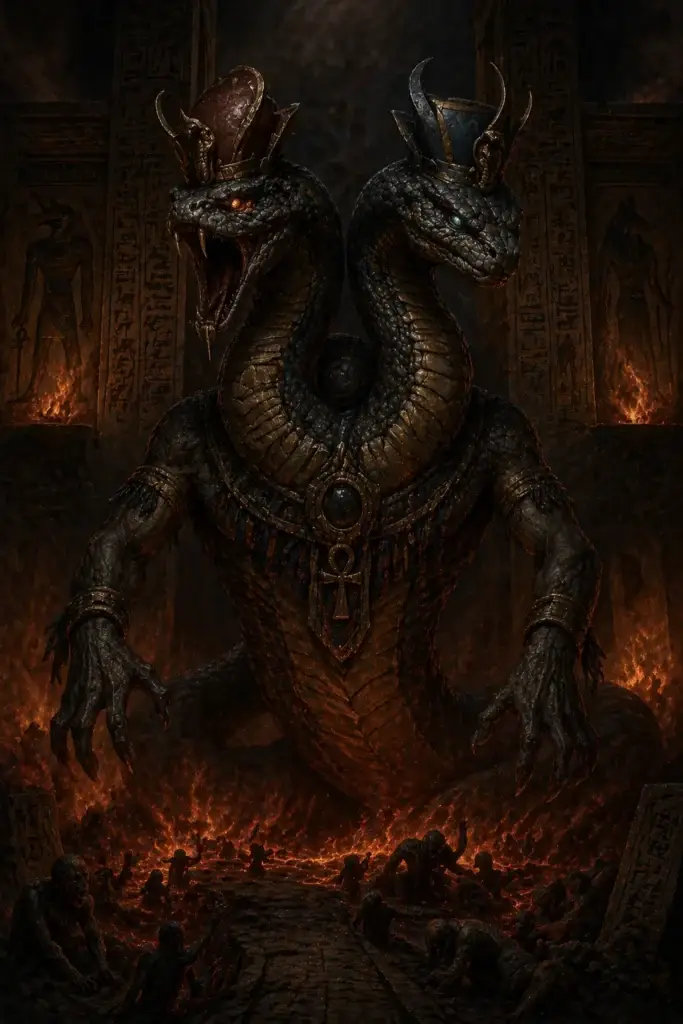
Nehebkau is depicted as a gigantic serpent, sometimes with a human upper body or a human head with a serpent snout. His color is often green or gold, the color of regeneration and of the hidden.
Sometimes he carries magical ropes or knots on his chest. The ankh (sign of life) can accompany him. In papyri he is shown as ancient, wise and dangerous. His serpent often has several coils, each coil a layer of magical power.
Nehebkau is the guardian of the Ka, the magical soul that accompanies every person and continues to exist even after death. He protects the Ka from evil spirits and demons.
In the Book of the Dead he is invoked as one of the guardians of the gates; his name must be known in order to pass.
Sorcerers and magicians invoked Nehebkau to gain power. Healers conjured him to heal magical injuries. His veneration was less loud and public than that of the principal gods, but central in magical circles. In regional cults (especially Nubia) Nehebkau was venerated as a direct protective being of local communities.
The most important aspects of Nehebkau at a glance. The following fields summarize origin, function, appearance, veneration, symbols and parallels.
Nehebkau (“the one who unites the Ka forces”) is the son of Serqet (scorpion goddess) and one of the oldest protective gods of Egypt.
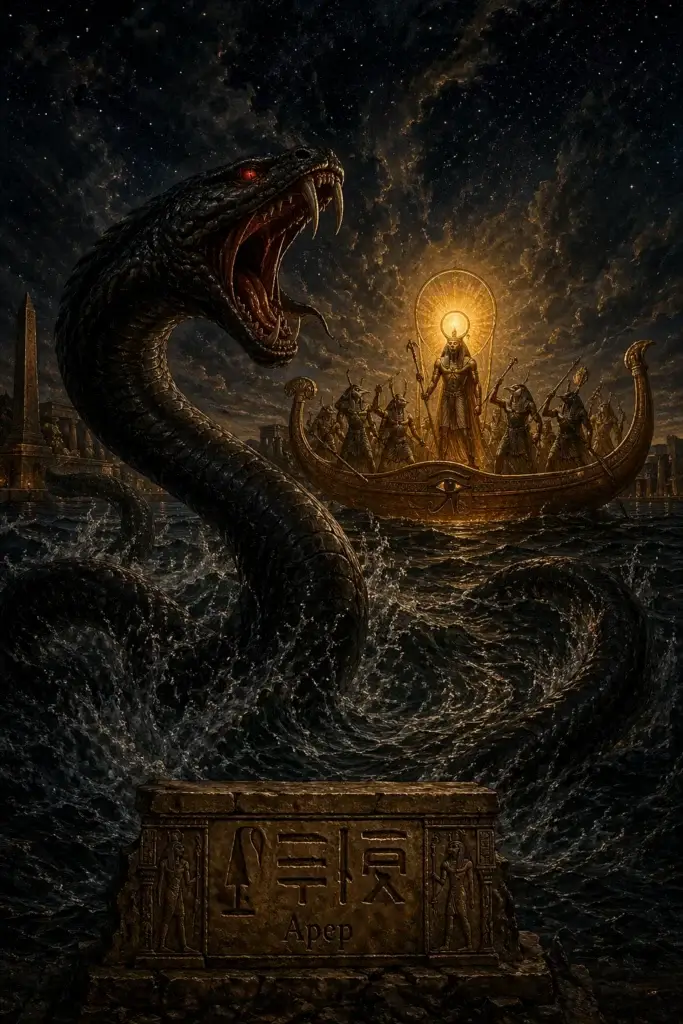
In the Pyramid Texts as the “serpent at the bow of the solar barque”, he accompanies Ra on his journey and protects him from the chaos serpent Apophis. In later traditions connected genealogically with Atum, Geb or Serqet.
Protection of the dead in the afterlife. Feeding of the deceased with the necessary Ka forces, so that they can continue to exist in the afterlife. Protector of the solar barque against the chaos serpent Apophis. Apotropaic function against snakebites and evil spirits. In Hellenistic and Roman syncretism also a healing deity (identified with Asclepius).
Two main forms:
Double serpent: serpent body with two heads at both ends, a symbol of the transition between worlds. On sarcophagi often depicted as an enveloping serpent.
Humanoid: human-like upper body with a serpent lower body. In the hand frequently a was scepter or ankh. Often scaled in blue or green.
On most temple reliefs in the company of Ra at the solar barque.
Sphere of effect: Nehebkau was invoked especially in the cult of the dead. Sarcophagi of the Middle and New Kingdom show Nehebkau invocations. In personal cult, protection against snakebites and bad dreams.
In the temple of Edfu his image is invoked at the annual purification procession. On apotropaic tablets (especially cippus stelae) depicted as protection.
Double-headed serpent, was scepter, ankh, green or blue scales, solar barque (companion), food offerings (for feeding the Ka). Sacred plant: sycamore tree. Sacred animals: serpents of all kinds, especially the Egyptian cobra.
Serqet (Egypt, mother), Wadjet (Egypt, serpent goddess of Lower Egypt), Atum (Egypt, in one tradition father), Asclepius (Greece, serpent healing god, syncretized in the Hellenistic period). Global serpent god parallels: Quetzalcoatl (Aztec, feathered serpent), Naga (Hinduism/Buddhism), Jormungand (Germanic), Yamata-no-Orochi (Japan).
Apotropaic and devotional rituals
Nehebkau (Egyptian Nḥb-k3w, “the one who harnesses the Kas”) is a hybrid, ambivalent serpent god of life and the underworld, originally fearsome, later transformed into a protective god of the Kas (life spirits) and of the pharaohs.
The Pyramid Texts (Spells 263, 318) and Coffin Texts frequently refer to him. His festival calendar day is the first day of the Raging Festival (Heri-renpet), a purification feast also celebrated at the new year (cf. Wilkinson; Hornung, Conceptions of God).
Invocations
In the Book of the Dead (chapter 149) Nehebkau is named as a companion of the deceased through the gates of the underworld.
Ritual texts for the living invoke him as a strengthener of the personal Ka. The anti-serpent incantation in the Pyramid Texts (Spells 226 to 243) is in part directed at Nehebkau for the averting of harm.
Amulets and protective symbols
Serpent-shaped amulets of faience (two-headed, or a serpent with human arms) as Nehebkau protection. Pharaohs bear his symbol on stela inscriptions to strengthen their own life force. Grave goods bearing his name for the journey through the underworld. In the Atum hymn (BD 175) his apotropaic function as keeper of the Ka energy is emphasized.
Nehebkau belongs to the oldest serpent deities discernible in the Egyptian sources. His name appears already in the Pyramid Texts of the Old Kingdom, the oldest surviving religious texts of Egypt, recorded in the pyramids of the late 5th and the 6th Dynasty. His attestation thus reaches back into the third millennium BCE.
In these early texts Nehebkau appears in a twofold role that remains characteristic of his entire later transmission. On the one hand he is a threatening serpent against whom protective spells are directed; on the other hand he is a powerful being whose force can benefit the deceased king.
This ambivalence is not conceived as contradictory, but corresponds to the Egyptian understanding of the serpent as a dangerous, yet at the same time potent, manifestation.
The Pyramid Texts connect Nehebkau with the earth, with the region below the surface of the ground, and with the provisioning of the dead with food and life force.
From the perspective of the history of religion it is noteworthy that Nehebkau is continuously attested across the whole of Egyptian history, from the Pyramid Texts through the Coffin Texts of the Middle Kingdom to the books of the dead of the New Kingdom and the temple texts of the Late Period.
Few deities can be traced over so long a period. This continuity makes him a rewarding object of study for the question of how a deity could shift its significance over millennia without losing its core.
The name Nehebkau is usually rendered as nehebkau and contains the Egyptian word ka in the plural, kau.
The Ka is one of the central components of the Egyptian conception of the person: a kind of life force or giver of life that accompanies a person beyond death and that must be provided for after death.
The first component of the name is usually connected with a verb meaning to harness, to join together, or to bestow.
The usual translation is therefore something like the one who bestows the Ka forces or the one who joins together the Ka forces. This interpretation makes Nehebkau a deity directly concerned with the bestowal of life force.
In the texts of the dead he accordingly appears as a being that secures food and vitality for the deceased. One tradition associates him with the provisioning of the many Kau attributed to various gods.
The precise grammatical analysis of the name is disputed in detail, yet the reference to the Ka is regarded as secure and is decisive for understanding the deity. Nehebkau is thus not a mere figure of terror, but a power belonging to the very center of the Egyptian conception of continued life.
His serpent form and his function as giver of life force do not stand in contradiction: in Egyptian symbolism the serpent, as a chthonic, earthbound being, could be associated precisely for that reason with the renewal of life, because it sheds its skin and emerges from the earth, the region in which the dead also lay.
The most striking development in the transmission of Nehebkau is the shift from a threatening to a predominantly beneficent being. In the earliest layers Nehebkau is a dangerous serpent.
Several old spells aim to ban him or render him harmless. A well-known formula states that Nehebkau is only harmless once one has trodden on his spine or his limbs, that is, once he has been subdued.
Over time this threatening trait recedes. Already in the Coffin Texts, and more strongly in the New Kingdom, Nehebkau appears predominantly as a helpful, protective and nourishing deity. He is counted among the companions and servants of the sun god Ra and the god of the dead Osiris.
In some texts he is regarded as the son of the serpent goddess Renenutet or is associated with the earth and its gifts. He could be invoked as a giver of food and fertility.
From the perspective of the history of religion, this transformation can be interpreted as a process of domestication or integration: an originally fearsome being is incorporated into the pantheon and its power turned to the positive. Comparable processes can be observed with other Egyptian serpent and hybrid beings.
It should be emphasized, however, that the older threatening layer never wholly disappeared; even in late texts a remnant of the dangerous is preserved.
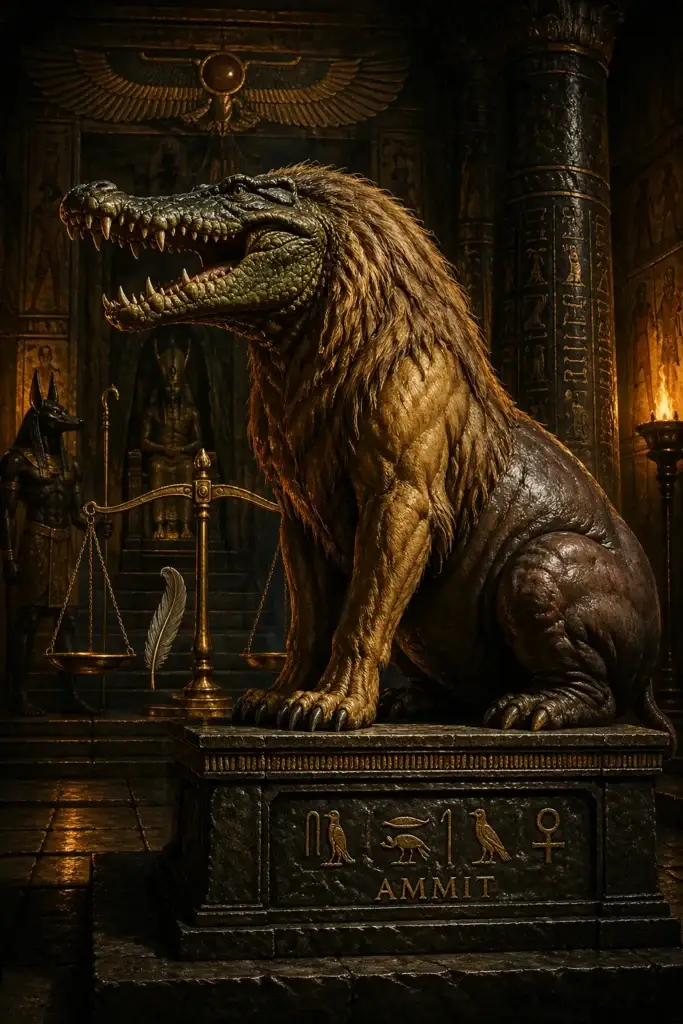
Nehebkau is thus an example of how, in Egyptian thought, protective power and dangerousness were often two sides of the same deity. Comparable ambivalent beings are Ammit and the dwarf god Bes.

Further standard works in the literature index.
The protective practice described here is a religious-studies classification of historical traditions. iWell Guard ties into this cultural-historical line of wearable protective objects and represents a contemporary form of it. More about the iWell Guard →
Against its influence, cross-cultural tradition names these protective means:
Compare in the Protection Compass →Recommended protective means
The simplest protective means in this collection: 41 layers of fine gold 999, platinum, silver and silicon, manufactured in Ruhla, Thuringia. It requires no activation, is bound to no person, and is effective within a radius of around 50 meters, even without being worn.
Related Beings

Metsavana, the Estonian forest elder with a moss beard, watches over hunting and game. Tradition,...

Nyen, air and dwelling spirits of the Tibetan tradition. Border guardians between the worlds, wit...

Szélanya, the wind mother of Hungarian folk belief. Origin, role in incantations and religious-st...

Hades, ruler of the underworld and Greek god of the dead. Helm of invisibility, Kerberos, Eleusin...

Amphitrite, Nereid and wife of Poseidon: dolphin myth, cult on Tenos and at the Isthmus, mother o...

Lips, the south-west wind of the Greeks. Origin, the Tower of the Winds, the ritual of Methana an...